
New here? This is lesson 232 of a free 240-lesson Japanese course.
Back home and here in Japanese
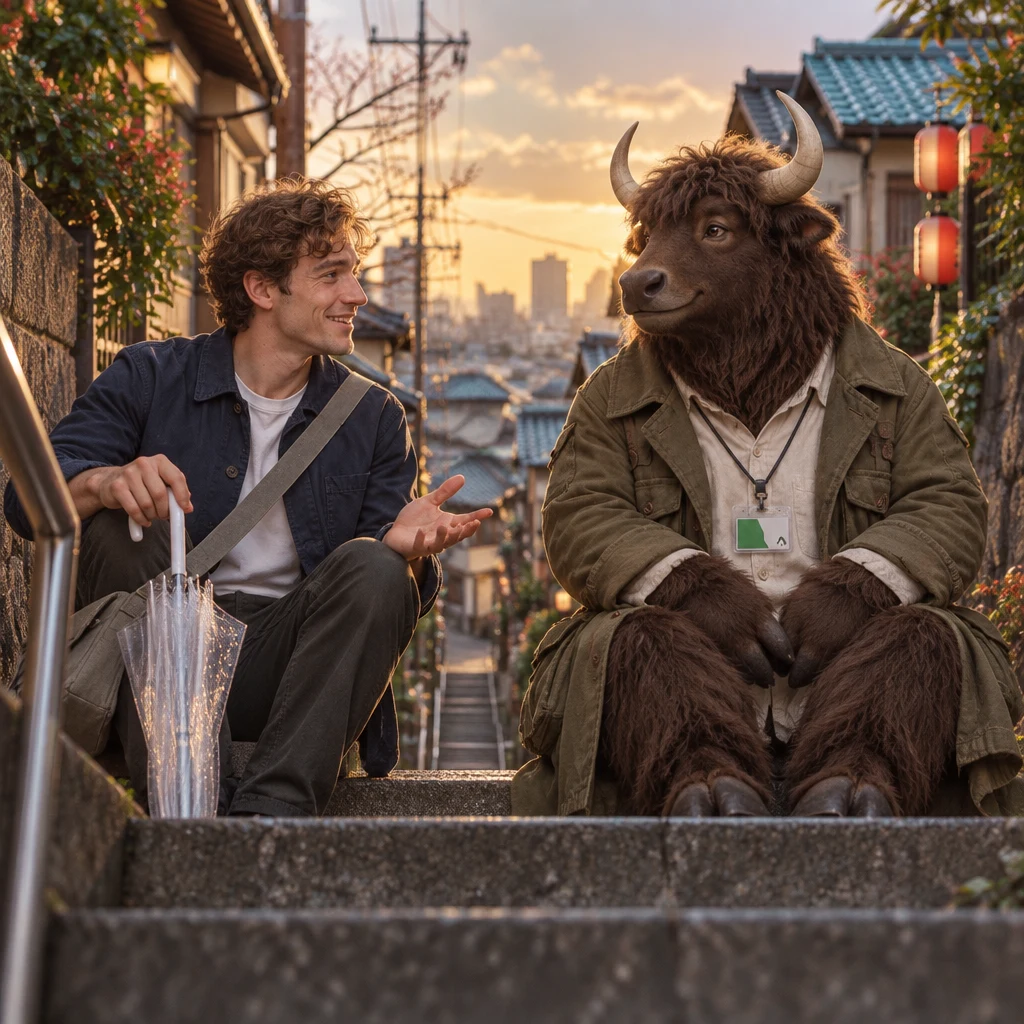
Leo and Haruka stop on the Yūyake Dandan steps at dusk. She asks what confused him when he first arrived in Tokyo.
Goro joins their conversation about daily travel and neighbors. Leo explains what changed for him, without choosing a winning country.
You will compare personal experiences, describe what now feels familiar, and leave room for the things you still do not understand.
By the end of this lesson
Compare life back home with life in Tokyo fairly, and describe what you value here.
- うちの国では、ちょっと違います。Where I'm from, it's a bit different.
- 最初は、全然慣れませんでした。At first I couldn't get used to it at all.
- 今は、もう慣れました。Now I'm used to it.
- どちらがいい、ということではないです。It's not that one is better.
- ここが好きなのは、近所づきあいです。What I like here is the neighborhood.
- まだ、ピンとこないこともあります。Some things still don't quite click.
Scene — a walk at dusk
Evening light falls across the Yūyake Dandan steps in Yanaka. Leo and Haruka pause above the shopping street, where a cat watches people pass.
Goro catches up with them. Haruka asks Leo what threw him at first, and their conversation turns to the everyday details of feeling at home.

Learn — life in two places
These six polite lines help you compare experiences without declaring one place superior.
Describe your adjustment, explain what you appreciate, and acknowledge what still feels unfamiliar.

うちの国では、ちょっと違います。
Where I'm from, it's a bit different.
When to use it: Use this to introduce a difference between life here and life back home.
The opening phrase limits this observation to your home country.

最初は、全然慣れませんでした。
At first I couldn't get used to it at all.
When to use it: Use this to describe difficulty adjusting during an earlier period.
The negative past ending places the difficulty in the past without saying whether it continues now.

今は、もう慣れました。
Now I'm used to it.
When to use it: Use this when something that once felt unfamiliar has become familiar.
The word meaning already shows that the adjustment has happened by now.
どちらがいい、ということではないです。
It's not that one is better.
When to use it: Use this when someone interprets your comparison as a judgment about which place is better.
The ending rejects the interpretation that your comparison is about choosing a better option.

ここが好きなのは、近所づきあいです。
What I like here is the neighborhood.
When to use it: Use this to explain that everyday relationships with neighbors are something you appreciate here.
The neighborhood expression refers to relationships and interaction with neighbors, rather than the physical area.

まだ、ピンとこないこともあります。
Some things still don't quite click.
When to use it: Use this to acknowledge that some customs or explanations still do not make intuitive sense.
も includes things that remain unclear alongside the things you already understand.
Story — talking on the steps
Haruka asks for a concrete example, and Leo remembers puzzling train transfers.
Goro shares his own experience as they compare familiar routines and neighborhood connections.
- Haruka and Leo pause on the steps. Goro catches up, his coat pockets bulging.
 Haruka最初、東京で何に戸惑った?What confused you at first in Tokyo?
 Leo最初は、電車の乗り換えに戸惑った。At first, train transfers confused me.
 Goro私もです。うちの国では、ちょっと違います。Me too. Where I'm from, it's a bit different.
- Harukaゴローさんも、慣れるまで大変でしたか。Was adjusting difficult for you too, Goro?
- Goro最初は、全然慣れませんでした。At first I couldn't get used to it at all.
- Harukaレオさんは、今はどう?How about you now, Leo?
- Leo今はもう慣れた。乗り換えの時間も、だいたい分かるよ。I'm used to it now. I have a pretty good idea how long transfers take too.
- Goro今は、もう慣れました。私も、いつもの道なら大丈夫です。Now I'm used to it. I'm fine on my usual routes too.
- Harukaじゃあ、東京のほうが暮らしやすい?So is life easier in Tokyo?
- Leoそうとも言えないな。向こうでは、乗り換えなしで友達の家に行けたし。I wouldn't necessarily say that. Back home, I could visit friends without changing trains.
- Goroどちらがいい、ということではないです。It's not that one is better.
- Leoそうだね。向こうの暮らしも好きだよ。Exactly. I like life back home too.
- Harukaじゃあ、ここで気に入ってるのは?Then what do you particularly like here?
- Leo近所の人と、ちょっと立ち話できるところかな。Probably being able to stop and chat with the neighbors.
- Goroここが好きなのは、近所づきあいです。What I like here is the neighborhood.
- Harukaゴローさんも、よく声をかけられますよね。People often stop to talk to you too, Goro.
- Goroええ、雅子さんが、私の好みを覚えてくれています。Yes, and Masako remembers my preferences.
- Harukaレオさんは、まだ分からないことある?Leo, is there anything you still find confusing?
- Leoうん。今度ごはんに行こうって、本当の誘いなのか迷う。Yeah. When someone says we should eat together sometime, I wonder whether it's an actual invitation.
- Goroまだ、ピンとこないこともあります。Some things still don't quite click.
- Haruka私も迷うよ。具体的な日を聞いてみたら?I wonder about that too. Why not ask about a specific day?
- Leoなるほど。今度、聞いてみる。That makes sense. I'll ask next time.
- Goroそろそろ行きます。I'd better get going.
- Haruka私たちも行こう。猫が階段の真ん中で寝る前に。Let's get going too, before the cat falls asleep in the middle of the steps.
Practice — compare without ranking
Listen for the difference between describing a change and choosing a winner.
Then assemble the comparison lines and choose replies that express the speaker's particular experience.
0 of 10 done
What did you hear?
What did you hear?
What do you say?
What do you say?
Explain that train transfers work a little differently in your home country.
Build the line
Build the line
At first I couldn't get used to it at all.
、。
Tap the words in order.
True or false?
True or false?
The speaker has now adjusted to something that used to feel unfamiliar.
What does it mean?
What does it mean?
どちらがいい、ということではないです。
Pick the reply
Goro says:
Pick the reply
ここでの暮らしで、どんなところが好きですか。
What do you like about life here?
And you reply with:
Fill the gap
Fill the gap
Some things still don't quite click.
まだ、ピンとこないこと____あります。
What do you say?
What do you say?
You are still on the steps but need to leave now; announce that you had better get going.
Build the line
Build the line
It's not that one is better.
、。
Tap the words in order.
Match the pairs
Japanese
うちの国では、ちょっと違います。Drop the English here今は、もう慣れました。Drop the English hereまだ、ピンとこないこともあります。Drop the English hereEnglish
Say it — share your perspective
Now compare experiences with Goro, who has also adjusted to life in Tokyo.
Use the polite lines to describe your experience and explain what you appreciate here.
- Goro電車の乗り換えは、レオさんの国でも同じですか。Do train transfers work the same way in your country, Leo?
- Leo (you)Explain that it is a little different back home.
Explain that it is a little different back home.
うちの国では、ちょっと違います。
Where I'm from, it's a bit different.
0 of 6 said
Recap — what you can say now
| Japanese | English | Play |
|---|---|---|
| うちの国では、ちょっと違います。 | Where I'm from, it's a bit different. | |
| 最初は、全然慣れませんでした。 | At first I couldn't get used to it at all. | |
| 今は、もう慣れました。 | Now I'm used to it. | |
| どちらがいい、ということではないです。 | It's not that one is better. | |
| ここが好きなのは、近所づきあいです。 | What I like here is the neighborhood. | |
| まだ、ピンとこないこともあります。 | Some things still don't quite click. |
Save your progress — it’s free
Keep your place in the course and see which lines you’ve learned.
Want the next lesson in your inbox?
Get the next lesson by email, one a day.
Join the newsletterDaily lesson emails are coming soon. Newsletter subscribers get them first.
Keep practicing with Yak Cards
Keep these comparisons ready with [Yak Cards](https://yakyacker.com/yak-cards/). Review how to describe adjustment, appreciation, and uncertainty before your next conversation.
Think of one everyday difference you can describe fairly.
Open Yak Cards