Welcome to Lesson 114 — time to practice talking to a doctor. In this short lesson you'll listen, repeat, and use polite phrases for symptoms, timing, and medicine. Have your speaking voice ready — you'll say each phrase aloud.
Level B1: This lesson focuses on practical phrases for a doctor visit: describing how long a symptom has lasted, where it hurts, whether it’s getting worse, allergies, and asking about medicine and recovery time. You'll practice these specific medical phrases in short dialogues and quick quizzes so you can explain symptoms clearly at the clinic (CEFR-aligned).
After this lesson you'll be able to:
Be able to tell a doctor how long symptoms have lasted and when they started.
Describe pain location and intensity politely (です/ます).
Ask about medicine dosage and expected recovery time.
Ready? Let's go!
When you tap play on phrases, we track your progress through this lesson.
1. Reading + Listening Practice
Hear core phrases, repeat aloud.
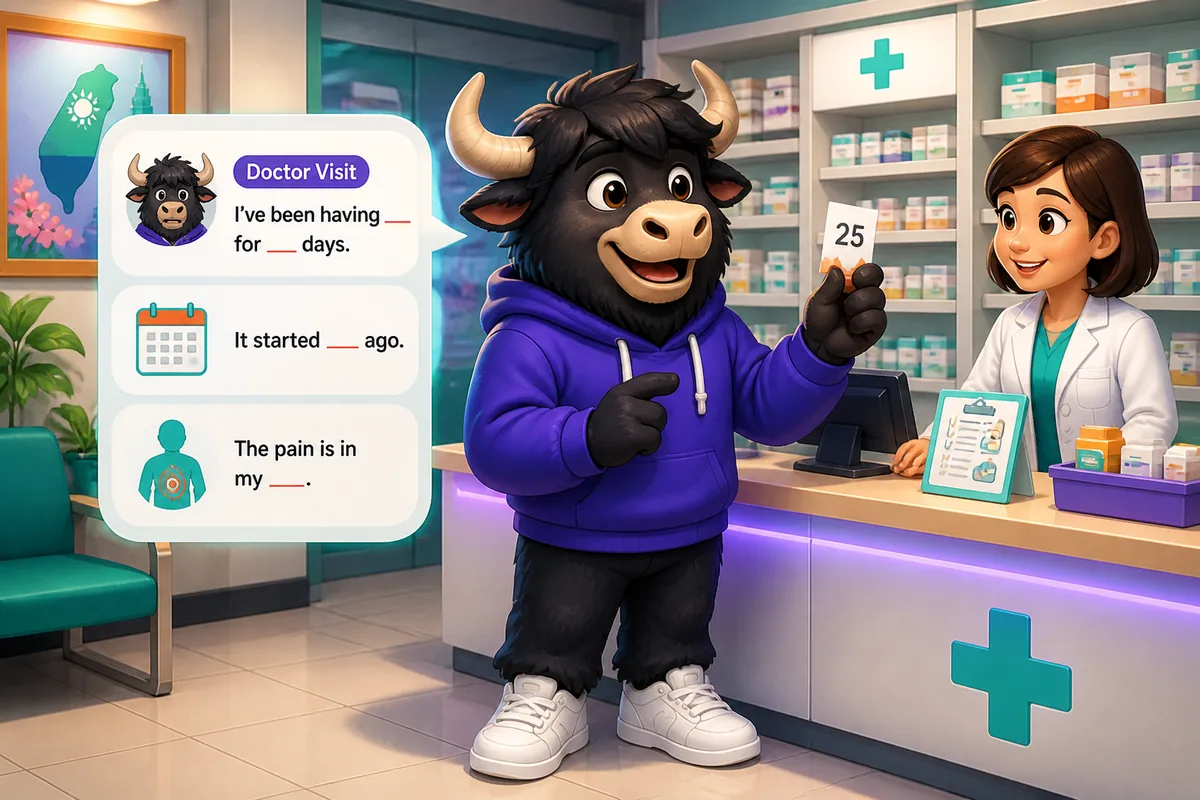
___が___日続いています。
___ ga ___ nichi tsuzuite imasu.
I've been having ___ for ___ days.
Meaning: I've been having ___ for ___ days.
When to use: Use this to tell a doctor what symptom you've had and for how many days. Put the symptom in the first blank and the number of days in the second; add が after the symptom.
Tip: Don't use を after the symptom; say せきが, not せきを.
せきが三日続いています。
Seki ga mikka tsuzuite imasu.
I've had a cough for three days.
頭痛が一週間続いています。
Zutsū ga isshūkan tsuzuite imasu.
My headache has continued for a week.
___前からです。
___ mae kara desu.
It started ___ ago.
Meaning: It started ___ ago.
When to use: Insert a time expression like 「3日前」「1週間前」 into the blank. You can combine it with a symptom: 「頭痛は三日前からです。」
咳は三日前からです。
Seki wa mikka mae kara desu.
The cough started three days ago.
痛みは二日前からです。
Itami wa futsuka mae kara desu.
The pain started two days ago.
___が痛いです。
___ ga itai desu.
The pain is in my ___.
Meaning: The pain is in my ___.
When to use: Put the body part into the blank, for example 「お腹が痛いです」「ひざが痛いです」.
お腹が痛いです。
Onaka ga itai desu.
My stomach hurts.
左のひざが痛いです。
Hidari no hiza ga itai desu.
My left knee hurts.
軽いですが、なかなかよくなりません。
Karui desu ga, nakanaka yoku narimasen.
It's mild, but it doesn't go away.
Meaning: It's mild, but it doesn't go away.
When to use: Use this to say a symptom is not severe but persists, for things like pain, cough, or low fever.
熱は軽いですが、なかなかよくなりません。
Netsu wa karui desu ga, nakanaka yoku narimasen.
The fever is mild, but it won't go away.
せきが軽いですが、なかなかよくなりません。
Seki ga karui desu ga, nakanaka yoku narimasen.
The cough is mild, but it doesn't get better.
だんだん悪くなっています。
Dandan waruku natte imasu.
It's getting worse.
Meaning: It's getting worse.
When to use: Say this when a symptom has become more severe than before.
頭痛がだんだん悪くなっています。
Zutsū ga dandan waruku natte imasu.
My headache is getting worse.
咳がだんだん悪くなっています。
Seki ga dandan waruku natte imasu.
My cough is getting worse.
熱があると思います。
Netsu ga aru to omoimasu.
I think I have a fever.
Meaning: I think I have a fever.
When to use: Use this when you suspect you have a fever but may not have measured your temperature.
熱があると思います。体がつらいです。
Netsu ga aru to omoimasu. Karada ga tsurai desu.
I think I have a fever. My body feels bad.
夜に熱があると思います。計っていませんが。
Yoru ni netsu ga aru to omoimasu. Hakatte imasen ga.
I think I had a fever last night. I haven't measured it.
この薬は、1日に何回飲めばいいですか。
Kono kusuri wa, ichinichi ni nankai nomeba ii desu ka.
How often should I take this medicine?
Meaning: How often should I take this medicine?
When to use: Use this for oral medicine. For ointments say 「使えばいいですか」 or 「塗ればいいですか」 instead.
薬をもらって、看護師に『この薬は、1日に何回飲めばいいですか。』と聞きました。
Kusuri o moratte, kangoshi ni 'Kono kusuri wa, ichinichi ni nankai nomeba ii desu ka.' to kikimashita.
I received medicine and asked the nurse, 'How often should I take this medicine in one day?'
説明書が読めないので、先生に『この薬は、1日に何回飲めばいいですか。』と聞きました。
Setsumeisho ga yomenai node, sensei ni 'Kono kusuri wa, ichinichi ni nankai nomeba ii desu ka.' to kikimashita.
I couldn't read the leaflet, so I asked the doctor, 'How many times a day should I take this?'
どのくらいでよくなりますか。
Dono kurai de yoku narimasu ka.
How long will it take to feel better?
Meaning: How long will it take to feel better?
When to use: Use this to ask for an estimate of recovery time.
患者:『どのくらいでよくなりますか。』 医師:『一週間ぐらいです。』
Kanja: 'Dono kurai de yoku narimasu ka.' Ishi: 'Isshūkan gurai desu.'
Patient: 'How long until I get better?' Doctor: 'About a week.'
心配なので、『どのくらいでよくなりますか。』と聞きました。
Shinpai na node, 'Dono kurai de yoku narimasu ka.' to kikimashita.
Worried, I asked, 'How long will it take to get better?'
___にアレルギーがあります。
___ ni arerugī ga arimasu.
I'm allergic to ___.
Meaning: I'm allergic to ___.
When to use: Put the medicine name or food in the blank and use the particle に. For example: 「ペニシリンにアレルギーがあります。」
Tip: Don't use が after the allergen; use に (e.g., ペニシリンにアレルギーがあります).
ペニシリンにアレルギーがあります。別の薬は使えますか?
Penishirin ni arerugī ga arimasu. Betsu no kusuri wa tsukaemasu ka?
I'm allergic to penicillin. Can I use another medicine?
ナッツにアレルギーがあります。食べられません。
Nattsu ni arerugī ga arimasu. Taberaremasen.
I'm allergic to nuts. I can't eat them.
何か重い病気でしょうか。
Nanika omoi byōki deshō ka.
Is it something serious?
Meaning: Is it something serious?
When to use: A polite way to express concern and ask whether a symptom might be serious.
不安で、『何か重い病気でしょうか。』と尋ねました。
Fuan de, 'Nanika omoi byōki deshō ka.' to tazunemashita.
Worried, I asked, 'Is it something serious?'
症状が長いので、『何か重い病気でしょうか。』と聞きました。
Shōjō ga nagai node, 'Nanika omoi byōki deshō ka.' to kikimashita.
Since the symptoms are long-lasting, I asked, 'Is it a serious illness?'
___と痛みます。
___ to itamimasu.
It hurts when I ___ .
Meaning: It hurts when I ___.
When to use: Put a verb phrase (dictionary form) in the blank, e.g., 歩くと痛みます。 If you use a noun, you can say 「___をすると痛みます。」
歩くと痛みます。
Aruku to itamimasu.
It hurts when I walk.
座ると腰が痛みます。
Suwaru to koshi ga itamimasu.
My lower back hurts when I sit.
___と、___がします。
___ to, ___ ga shimasu.
I feel ___ when I ___ .
Meaning: I feel ___ when I ___.
When to use: Put the action or situation first, then the symptom. Example: 立つと、めまいがします。
立つと、めまいがします。
Tatsu to, memai ga shimasu.
I feel dizzy when I stand up.
飲むと、胸やけがします。
Nomu to, muneyake ga shimasu.
I get heartburn when I drink (that).
痛みは出たりおさまったりします。
Itami wa detari osamattari shimasu.
The pain comes and goes.
Meaning: The pain comes and goes.
When to use: Use this when pain is not constant but increases and decreases over time.
痛みは出たりおさまったりします。動くと強くなります。
Itami wa detari osamattari shimasu. Ugoku to tsuyoku narimasu.
The pain comes and goes. It gets stronger when I move.
夜になると痛みは出たりおさまったりします。
Yoru ni naru to itami wa detari osamattari shimasu.
At night the pain comes and goes.
2. Conversational Listening Practice
Hear phrases in a real mini-conversation.
At the clinic: Anna describes symptoms and asks about medicine; David (doctor) asks questions.
Anna
頭が痛くて、三日続いています。
Atama ga itakute, mikka tsuzuite imasu.
My head hurts, and it's been going on for three days.
David
どのくらいの痛みですか?
Dono kurai no itami desu ka?
How bad is the pain?
Anna
軽いですが、なかなかよくなりません。
Karui desu ga, nakanaka yoku narimasen.
It's mild, but it doesn't get better.
David
熱はありますか?
Netsu wa arimasu ka?
Do you have a fever?
Anna
熱があると思います。ちなみに、ペニシリンにアレルギーがあります。
Netsu ga aru to omoimasu. Chinami ni, penishirin ni arerugī ga arimasu.
I think I have a fever. By the way, I'm allergic to penicillin.
David
この薬は、1日に何回飲めばいいですか。どのくらいでよくなりますか。
Kono kusuri wa, ichinichi ni nankai nomeba ii desu ka. Dono kurai de yoku narimasu ka.
How often should you take this medicine, and how long until you get better?
3. Guided Practice
Quizzes and matching to lock in meaning.
Which sentence means "It's getting worse"?
Which phrase asks about how often to take medicine?
How do you say "I'm allergic to penicillin."?
Which phrase means "The pain comes and goes."?
At reception I heard the medicine explanation and asked: 'How often should I take this medicine?'
受付で薬の説明を聞いて、あなたはたずねます:「___」
Uketsuke de kusuri no setsumei o kiite, anata wa tazunemasu: '___'
Because symptoms continue, you anxiously ask the doctor: 'How long will it take to get better?'
症状が長く続くので、あなたは不安になり、先生に『___』と聞きます。
Shōjō ga nagaku tsuzuku node, anata wa fuan ni nari, sensei ni '___' to kikimasu.
It hurts when I stand.
膝に力をかけると痛みます。あなたは医師に『___』と言います。
Hiza ni chikara o kakeru to itamimasu. Anata wa ishi ni '___' to iimasu.
Match the core phrases
Match the extra phrases
4. Speaking Practice
Say phrases yourself (mic/recording).
Recording stays on your device only. Check speech uses your browser's speech tools when available.
Say this phrase out loud:
___が___日続いています。
___ ga ___ nichi tsuzuite imasu.
I've been having ___ for ___ days.
Say this phrase out loud:
___前からです。
___ mae kara desu.
It started ___ ago.
Say this phrase out loud:
___が痛いです。
___ ga itai desu.
The pain is in my ___.
Say this phrase out loud:
軽いですが、なかなかよくなりません。
Karui desu ga, nakanaka yoku narimasen.
It's mild, but it doesn't go away.
Say this phrase out loud:
だんだん悪くなっています。
Dandan waruku natte imasu.
It's getting worse.
Say this phrase out loud:
熱があると思います。
Netsu ga aru to omoimasu.
I think I have a fever.
Say this phrase out loud:
この薬は、1日に何回飲めばいいですか。
Kono kusuri wa, ichinichi ni nankai nomeba ii desu ka.