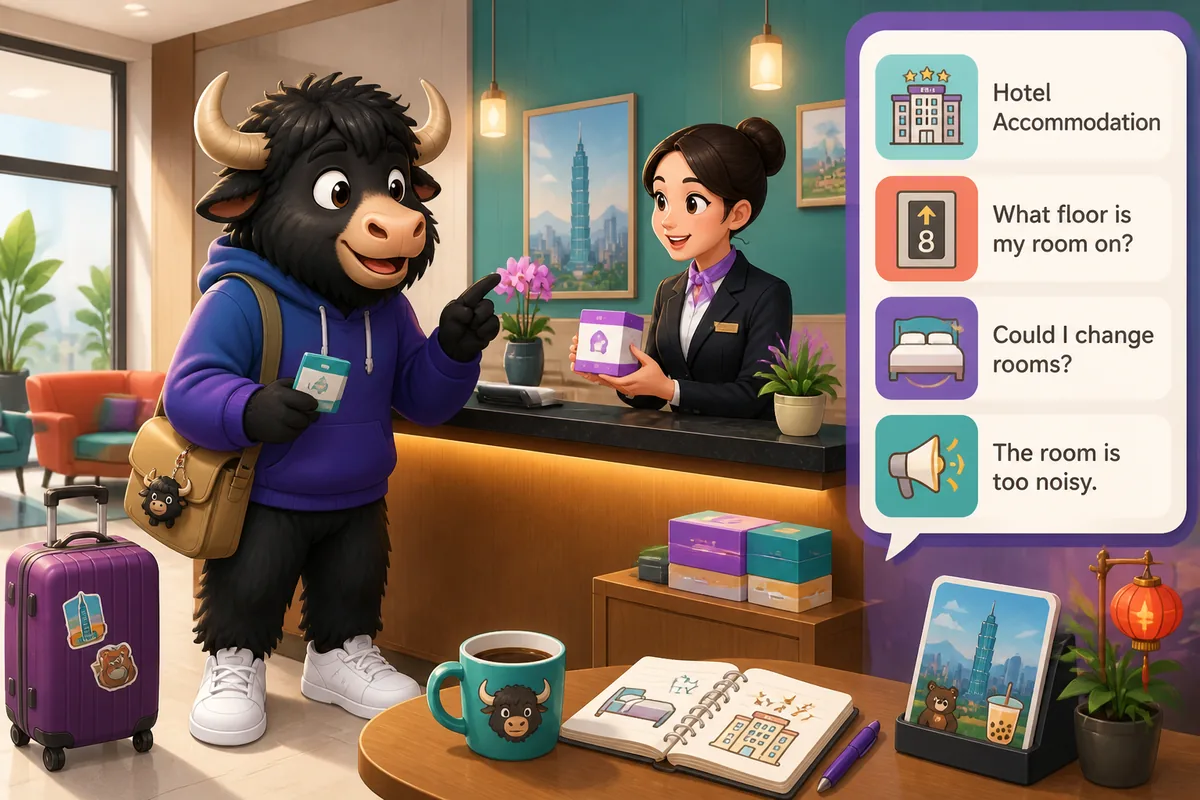
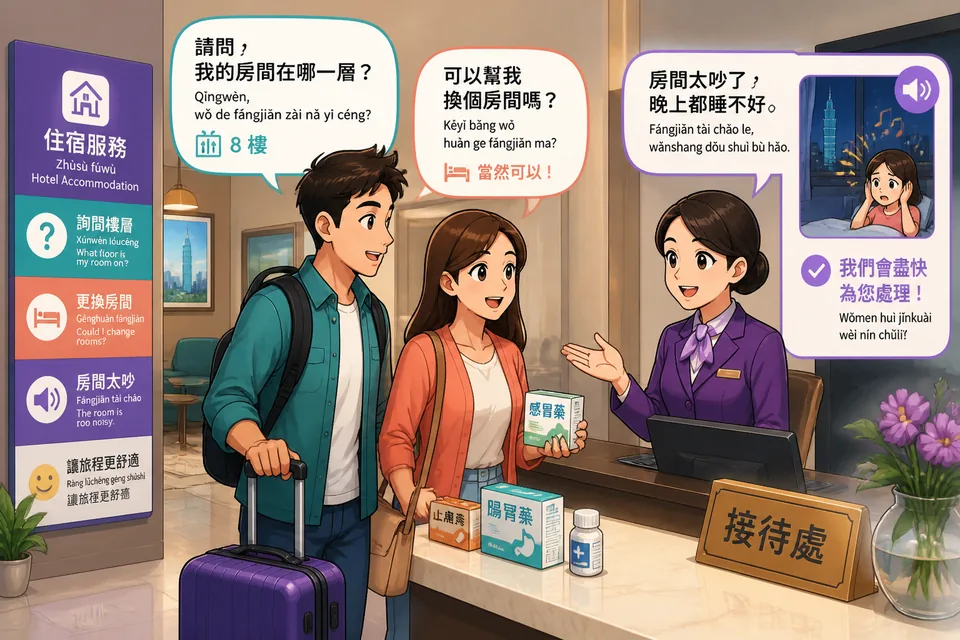
Welcome to Lesson 113 — quick, useful phrases for hotel stays. Repeat aloud, listen for natural rhythm, and get ready to talk to reception.
Level A2: In this short lesson you'll practice practical hotel phrases — asking which floor your room is on, requesting a room change, reporting problems (like noisy rooms or a broken air conditioner), booking details (how many nights), wake-up calls, parking, and late check-out. This CEFR-aligned pack is focused on polite, everyday speech you can use at the front desk.
After this lesson you'll be able to:
Practice polite, useful hotel questions and requests (A2).
Be able to say and recognize phrases for common problems (noise, AC, locked out).
Use time and numbers in requests (e.g., wake-up calls, nights).
Ready? Let's go!
When you tap play on phrases, we track your progress through this lesson.
1. Reading + Listening Practice
Hear core phrases, repeat aloud.
私の部屋は何階ですか。
Watashi no heya wa nan-kai desu ka.
What floor is my room on?
Meaning: What floor is my room on?
When to use: Use this at check-in or when you need to find your room.
すみません、私の部屋は何階ですか。
Sumimasen, watashi no heya wa nan-kai desu ka.
Excuse me, what floor is my room on?
エレベーターの前で確認したいのですが、私の部屋は何階ですか。
Erebētā no mae de kakunin shitai no desu ga, watashi no heya wa nan-kai desu ka.
I want to check in front of the elevator — what floor is my room on?
部屋を変えてもらえますか。
Heya o kaete moraemasu ka.
Could I change rooms?
Meaning: Could I change rooms?
When to use: Use this to politely request a different room at the front desk.
Tip: Beginners sometimes use casual forms (e.g., 部屋を変えてくれる?). Use 〜てもらえますか for polite requests.
隣の部屋がうるさいので、部屋を変えてもらえますか。
Tonari no heya ga urusai node, heya o kaete moraemasu ka.
The next room is noisy — could I change rooms?
窓からの景色が違う部屋に、部屋を変えてもらえますか。
Mado kara no keshiki ga chigau heya ni, heya o kaete moraemasu ka.
Could I change to a room with a different view?
部屋がうるさすぎます。
Heya ga urusasugimasu.
The room is too noisy.
Meaning: The room is too noisy.
When to use: Say this when you want to report excessive noise in your room.
夜中に通りの音で、部屋がうるさすぎます。
Yonaka ni tōri no oto de, heya ga urusasugimasu.
It's too noisy because of the street at night.
隣のパーティーで、部屋がうるさすぎます。
Tonari no pātī de, heya ga urusasugimasu.
The party next door — the room is too noisy.
エアコンが動きません。
Eakon ga ugokimasen.
The air conditioning isn't working.
Meaning: The air conditioning isn't working.
When to use: Use this to report when the AC or heating doesn't work.
Tip: Learners may say エアコンが効きません instead — that's also natural, but "動きません" focuses on the device not functioning.
エアコンが動きません。暑くて眠れません。
Eakon ga ugokimasen. Atsukute nemuremasen.
The air conditioner isn't working. It's too hot to sleep.
リモコンを押してもエアコンが動きません。
Rimokon o oshite mo eakon ga ugokimasen.
Even pressing the remote, the air conditioner doesn't work.
___にモーニングコールをお願いできますか。
___ ni mōningu kōru o onegai dekimasu ka.
Could I get a wake-up call at ___?
Meaning: Could I get a wake-up call at ___?
When to use: Insert a time into ___ when asking the front desk for a wake-up call.
Tip: Be sure to include に after the time (e.g., 7時に). Omitting に sounds unnatural.
7時にモーニングコールをお願いできますか。
Shichi-ji ni mōningu kōru o onegai dekimasu ka.
Could I get a wake-up call at 7:00?
朝6時半にモーニングコールをお願いできますか。
Asa roku-ji han ni mōningu kōru o onegai dekimasu ka.
Could I get a wake-up call at 6:30 in the morning?
駐車場はありますか。
Chūshajō wa arimasu ka.
Is parking available?
Meaning: Is parking available?
When to use: Ask this when you need to know if you can park at the hotel.
車で来たのですが、駐車場はありますか。
Kuruma de kita no desu ga, chūshajō wa arimasu ka.
I came by car — is there parking?
荷物が多いので、近くに駐車場はありますか。
Nimotsu ga ōi node, chikaku ni chūshajō wa arimasu ka.
I have a lot of luggage — is there parking nearby?
___泊で予約しています。
___-paku de yoyaku shite imasu.
My booking is for ___ nights.
Meaning: My booking is for ___ nights.
When to use: Tell the receptionist how many nights your reservation is for.
3泊で予約しています。
San-paku de yoyaku shite imasu.
I booked for three nights.
1泊で予約しています。
Ippaku de yoyaku shite imasu.
I booked for one night.
部屋はもう使えますか。
Heya wa mō tsukaemasu ka.
Is my room ready?
Meaning: Is my room ready?
When to use: Ask this at check-in to find out whether you can go to your room now.
早く着きました。部屋はもう使えますか。
Hayaku tsukimashita. Heya wa mō tsukaemasu ka.
I arrived early — is the room ready now?
チェックインは何時からですか。部屋はもう使えますか。
Chekkuin wa nan-ji kara desu ka. Heya wa mō tsukaemasu ka.
From what time is check-in? Is the room ready now?
レイトチェックアウトはできますか。
Reito chekkuauto wa dekimasu ka.
Can I get a late check-out?
Meaning: Can I get a late check-out?
When to use: Ask this when you want to leave the room later than the usual check-out time.
明日荷物が多いので、レイトチェックアウトはできますか。
Ashita nimotsu ga ōi node, reito chekkuauto wa dekimasu ka.
I have a lot of luggage tomorrow — can I get a late check-out?
午後2時までレイトチェックアウトはできますか。
Gogo ni-ji made reito chekkuauto wa dekimasu ka.
Can I have a late check-out until 2:00 PM?
部屋に入れなくなってしまいました。
Heya ni hairenaku natte shimaimashita.
I locked myself out of my room.
Meaning: I locked myself out of my room.
When to use: Use this to tell staff you cannot enter your room (lost or left the key inside).
鍵を中に置いてしまって、部屋に入れなくなってしまいました。
Kagi o naka ni oite shimatte, heya ni hairenaku natte shimaimashita.
I left the key inside and now I can't get into my room.
カードキーが反応せず、部屋に入れなくなってしまいました。
Kādo kī ga hannō sezu, heya ni hairenaku natte shimaimashita.
The key card doesn't work and I can't enter my room.
2. Conversational Listening Practice
Hear phrases in a real mini-conversation.
Check-in at the front desk
Anna
すみません、3泊で予約しています。
Sumimasen, san-paku de yoyaku shite imasu.
Excuse me, I have a reservation for three nights.
David
はい、確認しました。お部屋はもう使えます。
Hai, kakunin shimashita. O-heya wa mō tsukaemasu.
Yes, I found you. Your room is ready now.
Anna
ありがとうございます。私の部屋は何階ですか。
Arigatō gozaimasu. Watashi no heya wa nan-kai desu ka.
Thank you. What floor is my room on?
David
五階です。駐車場は地下にあります。
Go-kai desu. Chūshajō wa chika ni arimasu.
It's on the fifth floor. Parking is in the basement.
Anna
分かりました。あと、朝7時にモーニングコールをお願いできますか。
Wakarimashita. Ato, asa shichi-ji ni mōningu kōru o onegai dekimasu ka.
Got it. Also, could I get a wake-up call at 7 in the morning?
David
はい、7時にセットしておきます。
Hai, shichi-ji ni setto shite okimasu.
Yes, I'll set a 7:00 wake-up call.
3. Guided Practice
Quizzes and matching to lock in meaning.
Which phrase asks if the room is ready now?
How would you say 'The air conditioning isn't working'?
Which line asks for a wake-up call at a specific time?
How do you ask for a late check-out?
I say at reception: 'I have a reservation for three nights.'
受付で伝えます:すみません、___泊で予約しています。
Uketsuke de tsutaemasu: Sumimasen, ___-paku de yoyaku shite imasu.
Because the next room is noisy, I politely ask: 'Could I change rooms?'
隣の部屋がうるさいので、すみません、___。
Tonari no heya ga urusai node, sumimasen, ___.
I'm too hot and say: 'The air conditioning isn't working.'
暑くて困っています。すみません、___。
Atsukute komatte imasu. Sumimasen, ___.
Match the core phrases
Match the extra phrases
4. Speaking Practice
Say phrases yourself (mic/recording).
Recording stays on your device only. Check speech uses your browser's speech tools when available.