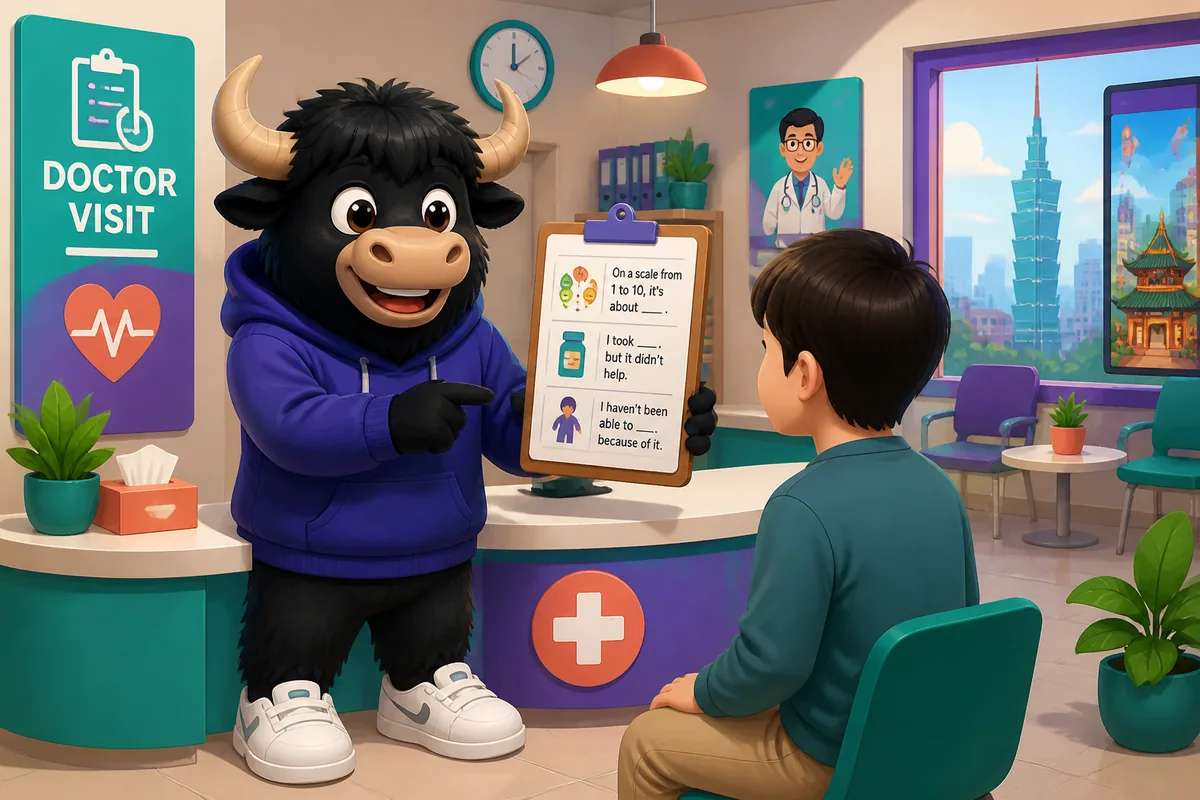
1から10で言うと、___くらいです。
Ichi kara jū de iu to, ___ kurai desu.
On a scale from 1 to 10, it's about ___ .
Meaning: On a scale from 1 to 10, it's about ___.
When to use: ___には痛みの強さの数字を入れます。医師に痛みの程度を聞かれたときに使えます。
Tip: 数字の言い方に注意。7は日常では「なな」、9は「きゅう」と読むのが自然です。
Examples ▼ 1から10で言うと、7くらいです。
Ichi kara jū de iu to, nana kurai desu.
On a scale from 1 to 10, it's about a 7.
夜は痛みが強くて、1から10で言うと、8くらいになります。
Yoru wa itami ga tsuyokute, ichi kara jū de iu to, hachi kurai ni narimasu.
At night the pain is stronger — about an 8 on a scale of 1–10.
___を飲みましたが、効きませんでした。
___ o nomimashita ga, kikimasen deshita.
I took ___, but it didn't help.
Meaning: I took ___, but it didn't help.
When to use: 薬について言うときは「飲みました」を使います。塗り薬なら「使いました」、注射なら「打ちました」が自然です。
Tip: 飲みました/使いました/打ちましたを症状と合う動詞で使い分けましょう(飲む=内服、使う=外用、打つ=注射)。
Examples ▼ イブラプロフェンを飲みましたが、効きませんでした。
Iburapurofen o nomimashita ga, kikimasen deshita.
I took ibuprofen, but it didn't work.
市販の風邪薬を飲みましたが、熱は下がりませんでした。
Shihankanno kazegusuri o nomimashita ga, netsu wa sagarimasen deshita.
I took an over-the-counter cold medicine, but my fever didn't go down.
そのせいで、___ことができていません。
Sono sei de, ___ koto ga dekite imasen.
I haven't been able to ___ because of it.
Meaning: I haven't been able to ___ because of it.
When to use: ___には普通形の動詞を入れます。例:そのせいで、よく寝ることができていません。
Examples ▼ そのせいで、仕事に集中することができていません。
Sono sei de, shigoto ni shūchū suru koto ga dekite imasen.
Because of it, I haven't been able to concentrate at work.
そのせいで、よく寝ることができていません。
Sono sei de, yoku neru koto ga dekite imasen.
Because of it, I haven't been able to sleep well.
検査は必要ですか。
Kensa wa hitsuyō desu ka.
Do I need any tests?
Meaning: Do I need any tests?
When to use: 病院で検査が必要か確認するときの自然で簡単な表現です。
Examples ▼ お話を聞いた後で、検査は必要ですか。
Ohanashi o kiita ato de, kensa wa hitsuyō desu ka.
After hearing my symptoms, do I need tests?
念のため、検査は必要ですか?
Nen no tame, kensa wa hitsuyō desu ka?
Just in case, are any tests necessary?
___は避けたほうがいいですか。
___ wa saketa hō ga ii desu ka.
Should I avoid ___ ?
Meaning: Should I avoid ___?
When to use: ___には食べ物・運動・行動などを入れます。動詞句なら「___のは避けたほうがいいですか」が自然です。
Examples ▼ 辛い食べ物は避けたほうがいいですか。
Karai tabemono wa saketa hō ga ii desu ka.
Should I avoid spicy foods?
重い運動は避けたほうがいいですか。
Omoi undō wa saketa hō ga ii desu ka.
Should I avoid heavy exercise?
次はいつ来ればいいですか。
Tsugi wa itsu kureba ii desu ka.
When should I come back?
Meaning: When should I come back?
When to use: 診察後の次回受診のタイミングを聞く自然な言い方です。より丁寧に言うなら「次はいつ伺えばいいですか」。
Examples ▼ 薬で様子を見ます。次はいつ来ればいいですか。
Kusuri de yōsu o mimasu. Tsugi wa itsu kureba ii desu ka.
We'll watch how the medicine works. When should I come back?
症状が続いたら、次はいつ来ればいいですか。
Shōjō ga tsuzuitara, tsugi wa itsu kureba ii desu ka.
If symptoms continue, when should I return?
最近、___に気づきました。
Saikin, ___ ni kizukimashita.
I've noticed ___ recently.
Meaning: I've noticed ___ recently.
When to use: ___には症状や変化を表す名詞句を入れます。文にする場合は「___ことに気づきました」にすると自然です。
Examples ▼ 最近、息切れに気づきました。
Saikin, ikigire ni kizukimashita.
I've noticed shortness of breath recently.
最近、右足にむくみがあることに気づきました。
Saikin, migi ashi ni mukumi ga aru koto ni kizukimashita.
I've recently noticed swelling in my right leg.
痛みが___まで広がります。
Itami ga ___ made hirogarimasu.
The pain spreads to my ___.
Meaning: The pain spreads to my ___.
When to use: ___には体の部位を入れます。日本語では「my」は普通言いません。部位の後に「まで」が付きます。
Examples ▼ 痛みが左腕まで広がります。
Itami ga hidari ude made hirogarimasu.
The pain spreads to my left arm.
最初は腰だけでしたが、今は脚まで広がります。
Saisho wa koshi dake deshita ga, ima wa ashi made hirogarimasu.
At first it was only my lower back, but now it spreads to my leg.
これは___の副作用でしょうか。
Kore wa ___ no fukusayō deshō ka.
Could this be a side effect of ___?
Meaning: Could this be a side effect of ___?
When to use: ___には薬の名前や治療名を入れます。「___の」で『___の副作用』になります。
Examples ▼ これはこの薬の副作用でしょうか。
Kore wa kono kusuri no fukusayō deshō ka.
Could this be a side effect of this medicine?
先週の注射の副作用でしょうか。
Senshū no chūsha no fukusayō deshō ka.
Could this be a side effect of the injection from last week?
人にうつりますか。
Hito ni utsurimasu ka.
Is it contagious?
Meaning: Is it contagious?
When to use: 病気が他の人に感染するか聞く言い方です。「うつる」は会話でよく使います。
Examples ▼ この病気は人にうつりますか。
Kono byōki wa hito ni utsurimasu ka.
Does this illness spread to other people?
子どもにうつるか心配です。人にうつりますか。
Kodomo ni utsuru ka shinpai desu. Hito ni utsurimasu ka.
I'm worried it might spread to my children. Is it contagious?
How do you ask 'Is it contagious?' in polite Japanese? 検査は必要ですか。 人にうつりますか。 これは___の副作用でしょうか。
Which phrase asks 'When should I come back?' 1から10で言うと、___くらいです。 ___は避けたほうがいいですか。 次はいつ来ればいいですか。
Which is the polite way to say 'I took ibuprofen, but it didn't help.'? イブラプロフェンを飲みましたが、効きませんでした。 イブラプロフェンを使いましたが、効きませんでした。 イブラプロフェンを打ちましたが、効きませんでした。
Which phrase expresses 'Because of it, I haven't been able to sleep well.'? そのせいで、よく寝ることができていません。 そのせいで、よく寝ました。 そのせいで、寝ることができます。
Doctor: I'm asking about your pain. You: On a scale from 1 to 10, it's about a 7. 医師:痛みを聞きます。あなた:1から10で言うと、___.
Ishi: Itami o kikimasu. Anata: Ichi kara jū de iu to, ___.
はい、お願いします。 7くらいです 今日の朝です 痛みが広がります。
Patient: Should I avoid this food? 患者:この食べ物は___?(回復中の行動について尋ねる)
Kanja: Kono tabemono wa ___? (Kaifuku-chū no kōdō ni tsuite tazuneru)
次はいつ来ればいいですか。 避けたほうがいいですか。 人にうつりますか。 検査は必要ですか。
Before the operation: Doctor, do I need any tests? 手術の前に確認したい:先生、___?
Shujutsu no mae ni kakunin shitai: Sensei, ___?
これは副作用でしょうか。 人にうつりますか。 検査は必要ですか。 そのせいで、来られません。
1から10で言うと、___くらいです。 Ichi kara jū de iu to, ___ kurai desu. ___を飲みましたが、効きませんでした。 ___ o nomimashita ga, kikimasen deshita. そのせいで、___ことができていません。 Sono sei de, ___ koto ga dekite imasen. 検査は必要ですか。 Kensa wa hitsuyō desu ka. ___は避けたほうがいいですか。 ___ wa saketa hō ga ii desu ka. 次はいつ来ればいいですか。 Tsugi wa itsu kureba ii desu ka. 最近、___に気づきました。 Saikin, ___ ni kizukimashita. 痛みが___まで広がります。 Itami ga ___ made hirogarimasu. On a scale from 1 to 10, it's about ___. I took ___, but it didn't help. I haven't been able to ___ because of it. Do I need any tests? Should I avoid ___? When should I come back? I've noticed ___ recently. The pain spreads to my ___.
これは___の副作用でしょうか。 Kore wa ___ no fukusayō deshō ka. 人にうつりますか。 Hito ni utsurimasu ka. 念のため、検査をしましょう。 Nen no tame, kensa o shimashō. それなら、安静にしてください。 Sore nara, ansei ni shite kudasai. 様子を見ましょう。 Yōsu o mimashō. 痛みがひどければ、すぐ来てください。 Itami ga hidokereba, sugu kite kudasai. Could this be a side effect of ___? Is it contagious? Let's do tests, just in case. In that case, please rest. Let's observe the situation. If the pain gets worse, please come immediately.
Recording stays on your device only. Check speech uses your browser's speech tools when available.
Say this phrase out loud:
1から10で言うと、___くらいです。
Ichi kara jū de iu to, ___ kurai desu.
On a scale from 1 to 10, it's about ___.
Check speech
Record Play back
Say this phrase out loud:
___を飲みましたが、効きませんでした。
___ o nomimashita ga, kikimasen deshita.
I took ___, but it didn't help.
Check speech
Record Play back
Say this phrase out loud:
そのせいで、___ことができていません。
Sono sei de, ___ koto ga dekite imasen.
I haven't been able to ___ because of it.
Check speech
Record Play back
Say this phrase out loud:
検査は必要ですか。
Kensa wa hitsuyō desu ka.
Do I need any tests?
Check speech
Record Play back
Say this phrase out loud:
___は避けたほうがいいですか。
___ wa saketa hō ga ii desu ka.
Should I avoid ___?
Check speech
Record Play back
Say this phrase out loud:
次はいつ来ればいいですか。
Tsugi wa itsu kureba ii desu ka.
When should I come back?
Check speech
Record Play back
Say this phrase out loud:
最近、___に気づきました。
Saikin, ___ ni kizukimashita.
I've noticed ___ recently.
Check speech
Record Play back
Say this phrase out loud:
痛みが___まで広がります。
Itami ga ___ made hirogarimasu.
The pain spreads to my ___.
Check speech
Record Play back
Say this phrase out loud:
これは___の副作用でしょうか。
Kore wa ___ no fukusayō deshō ka.
Could this be a side effect of ___?
Check speech
Record Play back
Say this phrase out loud:
人にうつりますか。
Hito ni utsurimasu ka.
Is it contagious?
Check speech
Record Play back