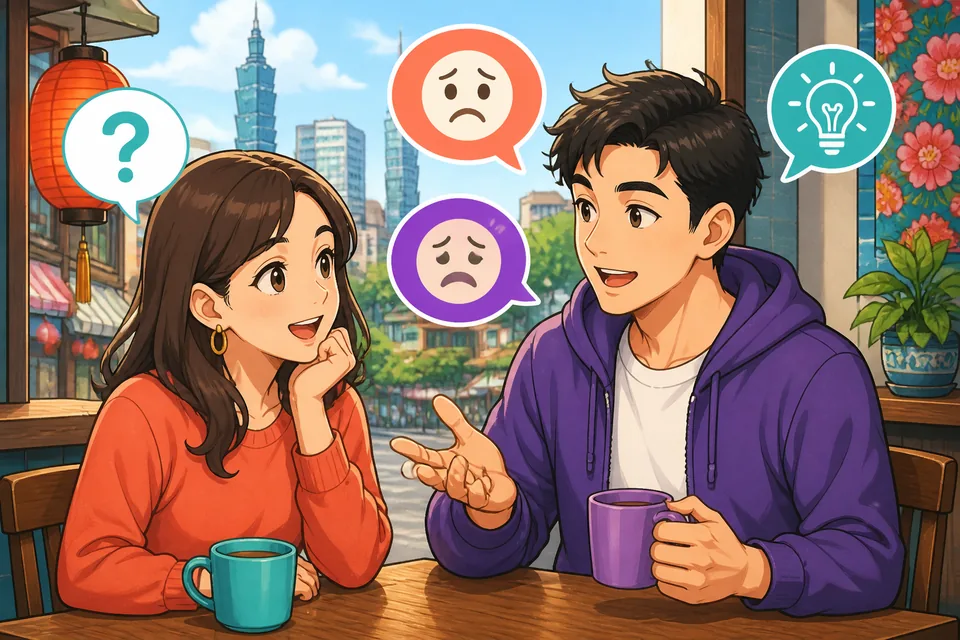
Welcome back! This short lesson helps you sound warm and natural when friends tell you news. Listen, repeat, and practice these handy responses.
Level A2: In this lesson you'll learn four polite reaction phrases to show empathy, shock, interest, or that you've noted useful information. We'll practice それは大変ですね。(Sore wa taihen desu ne.), それはひどいですね。(Sore wa hidoi desu ne.), なるほど、覚えておきます。(Naruhodo, oboete okimasu.), and 面白いですね。(Omoshiroi desu ne.). The lesson is CEFR-aligned and focuses on hearing, choosing, and saying these phrases naturally in conversation.
After this lesson you'll be able to:
Recognize and say four polite reaction phrases used in everyday conversations.
Use それは大変ですね。(Sore wa taihen desu ne.) and それはひどいですね。(Sore wa hidoi desu ne.) to show sympathy and strong disapproval.
Respond to useful information with なるほど、覚えておきます。(Naruhodo, oboete okimasu.) and show interest with 面白いですね。(Omoshiroi desu ne.).
Level A2 practice: listen, choose the best reaction, and say the phrases aloud.
Ready? Let's go!
When you tap play on phrases, we track your progress through this lesson.
1. Reading + Listening Practice
Hear core phrases, repeat aloud.
それは大変ですね。
Sore wa taihen desu ne.
That must be hard.
Meaning: That must be hard.
When to use: Use this polite phrase (それは大変ですね。) to show sympathy when someone describes a difficult situation, like trouble at work, illness, or a stressful event.
Tip: Don't use this for small annoyances. For minor issues, a lighter response like 「ああ、そうですか。」 is more natural.
引っ越しでトラックが遅れたと聞いて、私は「それは大変ですね。」と言いました。
Hikkoshi de torakku ga okureta to kiite, watashi wa "Sore wa taihen desu ne." to iimashita.
I heard the moving truck was delayed, so I said, "That must be hard."
毎日残業が続いていると言われて、先輩に「それは大変ですね。」と答えました。
Mainichi zangyō ga tsuzuite iru to iwarete, senpai ni "Sore wa taihen desu ne." to kotaemashita.
When my senior said they had overtime every day, I replied, "That must be hard."
それはひどいですね。
Sore wa hidoi desu ne.
That's awful.
Meaning: That's awful.
When to use: Use それはひどいですね。to react strongly to very bad news, unfair treatment, or serious mistakes. It's stronger than それは大変ですね。
詐欺にあったと聞いて、彼女は「それはひどいですね。」と驚きました。
Sagi ni atta to kiite, kanojo wa "Sore wa hidoi desu ne." to odoro kimashita.
Hearing she was scammed, she exclaimed, "That's awful."
店員が失礼だったと話したら、「それはひどいですね。」と同情しました。
Ten'in ga shitsurei datta to hanashitara, "Sore wa hidoi desu ne." to dōjō shimashita.
When someone said the clerk was rude, I sympathized, "That's awful."
なるほど、覚えておきます。
Naruhodo, oboete okimasu.
Good to know.
Meaning: Good to know.
When to use: Say なるほど、覚えておきます。when someone gives you useful information, advice, or instructions. It politely signals you'll remember it.
Tip: Beginners sometimes only say 「なるほど」 — that's OK for casual situations, but include 覚えておきます for polite, clear acknowledgement.
新しい提出期限を教えてもらって、私は「なるほど、覚えておきます。」と言いました。
Atarashii teishutsu kigen o oshiete moratte, watashi wa "Naruhodo, oboete okimasu." to iimashita.
I was told a new deadline, so I said, "Good to know; I'll remember it."
電車の乗り換え方法を聞いて、「なるほど、覚えておきます。」と答えました。
Densha no norikae hōhō o kiite, "Naruhodo, oboete okimasu." to kotaemashita.
After hearing how to transfer trains, I replied, "Good to know; I'll remember that."
面白いですね
Omoshiroi desu ne.
That's interesting.
Meaning: That's interesting.
When to use: Use 面白いですね。to show interest in a fact, idea, or story. It can mean "interesting" rather than "funny."
その伝統の話を聞いて、私は「面白いですね。」と言いました。
Sono dentō no hanashi o kiite, watashi wa "Omoshiroi desu ne." to iimashita.
I heard that tradition's story and said, "That's interesting."
新しいアプリの機能についての説明を聞いて、「面白いですね。」と反応しました。
Atarashii apuri no kinō ni tsuite no setsumei o kiite, "Omoshiroi desu ne." to hannō shimashita.
After hearing about a new app feature, I reacted, "That's interesting."
2. Conversational Listening Practice
Hear phrases in a real mini-conversation.
Anna asks David about his weekend; David shares a mix of bad luck and a useful tip.
Anna
週末はどうだった?
Shūmatsu wa dō datta?
How was your weekend?
David
旅行中に荷物が遅れて大変でした。でも、航空会社に連絡すると早く見つかりました。
Ryokō-chū ni nimotsu ga okurete taihen deshita. Demo, kōkū-gaisha ni renraku suru to hayaku mitsukarimashita.
My luggage was delayed and it was rough. But when I contacted the airline, they found it quickly.
Anna
それは大変ですね。
Sore wa taihen desu ne.
That must be hard.
David
しかも、宿のスタッフが無愛想でひどかったんです。
Shikamo, yado no sutaffu ga buaiso de hidokatta n desu.
Also, the hotel staff were rude—it was awful.
Anna
それはひどいですね。
Sore wa hidoi desu ne.
That's awful.
David
あと、次は早めに写真と荷物番号を記録しておくといいですよ。
Ato, tsugi wa hayame ni shashin to nimotsu bangō o kiroku shite oku to ii desu yo.
Also, next time it's good to record photos and the baggage number early.
Anna
なるほど、覚えておきます。
Naruhodo, oboete okimasu.
Good to know; I'll remember that.
3. Guided Practice
Quizzes and matching to lock in meaning.
Your friend says they lost three days of pay because of an error at work. Which Japanese reaction fits best?
If someone tells you their delivery was stolen from outside their door, which reaction is strongest and most natural?
Someone explains a clever shortcut to save data on your phone. What do you say to show you'll remember it?
A colleague describes a surprising cultural custom you haven't heard before. Which is the best quick reaction?
Your colleague says they were treated unfairly by their boss. You say, "That's awful."
同僚が上司に不当な扱いを受けたと話した。あなたは「___」。
Dōryō ga jōshi ni futō na atsukai o uketa to hanashita. Anata wa "___".
Your friend says they are tired because of many tests. You say, "That must be hard."
友達がテストがたくさんあって疲れていると言った時、あなたは「___」。
Tomodachi ga tesuto ga takusan atte tsukarete iru to itta toki, anata wa "___".
The teacher told you about a useful study app. You respond, "Good to know; I'll remember that."
先生が便利な勉強アプリを教えてくれた。返事は「___」。
Sensei ga benri na benkyō apuri o oshiete kureta. Henji wa "___".
Match the core phrases
Match the extra phrases
4. Speaking Practice
Say phrases yourself (mic/recording).
Recording stays on your device only. Check speech uses your browser's speech tools when available.