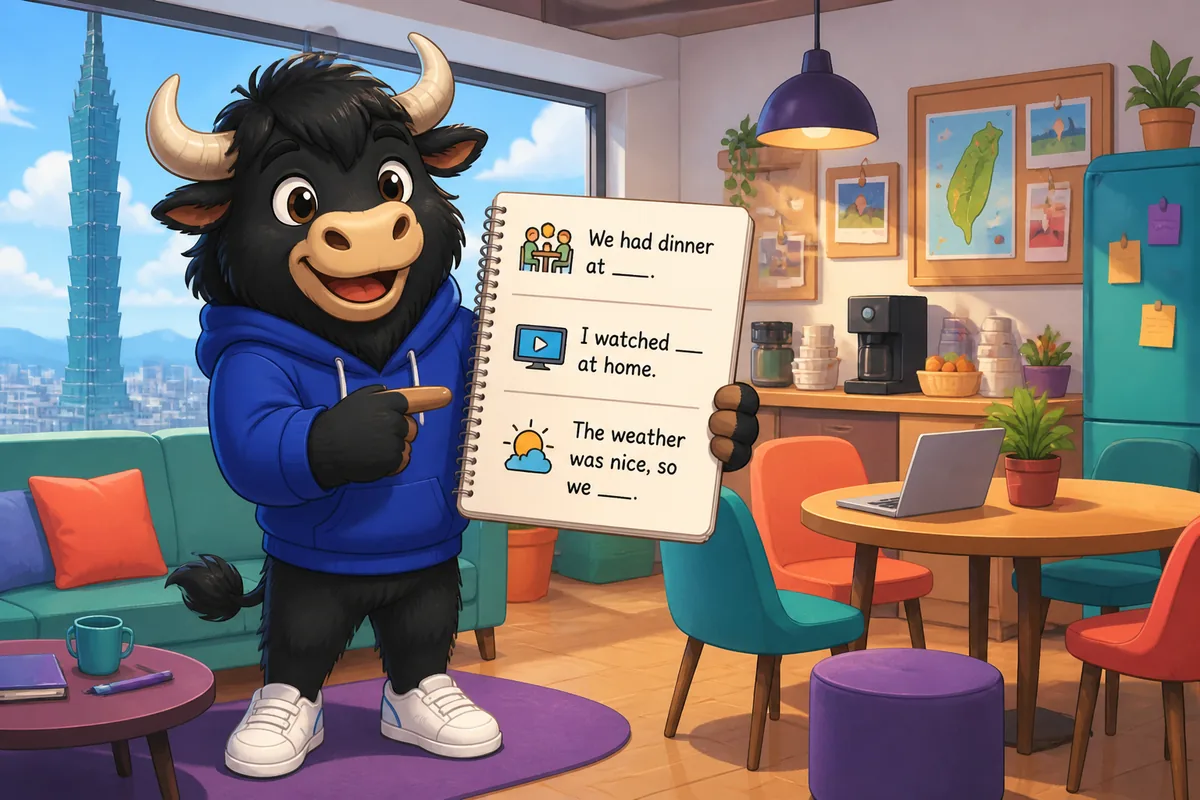
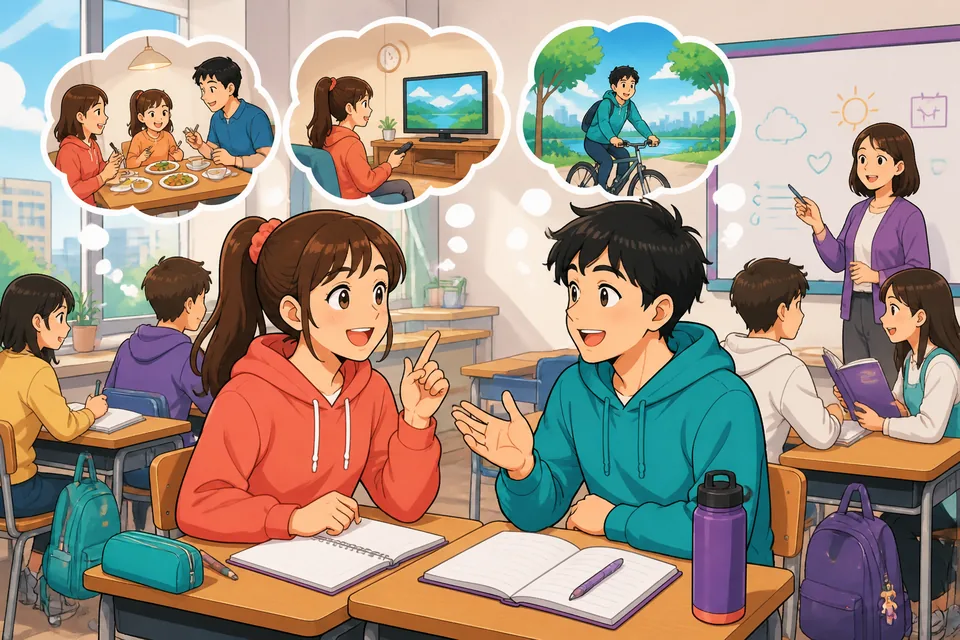
Ready to chat about your weekend? This short lesson helps you describe what you did, where you went, and ask others about their weekends. Repeat, listen, then speak — quick and friendly practice.
Level A2: In Lesson 133 you'll practice useful weekend phrases for talking about meals, watching things at home, how the weather changed your plans, and asking what someone usually does on weekends. This CEFR-aligned pack focuses on short, polite sentences you can use right away to describe your weekend and ask follow-up questions.
After this lesson you'll be able to:
Use polite past sentences to say where you had dinner and what you watched at home.
Link good weather to an activity using 天気がよかったので (Tenki ga yokatta node).
Ask and answer simple questions about weekend routines (週末はいつも何をしますか).
Level A2: Practice short opinions and how you spent most of the weekend.
Ready? Let's go!
When you tap play on phrases, we track your progress through this lesson.
1. Reading + Listening Practice
Hear core phrases, repeat aloud.
___で晩ごはんを食べました。
___ de bangohan o tabemashita.
We had dinner at ___.
Meaning: We had dinner at ___.
When to use: Use this to say where you ate dinner. Put a place name (店・場所の名前) before で to mark the location where the meal happened.
レストランで晩ごはんを食べました。
Resutoran de bangohan o tabemashita.
We had dinner at a restaurant.
友だちの家で晩ごはんを食べました。
Tomodachi no ie de bangohan o tabemashita.
We had dinner at a friend's house.
家で___を見ました。
Ie de ___ o mimashita.
I watched ___ at home.
Meaning: I watched ___ at home.
When to use: Use when you want to say what you watched at home. Put a movie, drama, or video title before を to mark what you watched.
家で映画を見ました。
Ie de eiga o mimashita.
I watched a movie at home.
家でドラマを見ました。
Ie de dorama o mimashita.
I watched a drama at home.
天気がよかったので、___。
Tenki ga yokatta node, ___.
The weather was nice, so we ___.
Meaning: The weather was nice, so we ___.
When to use: Use this to link good weather to a past activity. Follow 天気がよかったので with a past action sentence (e.g., 公園に行きました).
Tip: Beginners sometimes forget to use past tense after ので when describing a finished activity.
天気がよかったので、公園に行きました。
Tenki ga yokatta node, kōen ni ikimashita.
The weather was nice, so we went to the park.
天気がよかったので、散歩しました。
Tenki ga yokatta node, sanpo shimashita.
The weather was nice, so we took a walk.
週末はいつも何をしますか。
Shūmatsu wa itsumo nani o shimasu ka.
What do you usually do on weekends?
Meaning: What do you usually do on weekends?
When to use: Use this polite question to ask about someone's normal weekend routine. 何をしますか asks what activities they do.
週末はいつも何をしますか。
Shūmatsu wa itsumo nani o shimasu ka.
What do you usually do on weekends?
週末はいつも買い物をしますか。
Shūmatsu wa itsumo kaimono o shimasu ka.
Do you usually go shopping on weekends?
けっこう___でした。
Kekkō ___ deshita.
It was pretty ___ .
Meaning: It was pretty ___.
When to use: Use けっこう + noun or な-adjective (in past tense with でした) to give a short overall opinion about the weekend.
Tip: Don't put い-adjectives directly after けっこう without using their past/polite form when describing past events.
週末はけっこうゆっくりでした。
Shūmatsu wa kekkō yukkuri deshita.
The weekend was pretty relaxed.
旅行はけっこう楽しかったです。
Ryokō wa kekkō tanoshikatta desu.
The trip was pretty fun.
週末はほとんど___して過ごしました。
Shūmatsu wa hotondo ___ shite sugoshimashita.
I spent most of the weekend ___ .
Meaning: I spent most of the weekend ___.
When to use: Use this to say how most of your weekend was spent. Put an activity noun + して過ごしました or a verb in て-form + 過ごしました for actions.
週末はほとんど勉強して過ごしました。
Shūmatsu wa hotondo benkyō shite sugoshimashita.
I spent most of the weekend studying.
週末はほとんど寝て過ごしました。
Shūmatsu wa hotondo nete sugoshimashita.
I spent most of the weekend sleeping.
たまっていた___を片づけました。
Tamatte ita ___ o katazukemashita.
I caught up on ___ .
Meaning: I caught up on ___.
When to use: Use this to say you used the weekend to finish overdue tasks. Put a task noun (e.g., 仕事、洗濯、宿題) before を片づけました。
たまっていた宿題を片づけました。
Tamatte ita shukudai o katazukemashita.
I caught up on my piled-up homework.
たまっていた洗濯を片づけました。
Tamatte ita sentaku o katazukemashita.
I caught up on the laundry that had piled up.
___する時間はありましたか。
___ suru jikan wa arimashita ka.
Did you get to ___ ?
Meaning: Did you get to ___?
When to use: Use this to ask whether someone had time or a chance to do something. Put an activity noun + する時間はありましたか or a verb + 時間はありましたか.
映画を見る時間はありましたか。
Eiga o miru jikan wa arimashita ka.
Did you have time to watch a movie?
ゆっくりする時間はありましたか。
Yukkuri suru jikan wa arimashita ka.
Did you have time to relax?
2. Conversational Listening Practice
Hear phrases in a real mini-conversation.
Anna and David compare weekend plans and what they actually did.
Anna
週末はいつも何をしますか。
Shūmatsu wa itsumo nani o shimasu ka.
What do you usually do on weekends?
David
普段は家でゆっくりしますが、先週は違いました。
Fudan wa ie de yukkuri shimasu ga, senshū wa chigaimashita.
I usually relax at home, but last week was different.
Anna
天気がよかったので、どこかに行きましたか。
Tenki ga yokatta node, dokoka ni ikimashita ka.
The weather was nice, so did you go somewhere?
David
はい、天気がよかったので、公園に行きました。けっこう気持ちよかったです。
Hai, tenki ga yokatta node, kōen ni ikimashita. Kekkō kimochi yokatta desu.
Yes — the weather was nice, so I went to the park. It was pretty pleasant.
Anna
週末はほとんど何をして過ごしましたか。
Shūmatsu wa hotondo nani o shite sugoshimashita ka.
How did you spend most of the weekend?
David
午前はたまっていた仕事を片づけました。午後は家で映画を見ました。
Gozen wa tamatte ita shigoto o katazukemashita. Gogo wa ie de eiga o mimashita.
In the morning I caught up on piled-up work. In the afternoon I watched a movie at home.
Anna
いいですね。映画を見る時間はありましたか。
Ii desu ne. Eiga o miru jikan wa arimashita ka.
Nice. Did you have time to watch the movie?
David
はい、けっこうゆっくりできました。
Hai, kekkō yukkori dekimashita.
Yes, I was able to relax quite a bit.
3. Guided Practice
Quizzes and matching to lock in meaning.
Choose the sentence that asks "Did you have time to watch a movie?"
Which sentence means "I caught up on the laundry that had piled up."?
Select the sentence that uses 天気がよかったので to explain an action.
Which phrase asks about someone's usual weekend routine?
Last week I had dinner with friends at a restaurant.
先週は友だちと ___ で晩ごはんを食べました。
Senshū wa tomodachi to ___ de bangohan o tabemashita.
In the afternoon I watched a movie at home. It was very interesting.
午後は家で ___ を見ました。とても面白かったです。
Gogo wa ie de ___ o mimashita. Totemo omoshirokatta desu.
Because the weather was nice, I went to the park in the morning.
天気がよかったので、朝に ___ に行きました。
Tenki ga yokatta node, asa ni ___ ni ikimashita.
Match the core phrases
Match the extra phrases
4. Speaking Practice
Say phrases yourself (mic/recording).
Recording stays on your device only. Check speech uses your browser's speech tools when available.