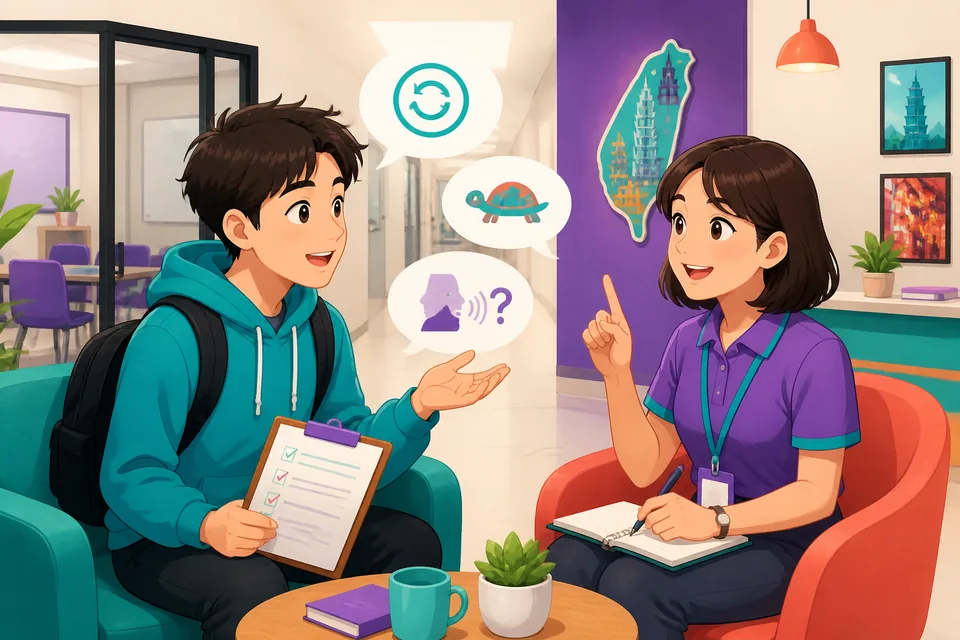
Welcome! In this short lesson you'll practice useful classroom phrases that make asking for help easy and polite. Say the lines out loud, try the mini-dialogue, then do the quick quizzes to lock it in.
Level A2: This lesson focuses on polite classroom requests you can use with a teacher — for example, 「すみません、もう一度言ってください。」 (Sumimasen, mō ichido itte kudasai.) and 「宿題はありますか?」 (Shukudai wa arimasu ka?). You'll practice asking for repetition, slower speech, pronunciation, permission to ask questions, missing items, deadlines, and more. CEFR-aligned and classroom-ready, Lesson 126 helps you speak up in class with confidence.
After this lesson you'll be able to:
Learn and repeat 13 polite classroom phrases (A2).
Ask a teacher to repeat or slow down: 「すみません、もう一度言ってください。」 (Sumimasen, mō ichido itte kudasai.) and 「すみません、もう少しゆっくり言ってください。」 (Sumimasen, mō sukoshi yukkuri itte kudasai.)
Ask for pronunciation, permission, deadlines, and check work politely.
Use these phrases out loud in a short mini-dialogue and guided practice.
Ready? Let's go!
When you tap play on phrases, we track your progress through this lesson.
1. Reading + Listening Practice
Hear core phrases, repeat aloud.
すみません、もう一度言ってください。
Sumimasen, mō ichido itte kudasai.
Can you repeat that, please?
Meaning: Can you repeat that, please?
When to use: Use this when you missed what the teacher said or didn't understand and need repetition.
先生、すみません、もう一度言ってください。
Sensei, sumimasen, mō ichido itte kudasai.
Teacher, excuse me, can you say that one more time?
聞き取れませんでした。もう一度言ってください。
Kikitoremasen deshita. Mō ichido itte kudasai.
I couldn't catch that. Please say it one more time.
すみません、もう少しゆっくり言ってください。
Sumimasen, mō sukoshi yukkuri itte kudasai.
Can you say that more slowly, please?
Meaning: Can you say that more slowly, please?
When to use: Ask this when the teacher is speaking too fast for you to follow.
英語が速いです。すみません、もう少しゆっくり言ってください。
Eigo ga hayai desu. Sumimasen, mō sukoshi yukkuri itte kudasai.
English is fast. Excuse me, could you say it a little more slowly?
説明が早くて分かりません。もう少しゆっくり言ってください。
Setsumei ga hayakute wakarimasen. Mō sukoshi yukkuri itte kudasai.
The explanation is fast and I don't understand. Please speak a bit more slowly.
___はどう発音しますか?
___ wa dō hatsuon shimasu ka?
How do you pronounce ___?
Meaning: How do you pronounce ___?
When to use: Use this to ask the teacher how to pronounce a word or name; put the word before は.
Tip: Don't use を or other particles before the topic; use は for the item you want pronounced.
この単語、'写真'はどう発音しますか?
Kono tango, 'shashin' wa dō hatsuon shimasu ka?
How do you pronounce this word, 'shashin' (photo)?
'エマ'はどう発音しますか?
'Ema' wa dō hatsuon shimasu ka?
How do you pronounce 'Emma'?
質問してもいいですか?
Shitsumon shite mo ii desu ka?
Can I ask a question?
Meaning: Can I ask a question?
When to use: Say this before you ask something in class to get permission politely.
すみません、質問してもいいですか?
Sumimasen, shitsumon shite mo ii desu ka?
Excuse me, may I ask a question?
授業中に一つ質問してもいいですか?
Jugyō-chū ni hitotsu shitsumon shite mo ii desu ka?
May I ask one question during class?
___を忘れました。
___ o wasuremashita.
I forgot my ___.
Meaning: I forgot my ___.
When to use: Tell the teacher you forgot an item (put the item before を).
Tip: Beginner students sometimes forget を after the item, e.g. say 'ノート忘れました' — remember 'ノートを忘れました。'
すみません、ノートを忘れました。
Sumimasen, nōto o wasuremashita.
Sorry, I forgot my notebook.
えんぴつを忘れました。貸してもらえますか?
Enpitsu o wasuremashita. Kashite moraemasu ka?
I forgot my pencil. Could you lend me one?
宿題はありますか?
Shukudai wa arimasu ka?
Do we have homework?
Meaning: Do we have homework?
When to use: Ask this to confirm whether there is assigned work after class.
今日の授業、宿題はありますか?
Kyō no jugyō, shukudai wa arimasu ka?
Do we have homework for today's class?
週末に宿題はありますか?
Shūmatsu ni shukudai wa arimasu ka?
Is there homework for the weekend?
いつまでですか?
Itsu made desu ka?
When is it due?
Meaning: When is it due?
When to use: Ask this to clarify the deadline for an assignment mentioned in class.
宿題はいつまでですか?
Shukudai wa itsu made desu ka?
When is the homework due?
プロジェクトはいつまでですか?
Purojekuto wa itsu made desu ka?
When is the project deadline?
トイレに行ってもいいですか。
Toire ni itte mo ii desu ka.
Can I go to the bathroom?
Meaning: Can I go to the bathroom?
When to use: Use this in class to politely ask permission to leave for the restroom.
すみません、トイレに行ってもいいですか。
Sumimasen, toire ni itte mo ii desu ka.
Excuse me, may I go to the restroom?
すみません、お手洗いに行ってもいいですか。
Sumimasen, o-tearai ni itte mo ii desu ka.
Excuse me, may I go to the washroom?
どの問題をすればいいですか。
Dono mondai o sureba ii desu ka.
Which exercise should we do?
Meaning: Which exercise should we do?
When to use: Ask this when you want to know which problem or exercise to complete in class.
今日の教科書、どの問題をすればいいですか。
Kyō no kyōkasho, dono mondai o sureba ii desu ka?
Which exercise in the textbook should we do today?
ワークシートのどの問題をすればいいですか?
Wākushīto no dono mondai o sureba ii desu ka?
Which problem on the worksheet should we do?
一人でやりますか、それともペアでやりますか。
Hitori de yarimasu ka, soretomo pea de yarimasu ka.
Should we work alone or in pairs?
Meaning: Should we work alone or in pairs?
When to use: Use this to clarify whether the activity is individual or collaborative.
一人でやりますか、それともペアでやりますか?
Hitori de yarimasu ka, soretomo pea de yarimasu ka?
Will we do it alone or in pairs?
この課題は一人でやりますか、それともペアでやりますか?
Kono kadai wa hitori de yarimasu ka, soretomo pea de yarimasu ka?
For this task, should we work alone or with a partner?
私の答えを見てもらえますか。
Watashi no kotae o mite moraemasu ka.
Can you check my answer?
Meaning: Can you check my answer?
When to use: Ask this when you want the teacher to look over or confirm your answer.
先生、私の答えを見てもらえますか。
Sensei, watashi no kotae o mite moraemasu ka?
Teacher, can you check my answer?
テキストのこの答え、見てもらえますか?
Tekisuto no kono kotae, mite moraemasu ka?
Can you check this answer in the text?
ここを説明してもらえますか。
Koko o setsumei shite moraemasu ka.
Can you explain this part?
Meaning: Can you explain this part?
When to use: Use this to ask the teacher to explain a specific line, paragraph, or question.
ページ10のここを説明してもらえますか?
Pēji 10 no koko o setsumei shite moraemasu ka?
Can you explain this part on page 10?
問題2のここを説明してもらえますか?
Mondai ni no koko o setsumei shite moraemasu ka?
Can you explain this part of question 2?
終わりました
Owarimashita.
I'm finished.
Meaning: I'm finished.
When to use: Say this when you have completed the task or test.
宿題、終わりました。
Shukudai, owarimashita.
I've finished the homework.
テスト、終わりました。提出してもいいですか?
Tesuto, owarimashita. Teishutsu shite mo ii desu ka?
I'm finished with the test. May I turn it in?
2. Conversational Listening Practice
Hear phrases in a real mini-conversation.
In-class clarification
Anna
すみません、質問してもいいですか?
Sumimasen, shitsumon shite mo ii desu ka?
Excuse me, may I ask a question?
David
先生、どの問題をすればいいですか。
Sensei, dono mondai o sureba ii desu ka?
Teacher, which exercise should we do?
Anna
説明が早いです。すみません、もう少しゆっくり言ってください。
Setsumei ga hayai desu. Sumimasen, mō sukoshi yukkuri itte kudasai.
The explanation is fast. Excuse me, could you speak a little more slowly?
David
ありがとうございます。終わりました、と言ってもいいですか?
Arigatō gozaimasu. Owarimashita, to itte mo ii desu ka?
Thanks. Is it okay to say 'I'm finished'?
3. Guided Practice
Quizzes and matching to lock in meaning.
How do you politely ask the teacher to repeat what they said?
Which phrase asks for permission to ask a question?
How do you ask 'Which exercise should we do?'
Which phrase means 'I'm finished'?
Teacher, the explanation is fast. Excuse me, please say it a little more slowly.