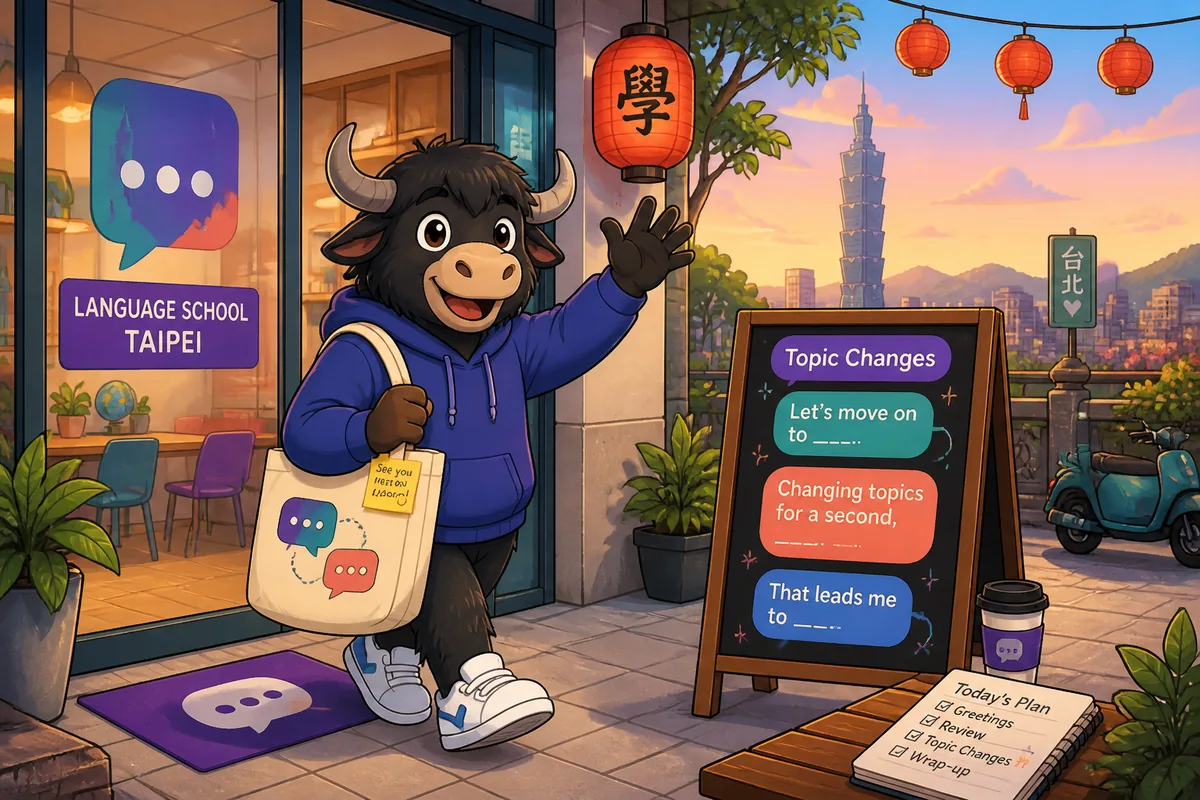
Ready to make topic changes sound natural? This short lesson helps you guide conversations forward with polite, useful phrases. Have fun — think of these lines as conversational glue.
Level B1: In this lesson you will practice four polite ways to change or connect topics in meetings and conversations: moving on, briefly changing subject, connecting from one point to the next, and adding one last point. This CEFR-aligned lesson (Lesson 87) focuses on using these phrases naturally in spoken Japanese.
After this lesson you'll be able to:
Use polite transitions to move to a named topic (e.g., では、___に移りましょう)。
Briefly change subjects with ちょっと話を変えますが、___。
Connect related points using そこから___につながります。
Add a final point with ___について、もう一つあります。 (Level B1)
Ready? Let's go!
When you tap play on phrases, we track your progress through this lesson.
1. Reading + Listening Practice
Hear core phrases, repeat aloud.
では、___に移りましょう。
Dewa, ___ ni utsurimashō.
Let's move on to ___.
Meaning: Let's move on to ___.
When to use: Use when you want to transition the group to a named topic or agenda item. Put the topic in the blank and keep the particle に.
Tip: Forgetting the particle に (e.g., saying 'へ' instead of 'に') — use に with 移る/移りましょう.
では、次の議題に移りましょう。
Dewa, tsugi no gidai ni utsurimashō.
Let's move on to the next agenda item.
では、次のトピックに移りましょう。
Dewa, tsugi no topikku ni utsurimashō.
Let's move on to the next topic.
ちょっと話を変えますが、___。
Chotto hanashi o kaemasu ga, ___.
Changing topics for a second, ___.
Meaning: Changing topics for a second, ___.
When to use: A polite way to signal a short change of subject. In casual talk you can shorten it to ちょっと話変わるけど、___.
Tip: Using the casual version in a formal meeting. Stick to ちょっと話を変えますが、 in polite settings.
ちょっと話を変えますが、来週の予定はどうですか。
Chotto hanashi o kaemasu ga, raishū no yotei wa dō desu ka.
Changing subjects for a moment: how about next week's schedule?
ちょっと話を変えますが、先週のイベントはどう思いましたか。
Chotto hanashi o kaemasu ga, senshū no ibento wa dō omoimashita ka.
Briefly changing topic: what did you think of last week's event?
そこから___につながります。
Soko kara ___ ni tsunagarimasu.
That leads me to ___.
Meaning: That leads to ___.
When to use: Use this to show how the current discussion connects to another related point. Put the related topic afterにつながります。
そこから次のプロジェクトの計画につながります。
Soko kara tsugi no purojekuto no keikaku ni tsunagarimasu.
That leads to planning for the next project.
そこから予算の話につながります。
Soko kara yosan no hanashi ni tsunagarimasu.
That leads to a discussion about the budget.
___について、もう一つあります。
___ ni tsuite, mō hitotsu arimasu.
One more thing about ___.
Meaning: One more thing about ___.
When to use: Use this to add a final point about a topic before moving on or wrapping up. Place the topic before について。
レポートについて、もう一つあります。
Repōto ni tsuite, mō hitotsu arimasu.
One more thing about the report.
会議の時間について、もう一つあります。
Kaigi no jikan ni tsuite, mō hitotsu arimasu.
One more thing about the meeting time.
2. Conversational Listening Practice
Hear phrases in a real mini-conversation.
A short meeting where Anna and David move topics and connect discussion points.
Anna
皆さん、では、次の議題に移りましょう。
Minasan, dewa, tsugi no gidai ni utsurimashō.
Everyone, let's move on to the next agenda item.
David
ちょっと話を変えますが、先週のアンケート結果は見ましたか。
Chotto hanashi o kaemasu ga, senshū no ankēto kekka wa mimashita ka.
Quick change of topic: did you see last week's survey results?
Anna
見ました。そこから予算の見直しにつながります。
Mimashita. Soko kara yosan no minaoshi ni tsunagarimasu.
I saw them. That leads to a budget review.
David
そうですね。予算について、もう一つあります。
Sō desu ne. Yosan ni tsuite, mō hitotsu arimasu.
Right. One more thing about the budget.
Anna
何ですか
Nan desu ka?
What is it?
David
新しい提案書を準備しました。
Atarashii teian-sho o junbi shimashita.
I've prepared a new proposal.
3. Guided Practice
Quizzes and matching to lock in meaning.
Which sentence means 'Let's move on to the next topic'?
Which phrase is best to briefly change the subject?
Which sentence matches 'That leads to a discussion about the budget.'?
Which sentence means 'One more thing about the meeting time'?
We've summarized so far. Let's move on to the next agenda item.
ここまでで話がまとまりました。___
Koko made de hanashi ga matomarimashita. ___
Expression for changing the scene: Changing topics briefly, what do you think about next month's event?
場面を換えたい時に言う表現:___ 来月のイベントについてどう思いますか?
Bamen o kaetai toki ni iu hyōgen: ___ Raigetsu no ibento ni tsuite dō omoimasu ka?
When the discussion continues and you want to add a final point: One more thing about the meeting time.
議論が続いている時に最後の追加点を言う:会議の時間について、___。
Giron ga tsudukete iru toki ni saigo no tsuika-ten o iu: Kaigi no jikan ni tsuite, ___.
Match the core phrases
Match the extra phrases
4. Speaking Practice
Say phrases yourself (mic/recording).
Recording stays on your device only. Check speech uses your browser's speech tools when available.