
New here? This is lesson 196 of a free 240-lesson Japanese course.
Linking what you say in Japanese
At a Ueno project meeting, Mori-san spots two bugs: the on-screen wording and the timing. Leo follows as she links the issues instead of listing them separately.
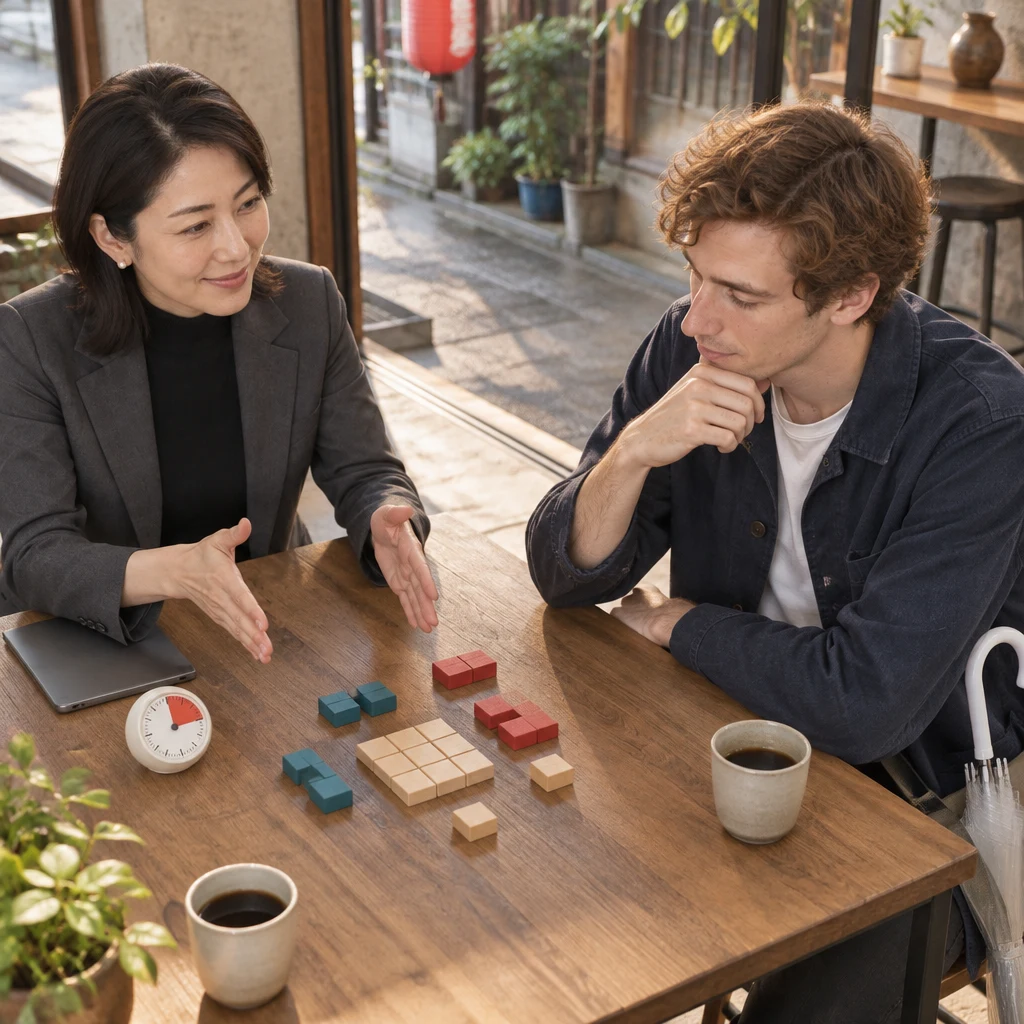
Then she returns to the first point, making the discussion easy to track. A yak's unfinished coffee is far away in Yanaka, but the umbrella remains in its stand.
Practice six transitions for adding a point, balancing views, and returning to a topic. These are polite phrases for clear, connected discussion.
By the end of this lesson
Connect two points smoothly and guide a discussion back to an earlier point.
- さっきの話に戻ると、___。Going back to what I was saying, ___.
- それなら、___。In that case, ___.
- 一方ではそういう見方もあります。On the other hand, there's also that view.
- 同時にこちらも大事です。At the same time, this matters too.
- とにかく話を続けます。Anyway, I'll go on.
- その上もう一つあります。On top of that, there's one more thing.
Scene — two bugs in one meeting
At Mori-san's Ueno office, Leo joins a project meeting about a small puzzle game. Two bugs appear in the same test: one in the Japanese wording, another in when the screen changes.
On a monitor, two simple screenshots sit side by side. Mori keeps the discussion focused while Leo listens for how the issues connect.

Learn — connect your points
These six expressions help a listener follow how your points relate. Some add information, some balance views, and one returns to an earlier point.
Use them in a meeting or a longer explanation, not as isolated greetings.

さっきの話に戻ると、___。
Going back to what I was saying, ___.
When to use it: Use this to return to a point you mentioned earlier.
戻ると introduces a return to an earlier point; the following clause names the point you are picking up again.
Say it: さっき has a small っ: hold a brief pause before き.

それなら、___。
In that case, ___.
When to use it: Use this when a previous point leads to a next step or conclusion.
それなら connects something just said to a result or next step, like “if so” or “in that case.”

一方ではそういう見方もあります。
On the other hand, there's also that view.
When to use it: Use this to acknowledge another viewpoint in a discussion.
一方では marks a contrasting viewpoint; も signals that this is another view, not the only one.
同時にこちらも大事です。
At the same time, this matters too.
When to use it: Use this to add a point that matters alongside the one just mentioned.
同時に links two considerations that matter together, rather than presenting one as a replacement.

とにかく話を続けます。
Anyway, I'll go on.
When to use it: Use this to set aside a pause or side issue and continue speaking.
とにかく signals that you are setting aside distractions and continuing the main discussion.

その上もう一つあります。
On top of that, there's one more thing.
When to use it: Use this to add another point to what you have already said.
その上 adds another point on top of what has already been said.
Story — wording and timing
At the Ueno office, Mori explains how two bugs relate: the wording is wrong, and the timing is off too. Then she brings the meeting back to the wording.
Highlighted phrases are the new lines. Turn on Show English if you want a gloss.
- Mori and Leo look at two screenshots from the game's latest test.
 Mori表示の言葉に問題がありました。There was a problem with the wording on the screen.
 Leoなるほど。That makes sense.
- Mori表示の言葉は短くしたほうがいいですね。It would be better to shorten the wording on the screen.
- Leoでも、説明を残したいという意見もあります。But some people also want to keep the explanation.
- Mori一方ではそういう見方もあります。On the other hand, there's also that view.
- Mori同時にこちらも大事です。At the same time, this matters too.
- Leo確かにそうです。That's true.
- Moriその上もう一つあります。On top of that, there's one more thing.
- Mori画面が切り替わるタイミングも少し遅れています。The timing of the screen change is also a little late.
- Leoそれなら、表示とタイミングを一緒に確認しましょう。In that case, let's check the wording and timing together.
- Moriさっきの話に戻ると、表示の言葉を先に直す必要があります。Going back to what I was saying, we need to fix the wording on the screen first.
- Leoそうですね。That's right.
- Moriあ、通知が来ましたね。少し話がそれました。Oh, a notification came in. We got a little sidetracked.
- Moriとにかく話を続けます。Anyway, I'll go on.
- Leoはい、分かりました。Yes, understood.
Practice — keep the discussion clear
Try ten short activities: listen for a transition, complete a phrase, build a line, and choose a response.
The examples stay close to Mori-san's meeting, so you can hear how each phrase moves the discussion along.
0 of 10 done
What did you hear?
What did you hear?
What do you say?
What do you say?
Mori-san has moved on to another issue. Bring the discussion back to the wording problem she mentioned earlier.
Fill the gap
Fill the gap
On the other hand, there's also that view.
一方ではそういう見方も____。
Build the line
Build the line
On top of that, there's one more thing.
。
Tap the words in order.
Pick the reply
Mori says:
Pick the reply
表示の言葉も、画面が切り替わるタイミングも確認したほうがいいですね。
We should check both the wording and the timing of the screen change.
And you reply with:
Swap the word
Swap the word
You are setting aside a pause and saying you will keep going. Fix the final verb.
とにかく話を____。
Match the pairs
Japanese
一方ではそういう見方もあります。Drop the English here同時にこちらも大事です。Drop the English hereその上もう一つあります。Drop the English hereEnglish
What does it mean?
What does it mean?
なるほど。
What do you say?
What do you say?
Mori-san says the wording is too long, and you suggest a next step based on her point.
What do you say?
What do you say?
Mori-san says both bugs need attention. Clearly agree with her.
Say it — link your own points
You are joining Mori-san's Ueno meeting. Listen for the connection between her points, then use a transition to add your own.
Tap play first if you want to hear each line. The speaking practice is for your own recording.
- Moriさっきの話ですが、表示の言葉を短くする案があります。About the earlier point, one option is to shorten the wording on the screen.
- Leo (you)Return to the earlier point and say you want to shorten the wording.
Return to the earlier point and say you want to shorten the wording.
さっきの話に戻ると、___。
Going back to what I was saying, ___.
0 of 5 said
Recap — what you can say now
| Japanese | English | Play |
|---|---|---|
| さっきの話に戻ると、___。 | Going back to what I was saying, ___. | |
| それなら、___。 | In that case, ___. | |
| 一方ではそういう見方もあります。 | On the other hand, there's also that view. | |
| 同時にこちらも大事です。 | At the same time, this matters too. | |
| とにかく話を続けます。 | Anyway, I'll go on. | |
| その上もう一つあります。 | On top of that, there's one more thing. |
Save your progress — it’s free
Keep your place in the course and see which lines you’ve learned.
Want the next lesson in your inbox?
Get the next lesson by email, one a day.
Join the newsletterDaily lesson emails are coming soon. Newsletter subscribers get them first.
Keep practicing with Yak Cards
Keep these transitions ready for your next meeting. Open the Yak Cards for this lesson and review them on the train.
A quick review helps you link your points without losing the thread.
Open Yak Cards