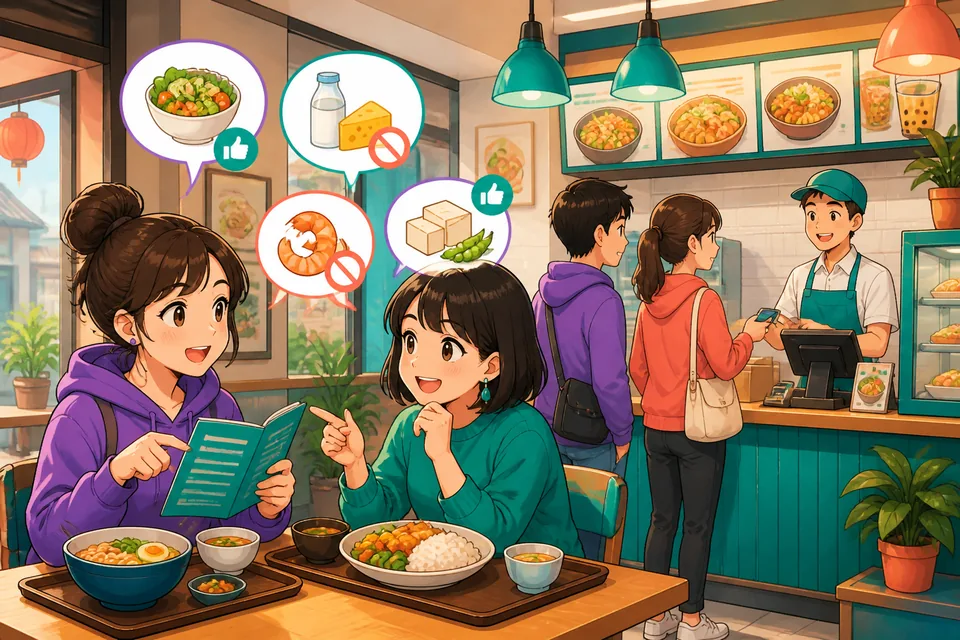
Hello — ready to talk about food? This short lesson helps you ask about menu options, allergies, and friendly requests when ordering. Have fun and imagine you're at a café or with friends!
Level A2: In Lesson 63 you'll practice polite, everyday phrases for food preferences — asking “Is there a ___ option?”, saying what you can or can't eat, checking for allergies, and asking to leave ingredients out. This CEFR-aligned mini-lesson focuses on useful restaurant and friend conversation lines you can use right away.
After this lesson you'll be able to:
Ask politely if a restaurant has a special menu option and ask about allergies.
Say what you can and can't eat (polite contrasts) and ask others about restrictions.
Make simple polite requests when ordering (e.g., “No nuts, please”).
Level A2: practice listening, choosing, and repeating short natural phrases.
Ready? Let's go!
When you tap play on phrases, we track your progress through this lesson.
1. Reading + Listening Practice
Hear core phrases, repeat aloud.
___のメニューはありますか。
___ no menyū wa arimasu ka.
Is there a ___ option?
Meaning: Is there a ___ option?
When to use: Use this to ask if a restaurant has a specific menu option (vegetarian, gluten-free, child-friendly, etc.).
ベジタリアンのメニューはありますか。
Bejitarian no menyū wa arimasu ka.
Do you have a vegetarian menu?
グルテンフリーのメニューはありますか。
Guruten-furī no menyū wa arimasu ka.
Is there a gluten-free menu?
___は食べられますが、___は食べられません。
___ wa taberaremasu ga, ___ wa taberaremasen.
I can eat ___, but not ___.
Meaning: I can eat ___, but not ___.
When to use: Use は after each food to clearly contrast what you can and cannot eat (polite).
Tip: Beginners sometimes use が instead of は after the second item; keep は after each food for a clear contrast.
魚は食べられますが、ナッツは食べられません。
Sakana wa taberaremasu ga, nattsu wa taberaremasen.
I can eat fish, but I can't eat nuts.
チーズは食べられますが、牛乳は食べられません。
Chīzu wa taberaremasu ga, gyūnyū wa taberaremasen.
I can eat cheese, but I can't drink milk.
___のアレルギーはありますか。
___ no arerugī wa arimasu ka.
Are you allergic to ___?
Meaning: Are you allergic to ___?
When to use: Ask this when you need to confirm whether someone has an allergy to a specific food.
ナッツのアレルギーはありますか。
Nattsu no arerugī wa arimasu ka.
Are you allergic to nuts?
甲殻類のアレルギーはありますか。
Kōkakurui no arerugī wa arimasu ka.
Do you have a shellfish allergy?
どんな食べ物が好きですか。
Donna tabemono ga suki desu ka.
What kind of food do you like?
Meaning: What kind of food do you like?
When to use: Use this polite, everyday question to ask someone about their general food preferences.
どんな食べ物が好きですか。
Donna tabemono ga suki desu ka.
What kind of food do you like?
どんな料理が好きですか。
Donna ryōri ga suki desu ka.
What kind of cuisine do you like?
___はなしでお願いします。
___ wa nashi de onegai shimasu.
No ___ for me, please.
Meaning: No ___ for me, please.
When to use: Use this when ordering to politely ask that an ingredient be left out (e.g., "no nuts").
Tip: Don't say なし alone without は in this pattern; use 食べ物+はなしでお願いします。
ナッツはなしでお願いします。
Nattsu wa nashi de onegai shimasu.
No nuts, please.
玉ねぎはなしでお願いします。
Tamanegi wa nashi de onegai shimasu.
No onions, please.
___が大好きです。
___ ga daisuki desu.
I'm a big fan of ___.
Meaning: I'm a big fan of ___.
When to use: Use が after the food or cuisine you like to emphasize strong liking (polite).
寿司が大好きです。
Sushi ga daisuki desu.
I really love sushi.
イタリアンが大好きです。
Itarian ga daisuki desu.
I'm a big fan of Italian food.
食べられないものはありますか?
Taberarenai mono wa arimasu ka?
Is there anything you can't eat?
Meaning: Is there anything you can't eat?
When to use: Ask this to learn about someone's dietary restrictions or allergies in a natural, polite way.
食べられないものはありますか?
Taberarenai mono wa arimasu ka?
Is there anything you can't eat?
アレルギーや苦手な食べ物はありますか?
Arerugī ya nigate na tabemono wa arimasu ka?
Do you have any allergies or foods you dislike?
大丈夫ですが、あまり好きではないです。
Daijōbu desu ga, amari suki de wa nai desu.
It's okay, but it's not my favorite.
Meaning: It's okay, but it's not my favorite.
When to use: Use this when you can eat something but want to politely say you don't really like it.
大丈夫ですが、あまり好きではないです。
Daijōbu desu ga, amari suki de wa nai desu.
It's okay, but I don't really like it.
食べられますが、あまり好きではないです。
Taberaremasu ga, amari suki de wa nai desu.
I can eat it, but it's not my favorite.
2. Conversational Listening Practice
Hear phrases in a real mini-conversation.
Two friends chatting about food and ordering at a cafe.
Anna
どんな食べ物が好きですか。
Donna tabemono ga suki desu ka.
What kind of food do you like?
David
寿司が大好きです。
Sushi ga daisuki desu.
I love sushi.
Anna
食べられないものはありますか?
Taberarenai mono wa arimasu ka?
Is there anything you can't eat?
David
魚は食べられますが、ナッツは食べられません。
Sakana wa taberaremasu ga, nattsu wa taberaremasen.
I can eat fish, but I can't eat nuts.
Anna
ナッツのアレルギーはありますか?
Nattsu no arerugī wa arimasu ka?
Are you allergic to nuts?
David
はい、ナッツは食べられません。サラダはナッツはなしでお願いします。
Hai, nattsu wa taberaremasen. Sarada wa nattsu wa nashi de onegai shimasu.
Yes, I can't eat nuts. Please leave nuts out of the salad.
3. Guided Practice
Quizzes and matching to lock in meaning.
How do you politely ask if a restaurant has a vegetarian option?
You want to say “I really like ramen.” Which is correct?
How would you politely ask not to include nuts in your order?
Which sentence asks if someone has an allergy to shellfish?
At a restaurant: Excuse me, do you have a vegetarian menu?
レストランで:すみません、___のメニューはありますか。
Resutoran de: Sumimasen, ___ no menyū wa arimasu ka.
On the plane: To the crew, do you have an allergy to nuts?
飛行機で:乗務員に、___のアレルギーはありますか。
Hikōki de: Jōmuin ni, ___ no arerugī wa arimasu ka.
When ordering: Salad — no nuts, please.
注文で:サラダは___お願いします。
Chūmon de: Sarada wa ___ onegai shimasu.
Match the core phrases
Match the extra phrases
4. Speaking Practice
Say phrases yourself (mic/recording).
Recording stays on your device only. Check speech uses your browser's speech tools when available.