
New here? This is lesson 93 of a free 240-lesson Japanese course.
Visiting a home in Japanese
Leo has a bag of sweets and a sketch of Haruka's building in his pocket. He stands at her door in a quiet Ueno lane and waits for her to open it.
Haruka laughs because he is still in his shoes when she asks him in. He takes them off, then offers the sweets the modest way.
You will arrive at a home, hand over a small gift, thank the host, and leave politely.
Shoes wait at the door. The Japanese stays everyday and polite.
By the end of this lesson
Arrive at a home, offer a gift, thank the host, and leave.
- お邪魔します。Thanks for having me in.
- どうぞ上がってください。Please come in.
- つまらないものですが。This is just a little something.
- これ、持ってきました。I brought this.
- 今日はありがとうございました。Thank you for today.
- お邪魔しました。Thank you for having me.
Scene — at her door
Haruka's building sits on a quiet lane near Ueno. Leo climbs the stairs with a bag of sweets from Yanaka Ginza and stands at her door in his sneakers.
A pair of indoor slippers waits just inside. Haruka opens the door with a sketchbook still under her arm.

Learn — lines for a visit
These six lines cover the door, a modest gift, and a polite goodbye.
You say one line as you arrive and a matching one as you leave.

お邪魔します。
Thanks for having me in.
When to use it: Say this as you step into someone's home.
します is polite present; you say this as you enter.
Say it: The u in します is almost silent.
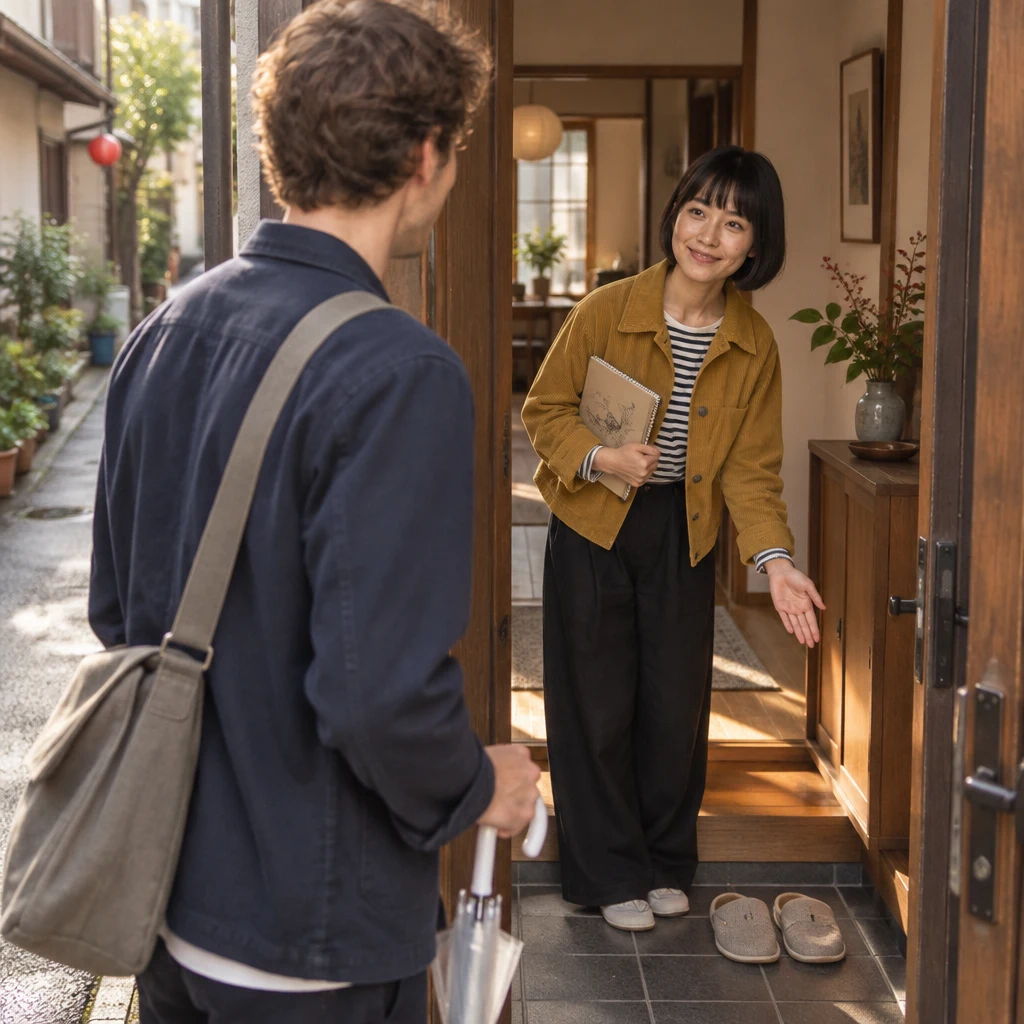
どうぞ上がってください。
Please come in.
When to use it: Use this at the door to invite a guest inside.
上がって is the て-form; ください makes a polite request.
Say it: The small っ in 上がって holds the next sound.

つまらないものですが。
This is just a little something.
When to use it: Offer a small gift as you enter a home.
が here softens the line; you downplay the gift.

これ、持ってきました。
I brought this.
When to use it: Hold out the gift as you say this line.
持ってきました is the て-form plus きました for bringing something.
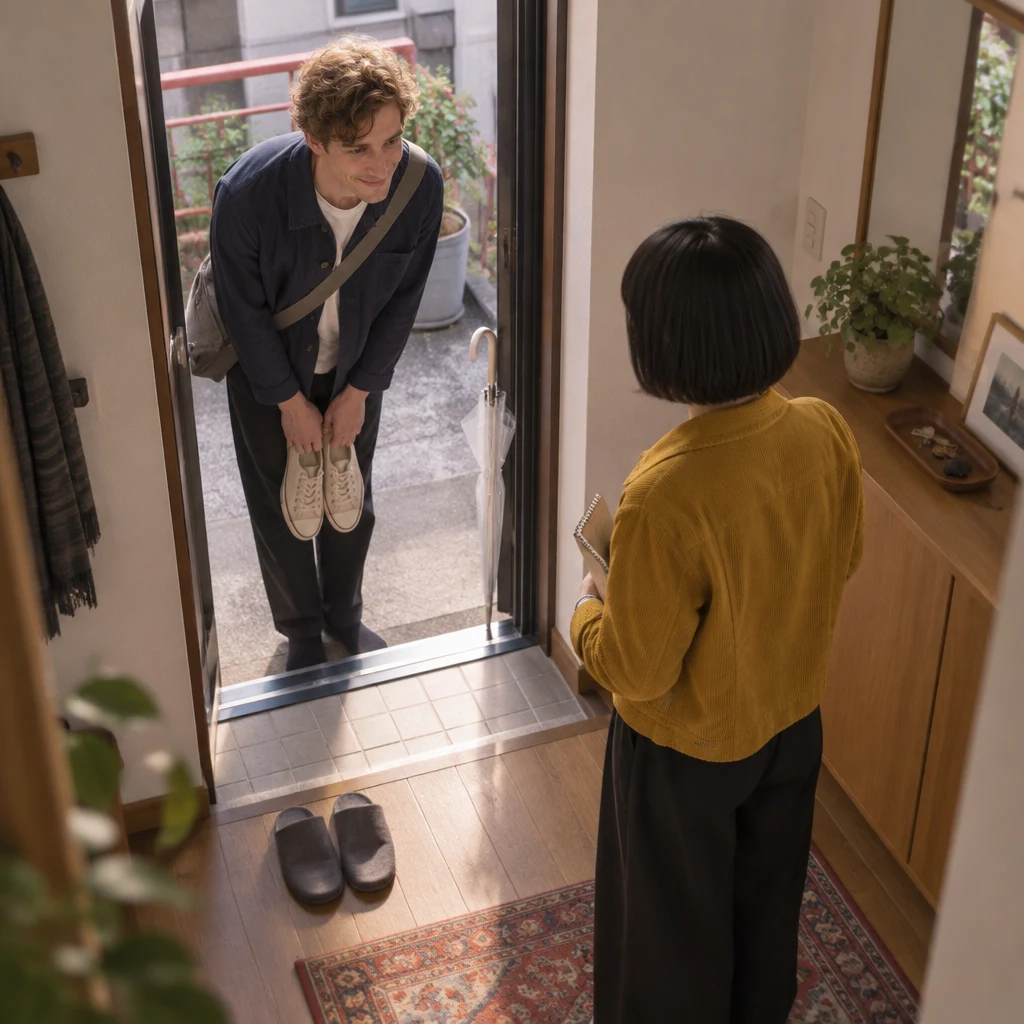
今日はありがとうございました。
Thank you for today.
When to use it: Thank the host as the visit is ending.
は marks 今日 as the topic of your thanks.

お邪魔しました。
Thank you for having me.
When to use it: Say this as you leave someone's home.
しました is past; you say this as you leave.
Story — still in his shoes
Leo stands at Haruka's door with sweets. He says the visiting line before she opens the door, then she invites him in while he is still wearing his shoes.
Highlighted phrases are the new lines. Turn on Show English if you want a gloss.
- Leo stands at the door with a bag of sweets and knocks.
 Leoお邪魔します。Thanks for having me in.
- The door opens. Haruka has a sketchbook under her arm.
 Harukaどうぞ上がってください。Please come in.
- Harukaあ、まだ靴を履いていますね。Ah, you're still in your shoes.
- Leoすみません。Sorry.
- Harukaいいえ、大丈夫です。No, it's fine.
- Leo takes off his sneakers and steps inside.
- Leoつまらないものですが。This is just a little something.
- Leoこれ、持ってきました。I brought this.
- Harukaありがとうございます。Thank you.
- Later, Leo stands at the door with his shoes in his hand.
- Leo今日はありがとうございました。Thank you for today.
- Leoお邪魔しました。Thank you for having me.
- Haruka気をつけてください。Take care.
Practice — pick the right visit
Ten short tasks wait in this round. You will listen, fill a gap, build a line, and pick the right visiting phrase.
Each one is small, so you move on quickly.
0 of 11 done
What did you hear?
What did you hear?
Match the pairs
Japanese
どうぞ上がってください。Drop the English hereつまらないものですが。Drop the English hereお邪魔しました。Drop the English hereEnglish
What do you say?
What do you say?
Haruka opens the door at two in the afternoon. Greet her.
Fill the gap
Fill the gap
This is just a little something.
つまらないものです____。
What does it mean?
What does it mean?
どうぞ上がってください。
Pick the reply
Haruka says:
Pick the reply
どうぞ上がってください。
Please come in.
And you reply with:
Build the line
Build the line
I brought this.
、。
Tap the words in order.
Find the mistake
Find the mistake
Swap the word
Swap the word
This is Leo's first visit to Haruka's home. The visit is ending, and he thanks her for today using the topic marker, not 'also.'
今日____ありがとうございました。
True or false?
True or false?
A guest says this when leaving a friend's home.
What do you say?
What do you say?
Haruka puts out a pair of indoor slippers for you. Thank her.
Say it — your turn to speak
You are Leo at Haruka's door. When the cue is yours, tap the microphone and say the line.
Tap play first if you want to hear it. The recording stays on this device.
- Harukaどうぞ上がってください。Please come in.
- Leo (you)Say this as you step into the genkan.
Say this as you step into the genkan.
お邪魔します。
Thanks for having me in.
0 of 5 said
Recap — what you can say now
| Japanese | English | Play |
|---|---|---|
| お邪魔します。 | Thanks for having me in. | |
| どうぞ上がってください。 | Please come in. | |
| つまらないものですが。 | This is just a little something. | |
| これ、持ってきました。 | I brought this. | |
| 今日はありがとうございました。 | Thank you for today. | |
| お邪魔しました。 | Thank you for having me. |
Save your progress — it’s free
Keep your place in the course and see which lines you’ve learned.
Want the next lesson in your inbox?
Get the next lesson by email, one a day.
Join the newsletterDaily lesson emails are coming soon. Newsletter subscribers get them first.
Keep practicing with Yak Cards
Keep these visiting lines in your pocket. Open the Yak Cards for this lesson and run them on the train.
A short Yak Cards round before a visit keeps the door lines ready.
Open Yak Cards