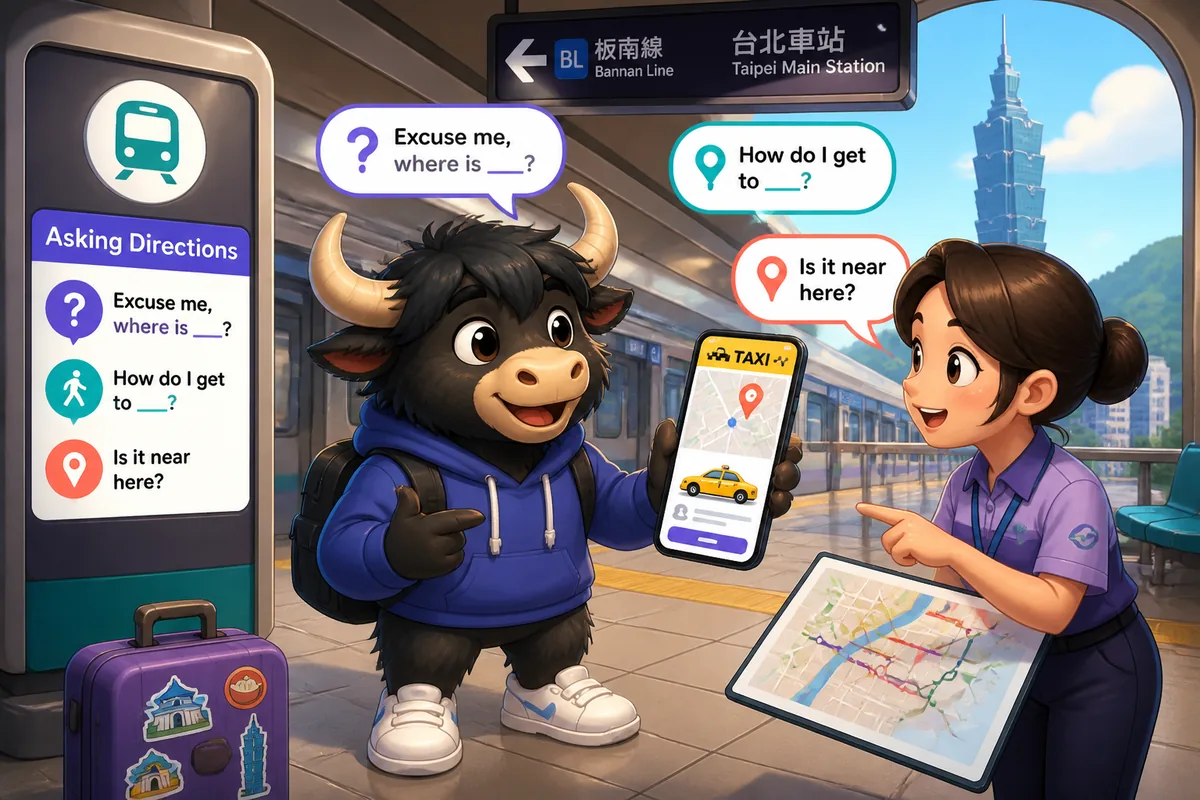
Ready to ask for directions in Japanese? This short lesson gives you polite, everyday phrases you can use on the street or at a station. Listen, repeat, practice, and then try saying them out loud — you'll be giving directions in no time!
Level A1: In this CEFR-aligned lesson you'll learn common phrases for asking and giving directions, like “すみません、___はどこですか。” (Sumimasen, ___ wa doko desu ka.) and simple replies such as まっすぐ行ってください (Massugu itte kudasai). We'll practice asking where something is, how far it is, and short direction sentences (turn left/right, it's on the left/right).
After this lesson you'll be able to:
Ask politely where a place is and how to get there using phrases such as すみません、___はどこですか。
Understand and say short directions: まっすぐ行ってください, 左に曲がってください, 右に曲がってください.
Practice distance questions: ここから近いですか / ここから遠いですか.
Ready? Let's go!
When you tap play on phrases, we track your progress through this lesson.
1. Reading + Listening Practice
Hear core phrases, repeat aloud.
すみません、___はどこですか。
Sumimasen, ___ wa doko desu ka.
Excuse me, where is ___?
Meaning: Excuse me, where is ___?
When to use: Use this to politely ask the location of a specific place. Put the place name in the blank (e.g. 駅, トイレ).
Tip: Beginners sometimes use が instead of は here; use は to mark the topic/place.
すみません、駅はどこですか。
Sumimasen, eki wa doko desu ka.
Excuse me, where is the station?
すみません、トイレはどこですか。
Sumimasen, toire wa doko desu ka.
Excuse me, where is the bathroom?
___へはどう行けばいいですか。
___ e wa dō ikeba ii desu ka.
How do I get to ___?
Meaning: How do I get to ___?
When to use: Ask this to find out the route or steps to reach a destination. Put the destination in the blank.
Tip: Learners may mix へ and に; both work, but へ emphasizes direction. Keep polite form: どう行けばいいですか。
駅へはどう行けばいいですか。
Eki e wa dō ikeba ii desu ka.
How do I get to the station?
美術館へはどう行けばいいですか。
Bijutsukan e wa dō ikeba ii desu ka.
How do I get to the art museum?
ここから近いですか。
Koko kara chikai desu ka.
Is it near here?
Meaning: Is it near here?
When to use: Ask when you want to know if a place is close to your current location.
このカフェはここから近いですか。
Kono kafe wa koko kara chikai desu ka.
Is this café near here?
駅はここから近いですか。
Eki wa koko kara chikai desu ka.
Is the station near here?
ここから遠いですか。
Koko kara tōi desu ka.
Is it far from here?
Meaning: Is it far from here?
When to use: Use to ask whether a place is a long distance from where you are now.
スーパーはここから遠いですか。
Sūpā wa koko kara tōi desu ka.
Is the supermarket far from here?
病院はここから遠いですか。
Byōin wa koko kara tōi desu ka.
Is the hospital far from here?
まっすぐ行ってください。
Massugu itte kudasai.
Go straight.
Meaning: Go straight.
When to use: Give a simple instruction to continue forward along a street or path. Polite command.
まっすぐ行ってください。そして右に曲がってください。
Massugu itte kudasai. Soshite migi ni magatte kudasai.
Go straight. Then turn right, please.
まっすぐ行ってください。駅が見えます。
Massugu itte kudasai. Eki ga miemasu.
Go straight, please. You will see the station.
左に曲がってください。
Hidari ni magatte kudasai.
Turn left.
Meaning: Turn left.
When to use: Use this to tell someone to make a left turn while giving directions.
二つ目の角で左に曲がってください。
Futatsu-me no kado de hidari ni magatte kudasai.
Turn left at the second corner, please.
橋の手前で左に曲がってください。
Hashi no temae de hidari ni magatte kudasai.
Turn left before the bridge, please.
右に曲がってください。
Migi ni magatte kudasai.
Turn right.
Meaning: Turn right.
When to use: Use this to tell someone to turn right when describing a route.
交差点で右に曲がってください。
Kōsaten de migi ni magatte kudasai.
Turn right at the intersection, please.
次の角を右に曲がってください。そこにあります。
Tsugi no kado o migi ni magatte kudasai. Soko ni arimasu.
Turn right at the next corner. It's there.
左にあります
Hidari ni arimasu.
It's on the left.
Meaning: It's on the left.
When to use: Say this when indicating a building or place is located on the left side.
郵便局は左にあります。
Yūbinkyoku wa hidari ni arimasu.
The post office is on the left.
銀行は信号を過ぎたら左にあります。
Ginkō wa shingō o sugita ra hidari ni arimasu.
The bank is on the left after the traffic light.
右にあります
Migi ni arimasu.
It's on the right.
Meaning: It's on the right.
When to use: Use to tell someone that the place is on the right side of the street.
コンビニは右にあります。
Konbini wa migi ni arimasu.
The convenience store is on the right.
図書館は角を曲がって右にあります。
Toshokan wa kado o magatte migi ni arimasu.
The library is on the right after turning the corner.
___への行き方を教えてください。
___ e no ikikata o oshiete kudasai
Can you tell me the way to ___?
Meaning: Can you tell me the way to ___?
When to use: A polite request for directions. Put the place name before への (e.g. 駅への行き方を教えてください).
Tip: Beginners sometimes forget the の after へ (use への for 'the way to ___').
駅への行き方を教えてください。
Eki e no ikikata o oshiete kudasai.
Please tell me the way to the station.
学校への行き方を教えてください。
Gakkō e no ikikata o oshiete kudasai.
Please tell me how to get to the school.
___へはこの道でいいですか。
___ e wa kono michi de ii desu ka
Is this the way to ___?
Meaning: Is this the way to ___?
When to use: Use when you want to confirm if the current path/road leads to a destination (put destination before へは).
駅へはこの道でいいですか。
Eki e wa kono michi de ii desu ka.
Is this the way to the station?
公園へはこの道でいいですか。
Kōen e wa kono michi de ii desu ka.
Is this the way to the park?
___はどちらですか。
___ wa dochira desu ka
Which way is ___?
Meaning: Which way is ___?
When to use: Ask someone to point or indicate the direction of a place. どちら is a polite word for 'which way/where'.
駅はどちらですか。
Eki wa dochira desu ka.
Which way is the station?
トイレはどちらですか。
Toire wa dochira desu ka.
Which way is the bathroom?
まっすぐ行きますか。
massugu ikimasu ka
Do I go straight?
Meaning: Do I go straight?
When to use: Ask if you should continue straight (short confirmation). For asking for advice you can also use まっすぐ行けばいいですか。
まっすぐ行きますか。それとも右に曲がりますか。
Massugu ikimasu ka. Soretomo migi ni magarimasu ka.
Do I go straight? Or turn right?
この道をまっすぐ行きますか。
Kono michi o massugu ikimasu ka.
Do I go straight on this road?
2. Conversational Listening Practice
Hear phrases in a real mini-conversation.
Asking for the station
Anna
すみません、駅はどこですか。
Sumimasen, eki wa doko desu ka.
Excuse me, where is the station?
David
まっすぐ行ってください。三つ目の角を左に曲がってください。
Massugu itte kudasai. Mittsu-me no kado o hidari ni magatte kudasai.
Go straight, please. Turn left at the third corner, please.
Anna
ここから近いですか。
Koko kara chikai desu ka.
Is it near here?
David
はい、すぐ左にあります。
Hai, sugu hidari ni arimasu.
Yes, it's just on the left.
3. Guided Practice
Quizzes and matching to lock in meaning.
Which Japanese sentence asks 'How do I get to the museum?'
Which phrase tells someone to 'turn right' politely?
Which sentence means 'Is this the way to the station?'
Which phrase asks 'Do I go straight?'
I want to go to the station. Should I go straight to get to the station?
駅に行きたいです。駅へは___行けばいいですか。
Eki ni ikitai desu. Eki e wa ___ ikeba ii desu ka.
Excuse me, where is the bathroom? — Turn left at that corner. It's right there.
すみません、トイレはどこですか。— あの角を___ください。すぐあります。
Sumimasen, toire wa doko desu ka. — Ano kado o ___ kudasai. Sugu arimasu.
Is this road OK? — Yes, this road is fine.
この道でいいですか? — はい、この道で___。
Kono michi de ii desu ka? — Hai, kono michi de ___.
Match the core phrases
Match the extra phrases
4. Speaking Practice
Say phrases yourself (mic/recording).
Recording stays on your device only. Check speech uses your browser's speech tools when available.