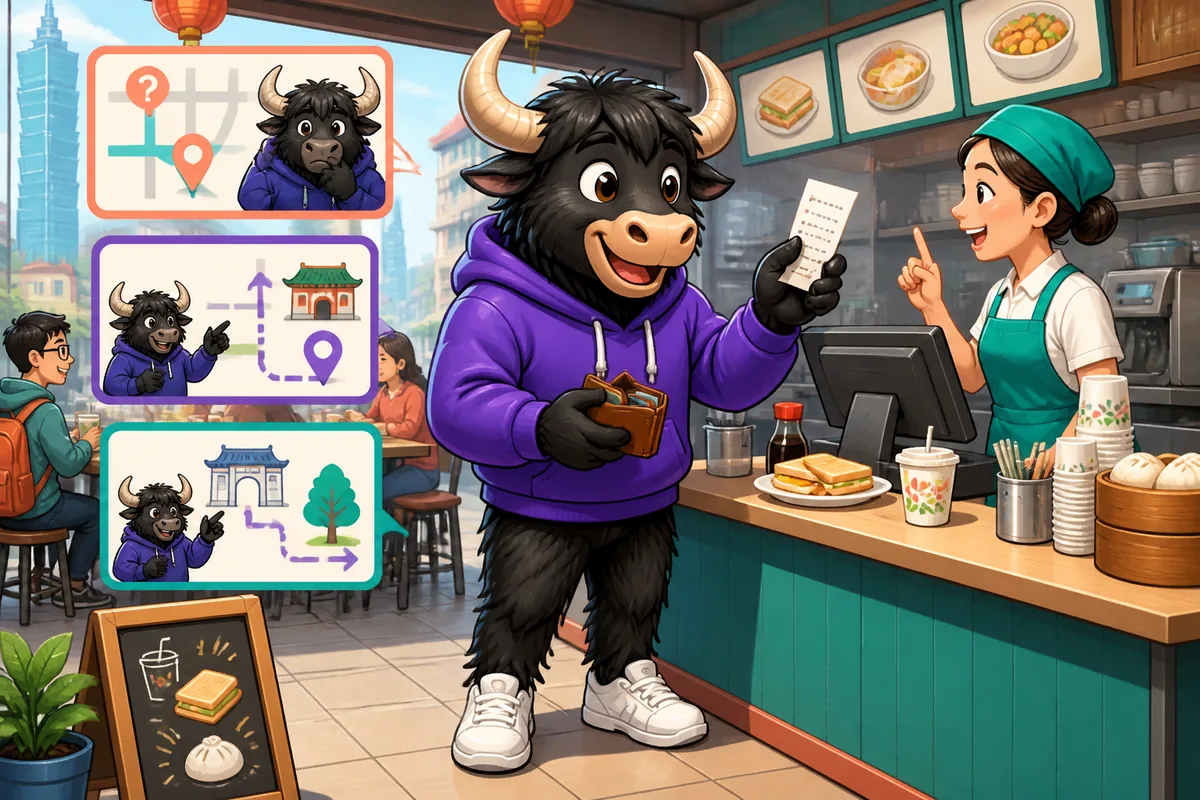
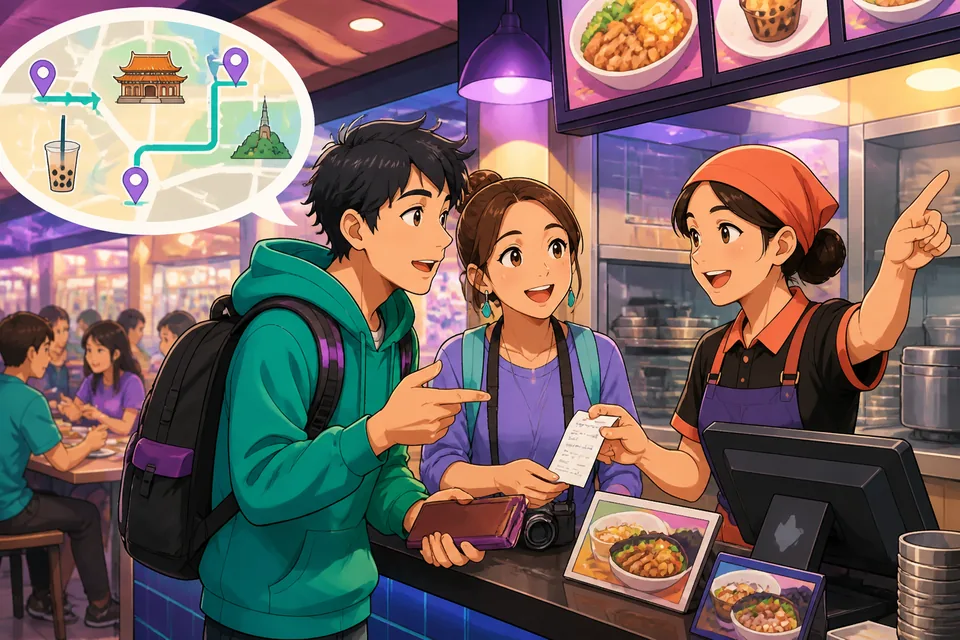
Ready to find your way? This short lesson gives you polite, useful phrases for asking and giving directions in Japanese. Practice aloud and imagine you're on a friendly street in town.
Level A1: In this lesson you'll learn key directions phrases like 「___で曲がりますか?」 (___ de magarimasu ka?) and 「___まで行ってください。」 (___ made itte kudasai.). We'll practice asking where to turn, telling someone to go to a point, cross a street, and saying locations like “in front of” or “across from.” This CEFR-aligned mini-lesson is practical and repeatable — quick Yak Yacker-approved directions practice!
After this lesson you'll be able to:
Recognize and say polite direction phrases such as 「___で曲がりますか?」 (___ de magarimasu ka?) and 「___まで行ってください。」 (___ made itte kudasai.).
Give simple instructions: pass (通り過ぎてください tōrisugite kudasai), cross (渡ってください watatte kudasai), and take the first turn (1つ目の___を曲がってください Hitotsume no ___ o magatte kudasai).
Use short location phrases: 「___の前です。」 (___ no mae desu.), 「___の向かいです。」 (___ no mukai desu.), and 「___と___の間です。」 (___ to ___ no aida desu.).
Ready? Let's go!
When you tap play on phrases, we track your progress through this lesson.
1. Reading + Listening Practice
Hear core phrases, repeat aloud.
___で曲がりますか?
___ de magarimasu ka?
Do I turn at ___?
Meaning: Do I turn at ___?
When to use: Use this question to check whether you should turn at a specific place like a corner (角 kado), intersection, or landmark.
この角で曲がりますか?
Kono kado de magarimasu ka?
Do I turn at this corner?
次の交差点で曲がりますか?
Tsugi no kōsaten de magarimasu ka?
Do I turn at the next intersection?
___まで行ってください。
___ made itte kudasai.
Go to ___.
Meaning: Go to ___.
When to use: Use this to tell someone to continue to a particular point or destination (駅まで, 銀行まで, etc.).
駅まで行ってください。
Eki made itte kudasai.
Please go to the station.
交番まで行ってください。
Kōban made itte kudasai.
Please go to the police box.
___を通り過ぎてください。
___ o tōrisugite kudasai.
Go past ___.
Meaning: Go past ___.
When to use: Use this to tell someone to pass a place on the way, like a shop, bridge, or landmark (コンビニを通り過ぎてください).
Tip: Beginners sometimes say 通ります instead of 通り過ぎて — remember 通り過ぎて means to go past something.
コンビニを通り過ぎてください。
Konbini o tōrisugite kudasai.
Please go past the convenience store.
大きい橋を通り過ぎてください。
Ōkii hashi o tōrisugite kudasai.
Please go past the big bridge.
___を渡ってください。
___ o watatte kudasai.
Cross ___.
Meaning: Cross ___.
When to use: Use this to instruct someone to cross a street, crosswalk, or bridge (横断歩道を渡ってください).
Tip: Don't use で here; crossing takes を (the direct object) not で.
横断歩道を渡ってください。
Ōdan hodō o watatte kudasai.
Please cross the crosswalk.
橋を渡ってください。
Hashi o watatte kudasai.
Please cross the bridge.
___の向かいです。
___ no mukai desu.
It's across from ___.
Meaning: It's across from ___.
When to use: Use this to point out a location directly opposite another place, often across a street (郵便局の向かいです).
郵便局の向かいです。
Yūbinkyoku no mukai desu.
It's across from the post office.
公園の向かいです。
Kōen no mukai desu.
It's across from the park.
___と___の間です。
___ to ___ no aida desu.
It's between ___ and ___.
Meaning: It's between ___ and ___.
When to use: Use AとBの間 to describe a place located between two landmarks, like stations, shops, or buildings.
駅とバス停の間です。
Eki to basutei no aida desu.
It's between the station and the bus stop.
レストランと薬局の間です。
Resutoran to yakkyoku no aida desu.
It's between the restaurant and the pharmacy.
___の前です。
___ no mae desu.
It's in front of ___.
Meaning: It's in front of ___.
When to use: Use ___の前 when the place is directly in front of another visible landmark (e.g., バス停の前です).
コンビニの前です。
Konbini no mae desu.
It's in front of the convenience store.
学校の前です
Gakkō no mae desu.
It's in front of the school.
___の後ろです。
___ no ushiro desu.
It's behind ___.
Meaning: It's behind ___.
When to use: Use ___の後ろ when the place is located behind a landmark (銀行の後ろです).
銀行の後ろです。
Ginkō no ushiro desu.
It's behind the bank.
スーパーの後ろです。
Sūpā no ushiro desu.
It's behind the supermarket.
1つ目の___を曲がってください。
Hitotsume no ___ o magatte kudasai.
Take the first ___.
Meaning: Take the first ___.
When to use: Use this to direct someone to take the first turn, street, or corner: 1つ目の角を右に曲がってください。
1つ目の角を曲がってください。
Hitotsume no kado o magatte kudasai.
Please take the first corner.
1つ目の道を左に曲がってください。
Hitotsume no michi o hidari ni magatte kudasai.
Take the first street to the left.
2. Conversational Listening Practice
Hear phrases in a real mini-conversation.
Asking for the station near a bank and bus stop
Anna
すみません、駅はどこですか?
Sumimasen, eki wa doko desu ka?
Excuse me, where is the station?
David
このまままっすぐ行って、1つ目の角を右に曲がってください。
Kono mama massugu itte, hitotsume no kado o migi ni magatte kudasai.
Go straight and take the first corner to the right.
Anna
ここで曲がりますか?
Koko de magarimasu ka?
Do I turn here?
David
いいえ、角を渡って、銀行を通り過ぎてください。
Iie, kado o watatte, ginkō o tōrisugite kudasai.
No — cross the corner and go past the bank.
Anna
駅は銀行の向かいですか?
Eki wa ginkō no mukai desu ka?
Is the station across from the bank?
David
はい、銀行の向かいです。
Hai, ginkō no mukai desu.
Yes, it's across from the bank.
3. Guided Practice
Quizzes and matching to lock in meaning.
How do you ask 'Do I turn at this corner?' in Japanese?
Which phrase means 'Go past the convenience store.'?
How do you say 'It's between the post office and the supermarket.'?
Which instruction asks someone to cross the street?
Go straight and take the first traffic light to the right. You'll see the station on the right.
まっすぐ行って、___。駅は右に見えます。
Massugu itte, ___. Eki wa migi ni miemasu.
After you cross the river, turn left at the next corner. The station is right in front.
川を渡ったら、___。駅はその前です。
Kawa o watattara, ___. Eki wa sono mae desu.
A: Where is this shop? B: It's in front of the bus stop.
A: この店はどこですか? B: ___
A: Kono mise wa doko desu ka? B: ___
Match the core phrases
Match the extra phrases
4. Speaking Practice
Say phrases yourself (mic/recording).
Recording stays on your device only. Check speech uses your browser's speech tools when available.