
New here? This is lesson 79 of a free 240-lesson Japanese course.
How good I am in Japanese
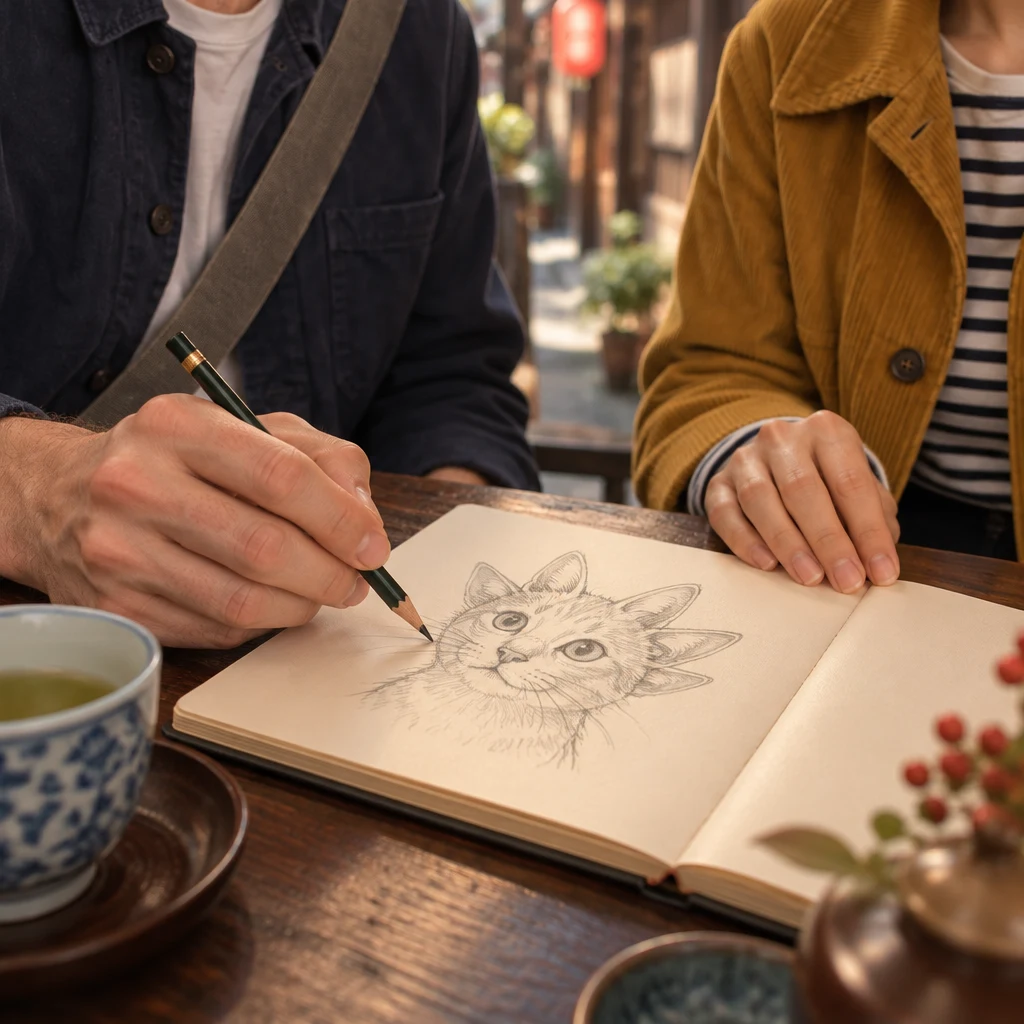
Haruka opens her sketchbook at Kissa Hotaru and slides a pencil toward Leo. The cat on the page looks easy. His cat does not.
She laughs, then tells him her own drawing is fun but still hard. He does not have to be good.
You will say how well you do a hobby, when you do it, and why you like it.
By the end of this lesson
Say how well you do a hobby and why you like it.
- ___はまだ初心者です。I'm still a beginner at ___.
- ___が上手になってきました。I'm getting better at ___.
- 楽しいですけど、難しいです。It's fun, but it's hard.
- 時間があるときにします。I do it when I have time.
- 面白いから、好きです。I like it because it's interesting.
- 上手じゃなくても、楽しいです。It's fun even if I'm not good at it.
Scene — a borrowed pencil
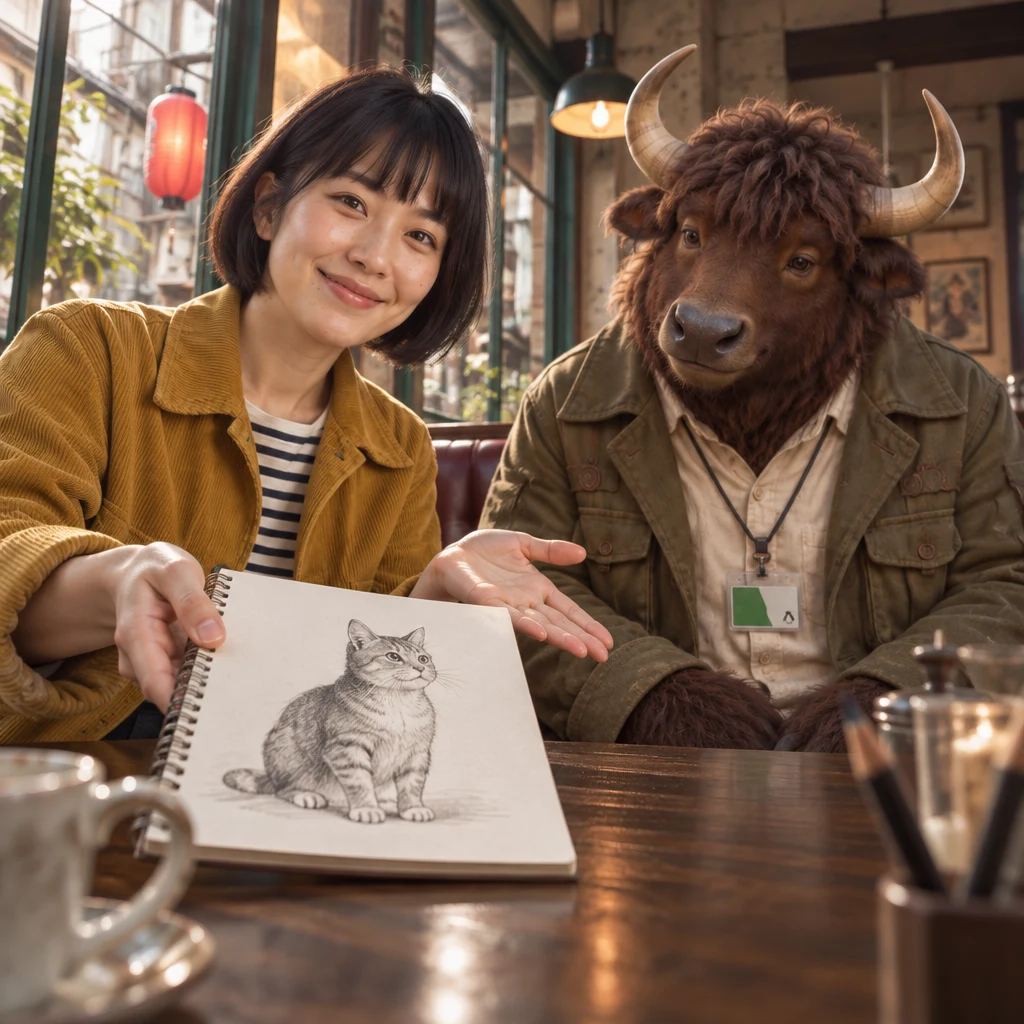
Saturday afternoon at Kissa Hotaru. Haruka's sketchbook is open on the dark wood table, beside a pencil and Leo's tea.
She turns a page to a cat and holds the book toward him. In the corner booth, Goro watches the pencil and ignores his coffee.

Learn — how well you do it
Six lines help you talk about a hobby with modest skill.
You can say you are new, you are improving, or you like it even when it is hard.

___はまだ初心者です。
I'm still a beginner at ___.
When to use it: Use this when you are still new to a hobby.
まだ keeps you in the beginner stage; you have not moved on.
Say it: Give ん in 初心者 its own beat.
___が上手になってきました。
I'm getting better at ___.
When to use it: Use this when a skill has started to improve.
が marks the skill that has been getting better.
Say it: The お sound in 上手 is long; do not clip it.

楽しいですけど、難しいです。
It's fun, but it's hard.
When to use it: Use this when something is fun and also hard.
けど joins two polite facts, with the hard part second.

時間があるときにします。
I do it when I have time.
When to use it: Use this when you do a hobby in free moments.
ときに marks the moment when you do the hobby.

面白いから、好きです。
I like it because it's interesting.
When to use it: Use this to say why you like a hobby.
から here means because, and it gives the reason first.
上手じゃなくても、楽しいです。
It's fun even if I'm not good at it.
When to use it: Use this when skill does not matter for enjoyment.
ても means even if, so skill is not required for fun.
Story — three-eared cat
Haruka lets Leo try a sketch. He is not good at it, and she does not mind.
Highlighted phrases are the new lines. Turn on Show English if you want a gloss.
- Haruka's sketchbook lies open. A pencil rolls toward Leo's tea.
 Leo見せてください。Please show me.
 Haruka少し描いてみますか。Want to try drawing a little?
- Leo絵はまだ初心者です。I'm still a beginner at drawing.
- Harukaがんばってください。Do your best.
- Leo draws a cat. It has three ears.
- Leoすみません。Sorry.
- Harukaいいえ、大丈夫です。No, it's fine.
- Leoええと、こうですか。Um, like this?
- Harukaいいですね。絵を描くのは楽しいですけど、難しいです。That's nice. Drawing is fun, but it's hard.
- Leo時間があるときにします。I do it when I have time.
- Harukaそうですね、上手じゃなくても、楽しいです。Right, it's fun even if you're not good at it.
- Leo面白いから、好きです。I like it because it's interesting.
- Haruka日本語はどうですか。How is your Japanese?
- Leo日本語が上手になってきました。I'm getting better at Japanese.
- Harukaよかったです。That's good.
Practice — pick the right skill line
Eleven short tasks mix listening, gaps, and building a line.
Watch から for because, and ても for even if you are not skilled.
0 of 11 done
What did you hear?
What did you hear?
What do you say?
What do you say?
You have never drawn before. Haruka holds out a pencil and a blank page, and you want to say you are a beginner at drawing.
Match the pairs
Japanese
___はまだ初心者です。Drop the English here楽しいですけど、難しいです。Drop the English here時間があるときにします。Drop the English here面白いから、好きです。Drop the English hereEnglish
Fill the gap
Fill the gap
I like it because it's interesting.
面白い____、好きです。
Pick the reply
Haruka says:
Pick the reply
日本語はどうですか。
How is your Japanese?
And you reply with:
Build the line
Build the line
I do it when I have time.
。
Tap the words in order.
What does it mean?
What does it mean?
上手じゃなくても、楽しいです。
Swap the word
Swap the word
You want to say it is fun even if you are not good.
上手じゃなくても、____です。
What do you say?
What do you say?
Haruka has a new page in her sketchbook. You want to look.
Find the mistake
Find the mistake
True or false?
True or false?
Use this to tell someone to do their best.
Say it — your turn to speak
You are Leo with a pencil in your hand. When the cue is yours, tap the microphone and say the line.
Tap play first if you want to hear it. The recording stays on this device.
- Haruka少し描いてみますか。Want to try drawing a little?
- Leo (you)Tell her you are still a beginner at drawing.
Tell her you are still a beginner at drawing.
___はまだ初心者です。
I'm still a beginner at ___.
0 of 5 said
Recap — what you can say now
| Japanese | English | Play |
|---|---|---|
| ___はまだ初心者です。 | I'm still a beginner at ___. | |
| ___が上手になってきました。 | I'm getting better at ___. | |
| 楽しいですけど、難しいです。 | It's fun, but it's hard. | |
| 時間があるときにします。 | I do it when I have time. | |
| 面白いから、好きです。 | I like it because it's interesting. | |
| 上手じゃなくても、楽しいです。 | It's fun even if I'm not good at it. |
Save your progress — it’s free
Keep your place in the course and see which lines you’ve learned.
Want the next lesson in your inbox?
Get the next lesson by email, one a day.
Join the newsletterDaily lesson emails are coming soon. Newsletter subscribers get them first.
Keep practicing with Yak Cards
Keep these hobby lines in your pocket. Open the Yak Cards for this lesson and run them on the train.
A short Yak Cards round keeps beginner and because ready for the next hobby talk.
Open Yak Cards