Hi — welcome to Lesson 60! A short, friendly practice to help you talk about your daily schedule. Say the phrases out loud and imagine a typical day as you learn.
Level A2: In this lesson you'll practice useful polite frames for daily routines — saying what you usually do and when, what happens before or after events, how long things take, and when you're busy. We'll hear short phrases, try a mini conversation, and do focused practice so these routine patterns feel natural. CEFR-aligned and comfy.
After this lesson you'll be able to:
Describe when you usually do everyday activities using polite Japanese (です/ます).
Ask and answer questions about routine times (e.g., いつも___のは何時ですか).
Say what happens before/after events and how long activities take.
Ready? Let's go!
When you tap play on phrases, we track your progress through this lesson.
1. Reading + Listening Practice
Hear core phrases, repeat aloud.
いつも___のは___です。
Itsumo ___ no wa ___ desu.
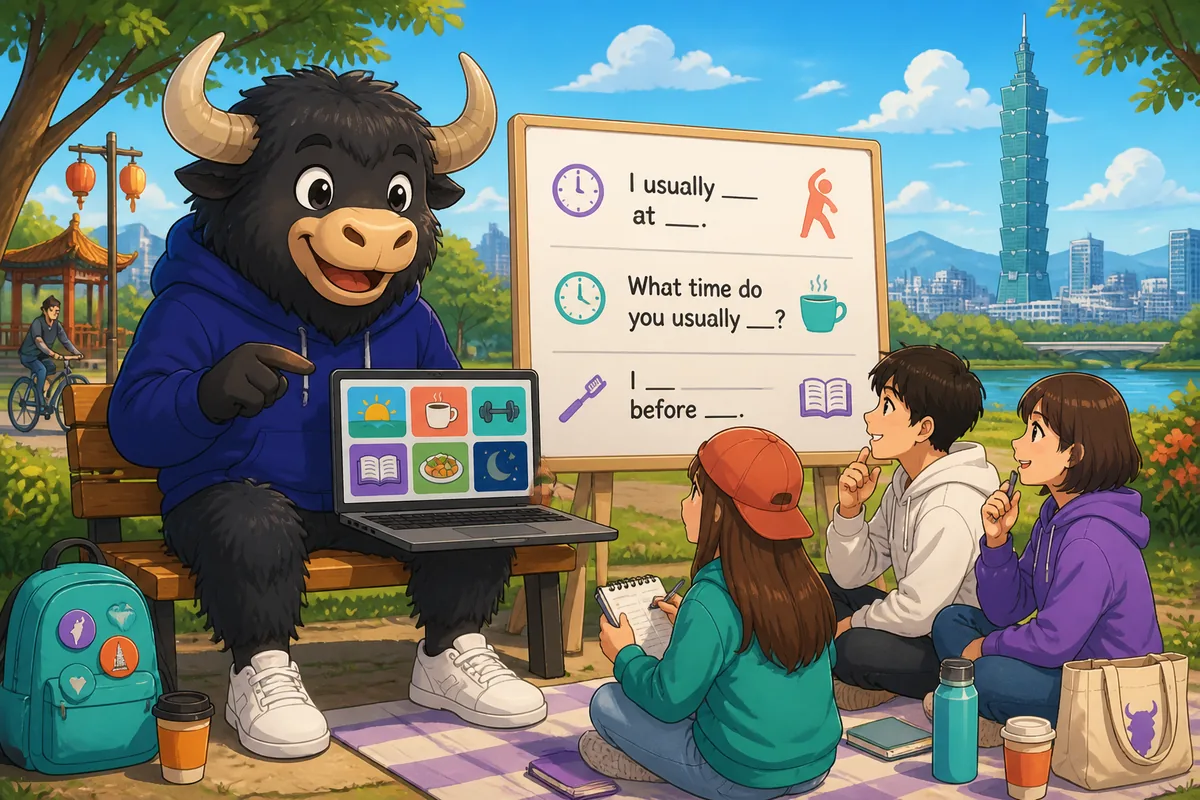
I usually ___ at ___.
Meaning: I usually ___ at ___.
When to use: Use this to state a regular action and the time it happens. The first blank takes a verb phrase in plain form; the second blank is a specific time (with に).
Tip: Don't put the ます-form (e.g., 起きます) in the first blank; use the plain form 起きる instead.
いつも起きるのは7時です。
Itsumo okiru no wa shichi-ji desu.
I usually wake up at 7:00.
いつも朝ごはんを食べるのは8時です。
Itsumo asagohan o taberu no wa hachi-ji desu.
I usually eat breakfast at 8:00.
いつも___のは何時ですか。
Itsumo ___ no wa nanji desu ka.
What time do you usually ___?
Meaning: What time do you usually ___?
When to use: Use this polite question to ask about the usual time for a routine action. Put a verb phrase in plain form in the blank.
いつも寝るのは何時ですか。
Itsumo neru no wa nanji desu ka.
What time do you usually sleep?
いつも仕事を始めるのは何時ですか。
Itsumo shigoto o hajimeru no wa nanji desu ka.
What time do you usually start work?
___のは、___の前です。
___ no wa, ___ no mae desu.
I ___ before ___.
Meaning: I ___ before ___.
When to use: Say this to explain that one routine happens before another event or time. Put a verb phrase (plain form) in the first blank and an event/time in the second blank.
宿題をするのは、夕ご飯の前です。
Shukudai o suru no wa, yūgohan no mae desu.
I do homework before dinner.
着替えるのは、学校に行く前です。
Kigaeru no wa, gakkō ni iku mae desu.
I change clothes before going to school.
___のあとで、いつも___ます。
___ no ato de, itsumo ___masu.
After ___, I usually ___.
Meaning: After ___, I usually ___.
When to use: Use this to say what you do after an event. The first blank can be a noun or a plain-form verb plus の; the second blank is the verb stem before ます.
朝ごはんのあとで、いつも新聞を読みます。
Asagohan no ato de, itsumo shinbun o yomimasu.
After breakfast, I usually read the newspaper.
仕事のあとで、いつもジムに行きます。
Shigoto no ato de, itsumo jimu ni ikimasu.
After work, I usually go to the gym.
___は、たいてい___ます。
___ wa, taitei ___masu.
On ___, I usually ___.
Meaning: On ___, I usually ___.
When to use: Put a day of week or time period in the first blank (e.g., 週末、月曜日の朝), and the verb stem (before ます) in the second blank.
週末は、たいてい友達と会います。
Shūmatsu wa, taitei tomodachi to aimasu.
On weekends, I usually meet friends.
月曜日の朝は、たいてい早く起きます。
Getsuyōbi no asa wa, taitei hayaku okimasu.
On Monday mornings, I usually wake up early.
___から___まで忙しいです。
___ kara ___ made isogashii desu.
I'm busy from ___ to ___.
Meaning: I'm busy from ___ to ___.
When to use: Use から after the start time and まで after the end time to indicate a busy period.
9時から12時まで忙しいです。
Ku-ji kara jū-ni-ji made isogashii desu.
I'm busy from 9:00 to 12:00.
午後は1時から4時まで忙しいです。
Gogo wa ichi-ji kara yo-ji made isogashii desu.
I'm busy from 1:00 to 4:00 in the afternoon.
___のに、___かかります。
___ no ni, ___ kakarimasu.
It takes me ___ to ___.
Meaning: It takes me ___ to ___.
When to use: Use this to describe how long a routine activity takes. Put a plain-form verb phrase in the first blank and a duration (e.g., 30分) in the second blank.
Tip: Beginners sometimes put ます-form in the first blank (e.g., 行きますのに); keep the first part in the plain form (行くのに).
学校へ行くのに、30分かかります。
Gakkō e iku no ni, sanjuppun kakarimasu.
It takes 30 minutes to get to school.
料理を作るのに、1時間かかります。
Ryōri o tsukuru no ni, ichi-jikan kakarimasu.
It takes an hour to cook.
毎日___ようにしています。
Mainichi ___ yō ni shite imasu.
I try to ___ every day.
Meaning: I try to ___ every day.
When to use: Use this to express a daily habit or goal; put a verb phrase in plain form in the blank.
毎日日本語を勉強するようにしています。
Mainichi Nihongo o benkyō suru yō ni shite imasu.
I try to study Japanese every day.
毎日歩くようにしています。
Mainichi aruku yō ni shite imasu.
I try to walk every day.
___は、___にはふだんしません。
___ wa, ___ ni wa fudan shimasen.
I don't usually ___ on ___.
Meaning: I don't usually ___ on ___.
When to use: Use this to say an activity is not part of your usual routine on a specific day. Put the activity in the first blank and a day or time in the second blank.
日曜日は、買い物にはふだん行きません。
Nichiyōbi wa, kaimono ni wa fudan ikimasen.
I don't usually go shopping on Sundays.
平日は、昼寝はふだんしません。
Heijitsu wa, hirune wa fudan shimasen.
On weekdays, I don't usually take naps.
___は、いつも何をしますか。
___ wa, itsumo nani o shimasu ka.
What do you usually do in the ___?
Meaning: What do you usually do in the ___?
When to use: Ask about someone's usual activity during a time period such as 朝、昼、夜、週末. Use は after the time word.
朝は、いつも何をしますか。
Asa wa, itsumo nani o shimasu ka.
What do you usually do in the morning?
週末は、いつも何をしますか。
Shūmatsu wa, itsumo nani o shimasu ka.
What do you usually do on weekends?
アラームは___に鳴ります。
arāmu wa ___ ni narimasu.
My alarm goes off at ___.
Meaning: My alarm goes off at ___.
When to use: Use に after a specific time (e.g., 6時に) when stating when an alarm rings.
アラームは6時に鳴ります。
Arāmu wa roku-ji ni narimasu.
My alarm goes off at 6:00.
アラームは平日だけ7時に鳴ります。
Arāmu wa heijitsu dake shichi-ji ni narimasu.
The alarm rings at 7:00 only on weekdays.
___の準備をします。
___ no junbi o shimasu.
I get ready for ___.
Meaning: I get ready for ___.
When to use: Use の after what you prepare for (e.g., 仕事の準備、学校の準備) to say what you're getting ready for.
仕事の準備をします。
Shigoto no junbi o shimasu.
I get ready for work.
旅行の準備をしています。
Ryokō no junbi o shite imasu.
I'm preparing for a trip.
___ごろ家を出ます。
___ goro ie o demasu.
I leave home at about ___.
Meaning: I leave home at about ___.
When to use: Put a time before ごろ (e.g., 8時ごろ) to say when you leave home.
8時ごろ家を出ます。
Hachi-ji goro ie o demasu.
I leave home at about 8:00.
7時半ごろ家を出ます。
Shichi-ji han goro ie o demasu.
I leave home at about 7:30.
2. Conversational Listening Practice
Hear phrases in a real mini-conversation.
Anna and David meet at a cafe and compare morning routines.
Anna
アラームは何時に鳴りますか。
Arāmu wa nan-ji ni narimasu ka.
What time does your alarm go off?
David
アラームは6時に鳴ります。いつも起きるのは6時半です。
Arāmu wa roku-ji ni narimasu. Itsumo okiru no wa roku-ji han desu.
My alarm goes off at 6:00. I usually wake up at 6:30.
Anna
朝ごはんのあとで、いつも何をしますか。
Asagohan no ato de, itsumo nani o shimasu ka.
After breakfast, what do you usually do?
David
朝ごはんのあとで、いつも新聞を読みます。それから8時ごろ家を出ます。
Asagohan no ato de, itsumo shinbun o yomimasu. Sorekara hachi-ji goro ie o demasu.
After breakfast, I usually read the newspaper. Then I leave home at about 8:00.
3. Guided Practice
Quizzes and matching to lock in meaning.
Which sentence asks 'What time do you usually sleep?'
Which sentence correctly says 'It takes 30 minutes to go to school'?
Which sentence means 'I leave home at about 8:00'?
Which sentence asks 'What do you usually do in the morning?'
Because school starts at 8:30 tomorrow, I will leave home earlier than usual, at about 7:00.
明日は学校が8時半に始まります。遅れないように、いつもより早く、___ごろ家を出ます。
Ashita wa gakkō ga hachi-ji han ni hajimarimasu. Okurenai yō ni, itsumo yori hayaku, ___ goro ie o demasu.
Teacher: What time do you usually sleep? Student: I usually sleep at 11:00.
先生: いつも寝るのは何時ですか。学生: いつも___のは11時です。
Sensei: Itsumo neru no wa nan-ji desu ka. Gakusei: Itsumo ___ no wa jūichi-ji desu.
It takes 30 minutes to go to school. I go by train every morning.
学校へ行くのに、___かかります。毎朝電車で行きます。
Gakkō e iku no ni, ___ kakarimasu. Maiasa densha de ikimasu.
Match the core phrases
Match the extra phrases
4. Speaking Practice
Say phrases yourself (mic/recording).
Recording stays on your device only. Check speech uses your browser's speech tools when available.