
New here? This is lesson 137 of a free 240-lesson Japanese course.
Bad signal in Japanese
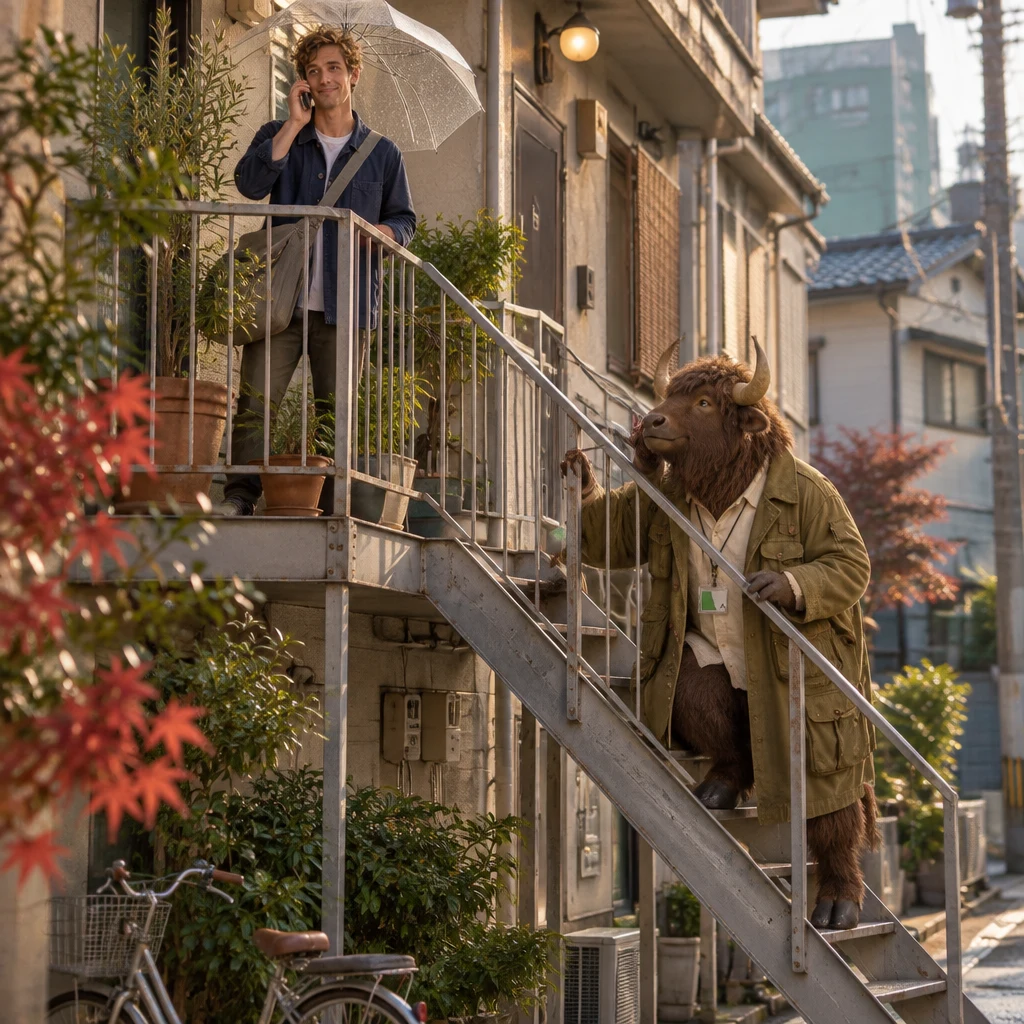
Leo missed Haruka's call on the metal stairs outside his Yanaka room. He rings her back, but the signal breaks, and Goro's Suica cord snags on the rail.
You will ask if someone can hear you, say the signal is bad, and admit you missed a call.
You will also say you got a message, call about Saturday, and promise to call back.
By the end of this lesson
Talk about a missed call, a bad signal, and a message.
- 聞こえますか。Can you hear me?
- 電波が悪いです。The signal is bad.
- 電話に出られませんでした。I missed your call.
- メッセージを受け取りました。I got your message.
- ___の件でお電話しました。I'm calling about ___.
- 後でかけ直します。I'll call you back later.
Scene — the metal stairs
Leo stands on the outside metal staircase of his two-storey building. Plants sit on the landing. He calls Haruka back, phone at his ear, but the line keeps breaking.
Below, Goro climbs the stairs, and the Suica cord on his coat catches the rail.
Learn — a dropped call
These six lines cover a dropped call: hearing, a weak signal, a missed ring, and a message.
You also say you are calling about Saturday and that you will ring back.

聞こえますか。
Can you hear me?
When to use it: Ask this when a call starts to break up.
か at the end makes this a question.

電波が悪いです。
The signal is bad.
When to use it: Use this when a call keeps cutting out.
が marks the signal as the thing that is bad.
Say it: Give ん in 電波 its own beat.

電話に出られませんでした。
I missed your call.
When to use it: Use this after you could not pick up.
に after 電話 marks the call you could not take.

メッセージを受け取りました。
I got your message.
When to use it: Use this when a text or voice note arrived.
を marks the message as the thing you received.
Say it: Hold the small っ in メッセージ.

___の件でお電話しました。
I'm calling about ___.
When to use it: Use this to say what topic is the reason you called.
の件で names the topic of the call.

後でかけ直します。
I'll call you back later.
When to use it: Promise a later call when you cannot talk now.
直します here means you will make the call again.
Story — the cord on the rail
Haruka's first call broke up on the metal stairs. Leo rings her back, but the signal is still weak, and Goro's Suica cord snags on the rail.
Highlighted phrases are the new lines. Turn on Show English if you want a gloss.
- Leo stands on the landing and calls Haruka back.
 Haruka今、電話できますか。Can you talk on the phone now?
 Leoはい、できます。Yes, I can.
- The line crackles on the metal stairs.
- Leo聞こえますか。Can you hear me?
- Harukaよく聞こえません。I can't hear you well.
- Leo電波が悪いです。The signal is bad.
- Goro climbs the stairs. The Suica cord on his coat catches the rail.
 Goroそうなんですね。Oh, I see.
- Leo電話に出られませんでした。I missed your call.
- Harukaメッセージは届きましたか。Did you get the message?
- Leoメッセージを受け取りました。I got your message.
- Harukaありがとうございます。Thank you.
- Leo土曜日の件でお電話しました。I'm calling about Saturday.
- The call starts to drop again.
- Leo後でかけ直します。I'll call you back later.
- Harukaまた連絡します。I'll let you know.
Practice — pick the right line
Ten short tasks wait in this round. You will listen, fill a gap, and build a line.
Each one is small, so you move on quickly.
0 of 10 done
What did you hear?
What did you hear?
What does it mean?
What does it mean?
よく聞こえません。
What do you say?
What do you say?
Haruka says she rang you this morning. Explain that you missed the call.
Fill the gap
Fill the gap
The signal is bad.
電波____悪いです。
Pick the reply
Haruka says:
Pick the reply
今はちょっと忙しいです。
I'm a bit busy right now.
And you reply with:
Build the line
Build the line
I got your message.
。
Tap the words in order.
Swap the word
Swap the word
You got Haruka's message. You did not send one.
メッセージを____。
What do you say?
What do you say?
You phone Haruka to talk about Saturday. Say: Saturday is the reason for your call.
True or false?
True or false?
This asks if someone can talk on the phone now.
What do you say?
What do you say?
The call is breaking up. Close by saying you will be in touch again.
Say it — your turn to speak
You are Leo on that metal staircase. When the cue is yours, tap the microphone and say the line.
Tap play first if you want to hear it. The recording stays on this device.
- Leo (you)Ask if she can hear you.
Ask if she can hear you.
聞こえますか。
Can you hear me?
0 of 6 said
Recap — what you can say now
| Japanese | English | Play |
|---|---|---|
| 聞こえますか。 | Can you hear me? | |
| 電波が悪いです。 | The signal is bad. | |
| 電話に出られませんでした。 | I missed your call. | |
| メッセージを受け取りました。 | I got your message. | |
| ___の件でお電話しました。 | I'm calling about ___. | |
| 後でかけ直します。 | I'll call you back later. |
Save your progress — it’s free
Keep your place in the course and see which lines you’ve learned.
Want the next lesson in your inbox?
Get the next lesson by email, one a day.
Join the newsletterDaily lesson emails are coming soon. Newsletter subscribers get them first.
Keep practicing with Yak Cards
Keep these phone lines in your pocket. Open the Yak Cards for this lesson and run them on the train.
A short Yak Cards round before you commute keeps a dropped call easy to handle.
Open Yak Cards