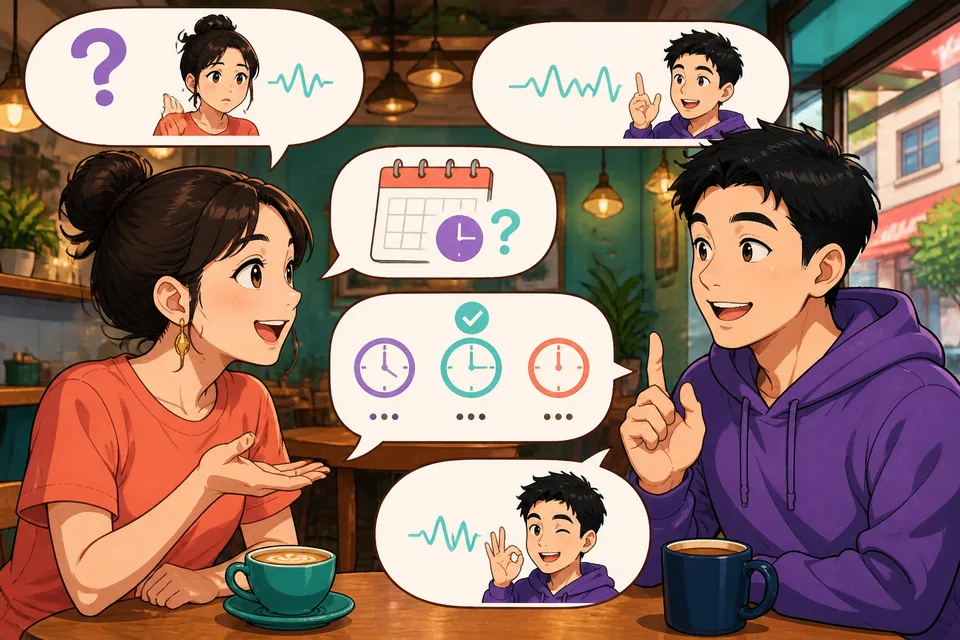
Ready to make sure you really understood someone? This short lesson helps you ask for repeats, rephrasing, and simple confirmations — polite and useful in everyday situations.
Listen, practice, and then say each phrase out loud so it sticks.
Level A1: In this lesson you'll learn polite clarification phrases like 別の言い方で言ってもらえますか。(Betsu no iikata de itte moraemasu ka.) and すみません、よく聞こえません。(Sumimasen, yoku kikoemasen.) — plus short checks like これで合っていますか。(Kore de atte imasu ka.). You'll practice hearing them in a tiny conversation, answering quick quizzes, and saying each phrase aloud. This lesson is CEFR-aligned and focused on practical survival phrases for asking and checking.
After this lesson you'll be able to:
Learn polite ways to ask someone to repeat or rephrase (A1).
Recognize and use confirmation questions like これですか。(Kore desu ka.) and どれですか。(Dore desu ka.).
Practice saying each phrase out loud so you can ask for clarification in real life.
Ready? Let's go!
When you tap play on phrases, we track your progress through this lesson.
1. Reading + Listening Practice
Hear core phrases, repeat aloud.
別の言い方で言ってもらえますか。
Betsu no iikata de itte moraemasu ka.
Can you say it another way?
Meaning: Can you say it another way?
When to use: Use this to ask someone to rephrase a sentence or explain it differently when you didn't understand the first wording.
Tip: Sometimes learners use もう一度言ってください for rephrasing; that asks only to repeat, not to change wording.
すみません、別の言い方で言ってもらえますか。
Sumimasen, Betsu no iikata de itte moraemasu ka.
Excuse me, can you say that another way?
専門用語が多いです。別の言い方で言ってもらえますか。
Senmon yōgo ga ōi desu. Betsu no iikata de itte moraemasu ka.
There are many technical words. Can you say it another way?
どれですか
Dore desu ka.
Which one?
Meaning: Which one?
When to use: Use when choosing from visible options or things already mentioned — point and ask which item is meant.
この色の靴はどれですか。
Kono iro no kutsu wa dore desu ka.
Which of these shoes is that color?
メニューの写真を指して: どれですか。
Menyū no shashin o sashite: Dore desu ka.
Pointing at the menu photo: Which one is it?
こうですか
Kō desu ka.
Like this?
Meaning: Like this?
When to use: Show an action, shape, or example and ask if it matches what the other person wanted or meant.
Tip: Beginners sometimes overuse これですか。 which asks about an object rather than an action or way of doing something.
こうですか。 (指で形を示して)
Kō desu ka. (Yubi de katachi o shimeshite)
Like this? (showing the shape with your finger)
書き方を変えて: こうですか。
Kaki-kata o kaete: Kō desu ka.
I changed the writing—like this?
これで合っていますか。
Kore de atte imasu ka.
Is this correct?
Meaning: Is this correct?
When to use: Use to check an answer, method, or chosen item — when you are showing or referring to a specific thing.
テストの答えを見せて: これで合っていますか。
Tesuto no kotae o misete: Kore de atte imasu ka.
Showing test answers: Is this correct?
住所を確認して: この住所で合っていますか。
Jūsho o kakunin shite: Kono jūsho de atte imasu ka.
Checking an address: Is this address correct?
この言葉は何ですか。
Kono kotoba wa nan desu ka.
What is this word?
Meaning: What is this word?
When to use: Point to or show a written word (in a book, app, or sign) when you don’t know its meaning and want to ask someone.
この言葉は何ですか。 (辞書を指して)
Kono kotoba wa nan desu ka. (Jisho o sashite)
What is this word? (pointing at the dictionary)
テキストの単語を指して: この言葉は何ですか。
Tekisuto no tango o sashite: Kono kotoba wa nan desu ka.
Pointing at a word in the text: What is this word?
すみません、よく聞こえません。
Sumimasen, yoku kikoemasen.
I can't hear you.
Meaning: I can’t hear you clearly.
When to use: Say this when speech is too quiet or noisy and you need the speaker to repeat or speak louder.
Tip: Don't use もう一度 alone — pair it with a request (e.g., もう一度言ってください) to ask for repetition.