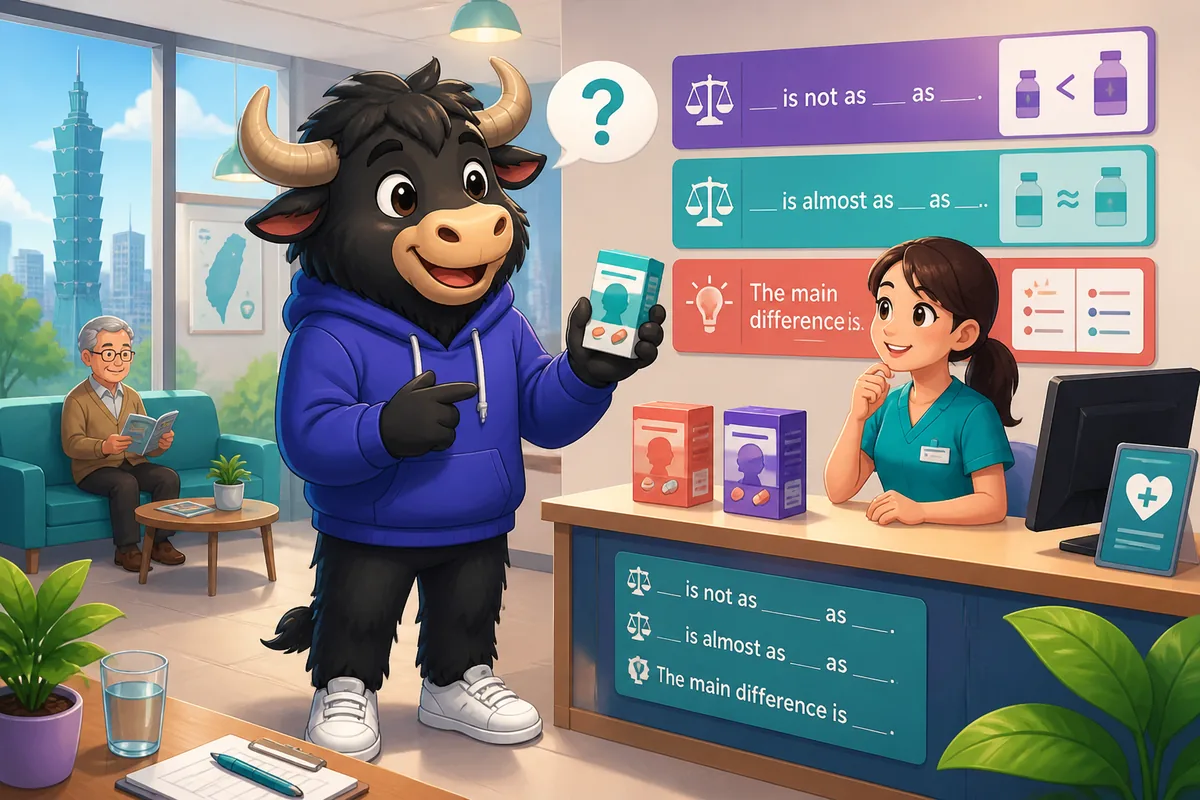
Welcome to Lesson 43 — let’s make comparisons simple and useful. In this short lesson you'll hear model phrases, practice them in context, and say them out loud.
Level B1: In this lesson you'll practice polite comparison phrases to say one thing is not as ... as another, almost the same, time comparisons, preferences, and balancing pros and cons. We'll use natural conversation (phones and apps) and guided exercises to help you say things like 「どちらのほうが…ですか。」 and 「主な違いは…です。」 (CEFR-aligned).
After this lesson you'll be able to:
Use polite comparison frames to say something is not as ... as another and to say things are almost the same.
Ask and answer which option is more (どちらのほうが…ですか。) and state a preference with a reason.
Describe shared features (共通点) and the main difference (主な違いは…).
Practice time comparisons (…は…より時間がかかります。) and balance pros and cons with 一方で…その一方で…
Ready? Let's go!
When you tap play on phrases, we track your progress through this lesson.
1. Reading + Listening Practice
Hear core phrases, repeat aloud.
___は___の点では、___ほどではありません。
___ wa ___ no ten de wa, ___ hodo de wa arimasen.
___ is not as ___ as ___.
Meaning: ___ is not as ___ as ___.
When to use: Use this to say that one thing does not reach the same level as another in a specific respect. Put a noun for the quality (e.g., 速さ, 便利さ, 人気) in the second blank and the comparison target before ほど.
Tip: Beginner mistake: putting an adjective instead of a noun for the quality (use 速さ, 便利さ, 人気など).
この車は価格の点では、あの車ほどではありません。
Kono kuruma wa kakaku no ten de wa, ano kuruma hodo de wa arimasen.
This car, in terms of price, is not as (high) as that car.
新しいモデルはバッテリーの点では、前のモデルほどではありません。
Atarashii moderu wa batterī no ten de wa, mae no moderu hodo de wa arimasen.
The new model, in battery life, is not as (good) as the previous model.
___は___の点で、___とほとんど同じくらいです。
___ wa ___ no ten de, ___ to hotondo onaji kurai desu.
___ is almost as ___ as ___.
Meaning: ___ is almost as ___ as ___.
When to use: Use this to say two things are very close in a given respect. Put a noun for the quality in the second blank (大きさ, 速さ, 便利さ). The comparison target follows と.
A社の新モデルは性能の点で、B社のモデルとほとんど同じくらいです。
A-sha no shin moderu wa seinō no ten de, B-sha no moderu to hotondo onaji kurai desu.
Company A's new model is almost the same as Company B's model in performance.
このアプリは機能の点で、あのアプリとほとんど同じくらいです。
Kono apuri wa kinō no ten de, ano apuri to hotondo onaji kurai desu.
This app is almost the same as that app in features.
主な違いは___です。
Omona chigai wa ___ desu.
The main difference is ___.
Meaning: The main difference is ___.
When to use: Use this to name the key difference between two options. Put a noun phrase or short clause after は.
主な違いは価格です。
Omona chigai wa kakaku desu.
The main difference is the price.
主な違いはバッテリーの持ちです。
Omona chigai wa batterī no mochi desu.
The main difference is battery life.
___も___も___です。
___ mo ___ mo ___ desu.
Both ___ and ___ are ___.
Meaning: Both ___ and ___ are ___.
When to use: Add も after both items to say “both A and B.” The final slot is the shared quality or category.
京都も大阪も観光地です。
Kyōto mo Ōsaka mo kankōchi desu.
Both Kyoto and Osaka are tourist destinations.
この本もその雑誌も面白いです。
Kono hon mo sono zasshi mo omoshiroi desu.
Both this book and that magazine are interesting.
何が必要かによります。
Nani ga hitsuyō ka ni yorimasu.
It depends on what you need.
Meaning: It depends on what you need.
When to use: Use this natural response when the best choice changes depending on purpose or situation.
どちらがいいですか? — 何が必要かによります。
Dochira ga ii desu ka? — Nani ga hitsuyō ka ni yorimasu.
Which is better? — It depends on what you need.
用途によって違います。何が必要かによります。
Yōto ni yotte chigaimasu. Nani ga hitsuyō ka ni yorimasu.
It depends on the use. It depends on what you need.
どちらのほうが___ですか。
Dochira no hō ga ___ desu ka.
Which one is more ___?
Meaning: Which one is more ___?
When to use: Use this to ask a simple comparison between two options. Put an adjective or descriptive noun in the blank. Casual: どっちのほうが___?
どちらのほうが安いですか。
Dochira no hō ga yasui desu ka.
Which one is cheaper?
どちらのほうが使いやすいですか。
Dochira no hō ga tsukaiyasui desu ka.
Which one is easier to use?
___と___はあまり違いがありません。
___ to ___ wa amari chigai ga arimasen.
There isn't much difference between ___ and ___.
Meaning: There isn't much difference between ___ and ___.
When to use: Use と between the two things being compared. Pair with negative あまり + negative to say not much difference.
このレストランとあのレストランはあまり違いがありません。
Kono resutoran to ano resutoran wa amari chigai ga arimasen.
There isn't much difference between this restaurant and that restaurant.
昨日のバージョンと今日のバージョンはあまり違いがありません。
Kinō no bājon to kyō no bājon wa amari chigai ga arimasen.
There's not much difference between yesterday's version and today's version.
___と___は共通点が多いです。
___ to ___ wa kyōtsūten ga ōi desu.
___ and ___ have a lot in common.
Meaning: ___ and ___ have a lot in common.
When to use: Use と to connect the two things. 共通点 means shared points or similarities.
日本と韓国は共通点が多いです。
Nihon to Kankoku wa kyōtsūten ga ōi desu.
Japan and Korea have a lot in common.
このアプリとあのアプリは共通点が多いです。
Kono apuri to ano apuri wa kyōtsūten ga ōi desu.
This app and that app have many similarities.
___は___より時間がかかります。
___ wa ___ yori jikan ga kakarimasu.
___ takes longer than ___.
Meaning: ___ takes longer than ___.
When to use: Put the activity or option that takes longer in the first blank and the comparison target before より in the second blank.
電車は飛行機より時間がかかります。
Densha wa hikōki yori jikan ga kakarimasu.
The train takes longer than the airplane.
手作りは機械より時間がかかります。
Tezukuri wa kikai yori jikan ga kakarimasu.
Handmade takes longer than machine-made.
一方で、___。その一方で、___。
Ippō de, ___. Sono ippō de, ___.
On the one hand, ___; on the other hand, ___.
Meaning: On the one hand, ___; on the other hand, ___.
When to use: Use this to present two contrasting points. Put a full clause after each phrase to show the contrast.
一方で、値段が安いです。その一方で、品質は良くありません。
Ippō de, nedan ga yasui desu. Sono ippō de, hinshitsu wa yoku arimasen.
On the one hand, the price is cheap. On the other hand, the quality is not good.
一方で、速いです。その一方で、燃費が悪いです。
Ippō de, hayai desu. Sono ippō de, nenpi ga warui desu.
On the one hand it's fast. On the other hand, fuel economy is bad.
___のほうが、___より好きです。理由は___です。
___ no hō ga, ___ yori suki desu. Riyū wa ___ desu.
I prefer ___ to ___ because ___.
Meaning: I prefer ___ to ___ because ___.
When to use: Put the preferred option first with のほうが, the compared option after より, and give a simple reason with 理由は…です。
Tip: Watch the order: the preferred item uses のほうが and the other uses より. Reversing them changes the meaning.
コーヒーのほうが、紅茶より好きです。理由は目が覚めるからです。
Kōhī no hō ga, kōcha yori suki desu. Riyū wa me ga sameru kara desu.
I prefer coffee to tea. The reason is it wakes me up.
夏のほうが、冬より好きです。理由は外で遊べるからです。
Natsu no hō ga, fuyu yori suki desu. Riyū wa soto de asoberu kara desu.
I prefer summer to winter because you can play outside.
___は、___より___やすいです。
___ wa, ___ yori ___ yasui desu.
___ is easier to ___ than ___.
Meaning: ___ is easier to ___ than ___.
When to use: Use this to compare two things by saying one is easier for a specific action. Put the comparison target after より and a verb stem (e.g., 使い, 住み, 読み) before やすい.
Tip: Beginner error: put the full verb instead of the verb stem before やすい (use 使い not 使います).
このアプリは、あのアプリより使いやすいです。
Kono apuri wa, ano apuri yori tsukai yasui desu.
This app is easier to use than that app.
この町は、隣の町より住みやすいです。
Kono machi wa, tonari no machi yori sumi yasui desu.
This town is easier to live in than the neighboring town.
2. Conversational Listening Practice
Hear phrases in a real mini-conversation.
Comparing two phones at a café
Anna
どちらのほうが使いやすいですか、iPhoneとこのAndroidと?
Dochira no hō ga tsukaiyasui desu ka, iPhone to kono Andoroido to?
Which one is easier to use, the iPhone or this Android?
David
このAndroidは操作の点で、iPhoneとほとんど同じくらいです。
Kono Andoroido wa sōsa no ten de, iPhone to hotondo onaji kurai desu.
This Android is almost the same as the iPhone in operation.
Omona chigai wa kakaku desu. Nani ga hitsuyō ka ni yorimasu ga, watashi wa kono Andoroido no hō ga, iPhone yori suki desu. Riyū wa batterī ga nagai kara desu.
The main difference is price. It depends on what you need, but I prefer this Android to the iPhone because the battery lasts longer.