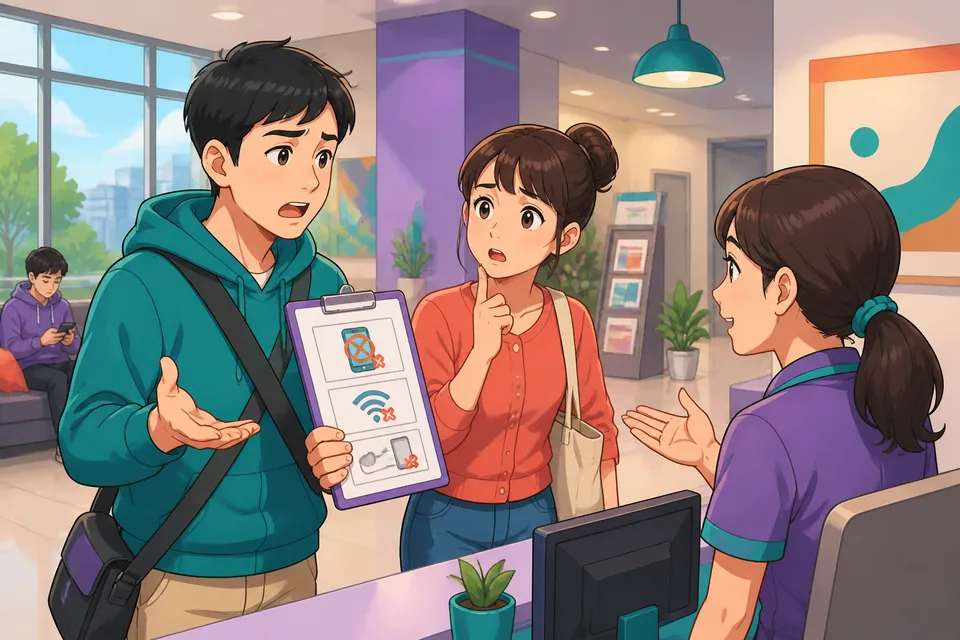
Ready to describe small emergencies and everyday problems? This lesson helps you say what’s wrong so people can help. Keep it calm — clear phrases go a long way.
Level A1: In this short lesson (Lesson 23) you'll learn polite, simple phrases to tell someone there is a problem — from machines that don't work to feeling unwell or being lost. We'll practice hearing and repeating the exact phrases (polite です/ます forms), hear them in a mini-conversation, and do quick quizzes to lock them in. CEFR-aligned and travel-ready.
After this lesson you'll be able to:
Recognize and say common polite problem statements (e.g., 問題があります。Mondai ga arimasu.).
Practice specific trouble phrases: 動きません。, なくしました。, 道に迷いました。, 気分が悪いです。
Be able to state simple missing/unusable objects (___がありません。, ___が使えません。) and ask for help.
Ready? Let's go!
When you tap play on phrases, we track your progress through this lesson.
1. Reading + Listening Practice
Hear core phrases, repeat aloud.
問題があります。
Mondai ga arimasu.
I have a problem.
Meaning: I have a problem.
When to use: To briefly tell someone there is a problem and get attention politely.
すみません、問題があります。
Sumimasen, mondai ga arimasu.
Excuse me, I have a problem.
問題があります。Wi‑Fiがつながりません。
Mondai ga arimasu. Waifai ga tsunagari masen.
I have a problem. The Wi‑Fi won't connect.
何かおかしいです。
Nanika okashii desu.
Something is wrong.
Meaning: Something is wrong.
When to use: Use when you notice something unusual about an object, situation, or how you feel.
この画面、何かおかしいです。
Kono gamen, nanika okashii desu.
Something is wrong with this screen.
料理の味が変です。何かおかしいです。
Ryōri no aji ga hen desu. Nanika okashii desu.
The food tastes odd. Something is wrong.
動きません
Ugokimasen.
It doesn't work.
Meaning: It doesn't work.
When to use: Say this when a machine, app, or device is not functioning.
エレベーターが動きません。
Erebētā ga ugokimasen.
The elevator doesn't work.
プリンターが動きません。印刷できません。
Purintā ga ugokimasen. Insatsu dekimasen.
The printer isn't working. I can't print.
___をなくしました。
___ o nakushimashita.
I lost ___.
Meaning: I lost ___.
When to use: Use to report a lost item. Put the lost item before をなくしました。
Tip: Beginners sometimes forget を after the lost item (e.g., saying '財布なくしました' — include を).
財布をなくしました。
Saifu o nakushimashita.
I lost my wallet.
パスポートをなくしました。助けてください。
Pasupōto o nakushimashita. Tasukete kudasai.
I've lost my passport. Please help.
道に迷いました。
Michi ni mayoimashita.
I'm lost.
Meaning: I'm lost.
When to use: Use when you don't know where you are or how to get to your destination.
すみません、道に迷いました。駅はどこですか?
Sumimasen, michi ni mayoimashita. Eki wa doko desu ka?
Excuse me, I'm lost. Where is the station?
地図を見たけど、道に迷いました。
Chizu o mita kedo, michi ni mayoimashita.
I looked at the map, but I'm lost.
気分が悪いです。
Kibun ga warui desu.
I feel sick.
Meaning: I feel sick.
When to use: Use to tell someone you feel unwell, including nausea or general discomfort.
ちょっと気分が悪いです。休めますか?
Chotto kibun ga warui desu. Yasumemasu ka?
I feel a bit sick. Can I rest?
気分が悪いです。水をください。
Kibun ga warui desu. Mizu o kudasai.
I feel sick. Please give me water.
___がありません。
___ ga arimasen.
There is no ___.
Meaning: There is no ___.
When to use: State that something you need is missing or unavailable; put the missing item before がありません。
Tip: Some learners say 'ありません' without using が for the missing item (remember: ___がありません).
現金がありません。カードで払えますか?
Genkin ga arimasen. Kādo de haraemasu ka?
I have no cash. Can I pay by card?
替えのタオルがありません。
Kae no taoru ga arimasen.
There is no spare towel.
___を開けられません。
___ o akeraremasen.
I can't open ___.
Meaning: I can't open ___.
When to use: Use when you are unable to open something; place the object before を開けられません。
Tip: Beginners might say '開けられない' in casual situations — polite form '開けられません' is safer when asking for help.
このドアを開けられません。鍵が固いです。
Kono doa o akeraremasen. Kagi ga katai desu.
I can't open this door. The lock is stiff.
ボトルのふたを開けられません。手伝ってください。
Botoru no futa o akeraremasen. Tetsudatte kudasai.
I can't open the bottle cap. Please help.
___が使えません。
___ ga tsukaemasen.
I can't use ___.
Meaning: I can't use ___.
When to use: Say this when a service, card, or device is unusable; put the item before が使えません。
Wi‑Fiが使えません。パスワードは合っていますか?
Waifai ga tsukaemasen. Pasuwādo wa atte imasu ka?
I can't use the Wi‑Fi. Is the password correct?
このカードが使えません。別の支払い方法は?
Kono kādo ga tsukaemasen. Betsu no shiharai hōhō wa?
I can't use this card. Is there another payment method?
___が聞こえません。
___ ga kikoemasen.
I can't hear ___.
Meaning: I can't hear ___.
When to use: Use to say you cannot hear a sound, person, or announcement; put the sound or person before が聞こえません。
アナウンスが聞こえません。何と言いましたか?
Anaunsu ga kikoemasen. Nan to iimashita ka?
I can't hear the announcement. What did they say?
先生の声が聞こえません。もっと大きく話してください。
Sensei no koe ga kikoemasen. Motto ōkiku hanashite kudasai.
I can't hear the teacher's voice. Please speak louder.
___が見えません。
___ ga miemasen.
I can't see ___.
Meaning: I can't see ___.
When to use: Use when something isn't visible (a sign, text, or object); put the thing before が見えません。
暗くて標識が見えません。
Kura kute hyōshiki ga miemasen.
It's dark and I can't see the signs.
前の人がいて、画面が見えません。
Mae no hito ga ite, gamen ga miemasen.
Someone is in front of me so I can't see the screen.
___が読めません。
___ ga yomemasen.
I can't read ___.
Meaning: I can't read ___.
When to use: Say this when you cannot read a sign, text, or language; put the text before が読めません。
漢字が読めません。英語の説明はありますか?
Kanji ga yomemasen. Eigo no setsumei wa arimasu ka?
I can't read kanji. Is there an English explanation?
この小さい字が読めません。拡大できますか?
Kono chiisai ji ga yomemasen. Kakudai dekimasu ka?
I can't read this small text. Can you enlarge it?
___が痛いです。
___ ga itai desu.
My ___ hurts.
Meaning: My ___ hurts.
When to use: State that a body part hurts; put the body part before が痛いです。
頭が痛いです。薬はありますか?
Atama ga itai desu. Kusuri wa arimasu ka?
My head hurts. Do you have medicine?
お腹が痛いです。トイレに行きたいです。
Onaka ga itai desu. Toire ni ikitai desu.
My stomach hurts. I need to go to the bathroom.
2. Conversational Listening Practice
Hear phrases in a real mini-conversation.
Anna is at a building lobby asking for help; David is a staff member.
Anna
すみません、問題があります。
Sumimasen, mondai ga arimasu.
Excuse me, I have a problem.
David
どうしましたか?
Dō shimashita ka?
What happened?
Anna
エレベーターが動きません。
Erebētā ga ugokimasen.
The elevator doesn't work.
David
大丈夫ですか?気分はどうですか?
Daijōbu desu ka? Kibun wa dō desu ka?
Are you okay? How do you feel?
Anna
ちょっと気分が悪いです。座りたいです。
Chotto kibun ga warui desu. Suwaritai desu.
I feel a bit sick. I want to sit down.
David
わかりました。座るところに案内します。救急が必要ですか?
Wakarimashita. Suwaru tokoro ni annai shimasu. Kyūkyū ga hitsuyō desu ka?
Understood. I'll show you a place to sit. Do you need an ambulance?
3. Guided Practice
Quizzes and matching to lock in meaning.
Which Japanese phrase means 'I have a problem.'?
Which phrase would you use if a machine won't run?
How do you say 'I can't use the Wi‑Fi' in Japanese?
If you cannot read a small label, which phrase fits?
Excuse me, I don't have the Wi‑Fi password.
すみません、Wi‑Fiのパスワードが ___。
Sumimasen, waifai no pasuwādo ga ___.
I pressed the button, but the smartphone doesn't work.
ボタンを押したけど、スマホが ___。
Botan o oshitakedo, sumaho ga ___.
Excuse me, please help quickly. My head hurts.
すみません、すぐに助けてください。___が痛いです。
Sumimasen, sugu ni tasukete kudasai. ___ ga itai desu.
Match the core phrases
Match the extra phrases
4. Speaking Practice
Say phrases yourself (mic/recording).
Recording stays on your device only. Check speech uses your browser's speech tools when available.