Welcome! This short lesson gives you ready-to-use classroom phrases for asking permission, explaining problems, and telling the teacher what's going on. Listen, repeat, and try the practice — it's quick and useful.
Level A2: In this lesson (Lesson 127) you'll practice polite classroom phrases you can say to a teacher or classmates — for example, asking to borrow something, saying you missed class, or telling the teacher you can't see the board. CEFR-aligned and focused on real classroom moments so you can speak confidently when you need help.
After this lesson you'll be able to:
Recognize and say seven polite classroom phrases used with teachers and classmates.
Practice when to use each phrase in short classroom conversations.
Gain confidence asking for permission and explaining small problems in class (Level A2).
Ready? Let's go!
When you tap play on phrases, we track your progress through this lesson.
1. Reading + Listening Practice
Hear core phrases, repeat aloud.
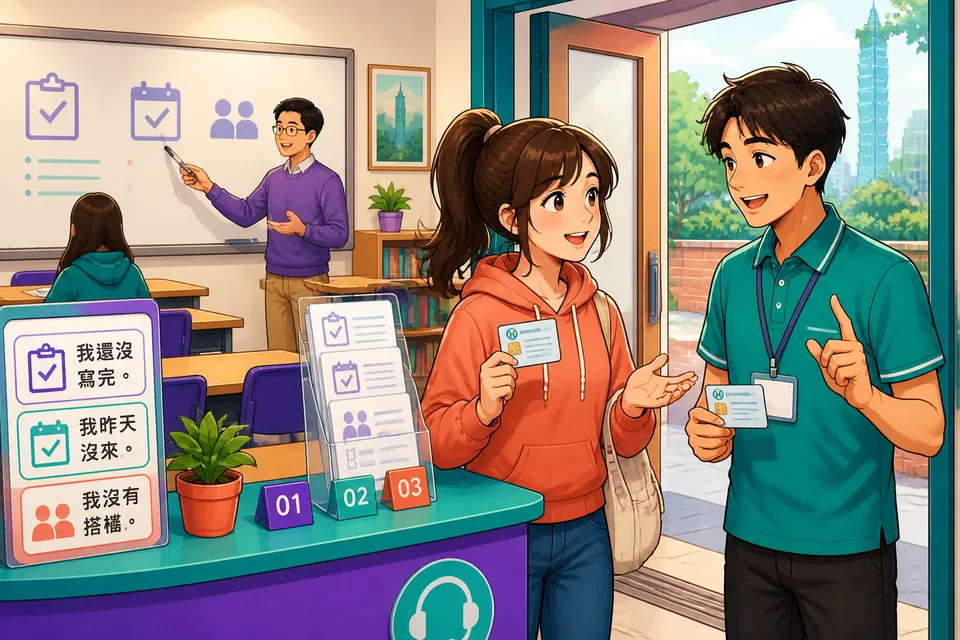
まだ終わっていません。
Mada owatte imasen.
I'm not finished yet.
Meaning: I'm not finished yet.
When to use: Say this politely when you need more time to complete an in-class task or assignment.
先生、すみません。まだ終わっていません。
Sensei, sumimasen. Mada owatte imasen.
Teacher, excuse me. I'm not finished yet.
テストはまだ終わっていません。時間が足りません。
Tesuto wa mada owatte imasen. Jikan ga tarimasen.
I haven't finished the test yet. I don't have enough time.
昨日、授業を休みました。
Kinō, jugyō o yasumimashita.
I was absent yesterday.
Meaning: I was absent yesterday.
When to use: Use this politely to explain to your teacher that you missed the previous class and may need notes or a quick recap.
昨日、授業を休みました。ノートを見せてもらえますか。
Kinō, jugyō o yasumimashita. Nōto o misete moraemasu ka.
I was absent yesterday. Could you show me your notes?
すみません、昨日授業を休みました。補習できますか?
Sumimasen, kinō jugyō o yasumimashita. Hoshū dekimasu ka?
Sorry, I was absent yesterday. Can I have a make-up help session?
ペアがいません。
Pea ga imasen.
I don't have a partner.
Meaning: I don't have a partner.
When to use: Say this politely when the teacher asks you to do pair work and you need someone to join you.
Tip: Don’t say ペアがない — use ペアがいません for polite speech.
すみません、ペアがいません。誰か一緒にできますか?
Sumimasen, pea ga imasen. Dareka issho ni dekimasu ka?
Excuse me, I don't have a partner. Can someone work with me?
今日のグループ活動でペアがいません。
Kyō no gurūpu katsudō de pea ga imasen.
I don't have a partner for today's group activity.
___を借りてもいいですか。
___ o karite mo ii desu ka.
Can I borrow ___?
Meaning: Can I borrow ___?
When to use: Use this polite frame to ask classmates or the teacher to borrow a classroom item (fill the blank with the item).
Tip: Remember to put the item before を (e.g., 鉛筆を).
鉛筆を借りてもいいですか。
Enpitsu o karite mo ii desu ka.
Can I borrow a pencil?
ノートを借りてもいいですか。昨日の授業のノートが必要です。
Nōto o karite mo ii desu ka. Kinō no jugyō no nōto ga hitsuyō desu.
Can I borrow your notebook? I need yesterday's class notes.
黒板が見えません。
Kokuban ga miemasen.
I can't see the board.
Meaning: I can't see the board.
When to use: Tell the teacher politely when the board (blackboard/whiteboard) is hard to see from your seat.
すみません、黒板が見えません。前に行ってもいいですか?
Sumimasen, kokuban ga miemasen. Mae ni itte mo ii desu ka?
Excuse me, I can't see the board. May I move to the front?
窓の光で黒板が見えません。
Mado no hikari de kokuban ga miemasen.
I can't see the board because of the light from the window.
入ってもいいですか。
haitte mo ii desu ka
May I come in?
Meaning: May I come in?
When to use: Use this polite phrase when you need to enter a classroom or a teacher's office, or when late and asking to join the lesson.
遅くなりました。入ってもいいですか。
Osoku narimashita. Haitte mo ii desu ka.
I'm late. May I come in?
掃除の時間ですが、学生が教室に戻っていいか聞きます。入ってもいいですか。
Sōji no jikan desu ga, gakusei ga kyōshitsu ni modotte ii ka kikimasu. Haitte mo ii desu ka.
It's cleaning time, but a student asks if they may return to the classroom. May I come in?
これ、書きますか。
kore, kakimasu ka
Do we need to write this down?
Meaning: Do we need to write this down?
When to use: Ask this in class when the teacher presents something and you’re unsure whether to take notes.
先生、これ、書きますか。重要ですか?
Sensei, kore, kakimasu ka. Jūyō desu ka?
Teacher, do we need to write this down? Is it important?
これ、ノートに書きますか、それとも板書だけですか。
Kore, nōto ni kakimasu ka, soretomo banso dake desu ka.
Do we write this in our notebooks or is it only on the board?
2. Conversational Listening Practice
Hear phrases in a real mini-conversation.
Anna arrives late and speaks with David near the door while the teacher is at the board.
Anna
すみません、入ってもいいですか。
Sumimasen, haitte mo ii desu ka.
Excuse me, may I come in?
David
うん、入って。今、黒板が見えますか?
Un, haitte. Ima, kokuban ga miemasu ka?
Yeah, come in. Can you see the board now?
Anna
黒板が見えません。前に行ってもいいですか。
Kokuban ga miemasen. Mae ni itte mo ii desu ka?
I can't see the board. May I go to the front?
David
どうぞ。昨日、授業を休みましたか?ノートありますよ。
Dōzo. Kinō, jugyō o yasumimashita ka? Nōto arimasu yo.
Sure. Were you absent yesterday? I have notes.
Anna
はい、昨日、授業を休みました。ノートを借りてもいいですか。
Hai, kinō jugyō o yasumimashita. Nōto o karite mo ii desu ka.
Yes, I was absent yesterday. Can I borrow your notes?
David
もちろん。あとでこれ、書きますか?と先生に聞いてみたら?
Mochiron. Ato de kore, kakimasu ka? to sensei ni kiite mitara?
Of course. Later, why not ask the teacher 'Do we need to write this down?'?
3. Guided Practice
Quizzes and matching to lock in meaning.
How do you politely tell the teacher you can't see the board?
Which phrase asks for permission to borrow an item?
You missed yesterday's class. Which phrase do you use to tell the teacher?
Which phrase politely asks if you need to take notes?
I'm late to class. Excuse me, may I come in?
教室に遅れました。すみません、___。
Kyōshitsu ni okuremashita. Sumimasen, ___.
I'm alone for the group work. Teacher, excuse me, I don't have a partner.
グループ作業で一人です。先生、すみません、___。
Gurūpu sagyō de hitori desu. Sensei, sumimasen, ___.
During the test my hand stopped. Excuse me teacher, I'm not finished yet.
テストの途中で手が止まりました。先生、すみません、___。
Tesuto no tochū de te ga tomarimashita. Sensei, sumimasen, ___.
Match the core phrases
Match the extra phrases
4. Speaking Practice
Say phrases yourself (mic/recording).
Recording stays on your device only. Check speech uses your browser's speech tools when available.