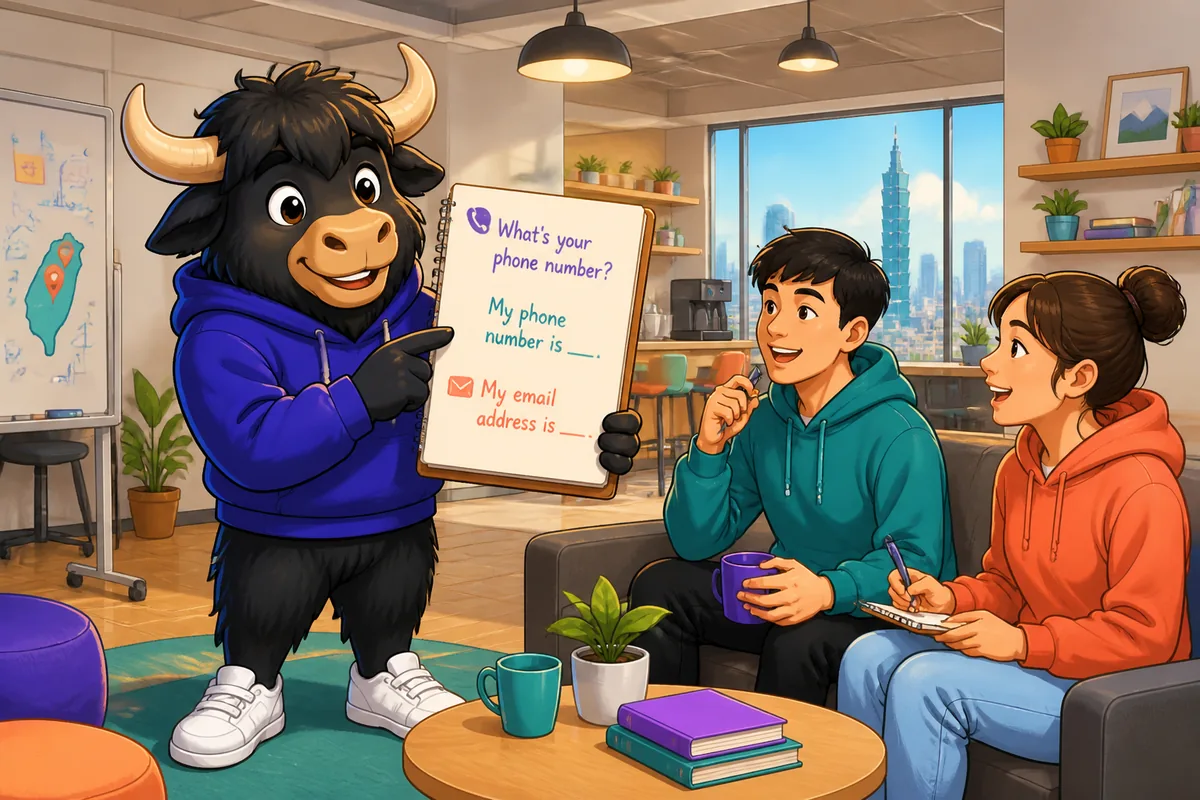
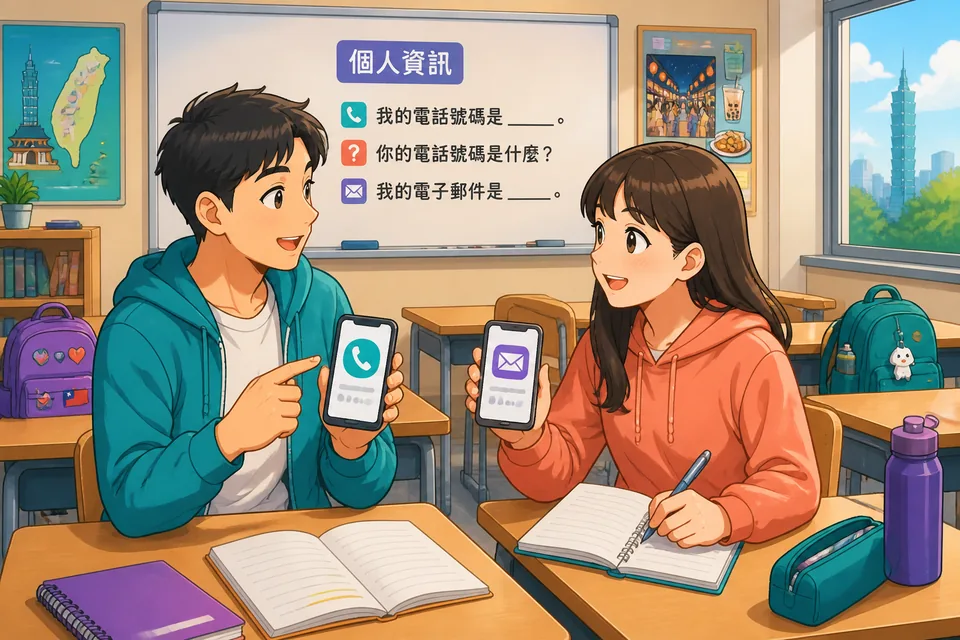
Hi — ready to share the basics? In this short lesson we'll practice giving and asking for contact details and simple identity facts. Listen, repeat, and try the short dialogue.
Level A1: In this lesson you'll practice polite ways to ask for and give phone numbers and email addresses, say your first name, birthday, where you study or work, and your nationality. CEFR-aligned and friendly — perfect for introductions and swapping contact info.
After this lesson you'll be able to:
Ask for and give a phone number and an email address using polite phrases.
Say your first name (下の名前 (shita no namae)), birthday (誕生日 (tanjōbi)), where you study or work, and your nationality.
Be confident using these polite frames in short conversations (Level A1).
Ready? Let's go!
When you tap play on phrases, we track your progress through this lesson.
1. Reading + Listening Practice
Hear core phrases, repeat aloud.
電話番号は___です。
Denwa bangō wa ___ desu.
My phone number is ___.
Meaning: My phone number is ___.
When to use: Use this to give your phone number in conversation. Put the digits where the blank is. It's polite and natural to omit 私の because context shows it is yours.
Tip: Don't repeat 「私の電話番号は…」 every time; short form is natural. Also, say the numbers clearly (with hyphens helps when writing).
電話番号は090-1234-5678です。
Denwa bangō wa 090-1234-5678 desu.
My phone number is 090-1234-5678.
電話番号は080-5555-1212です。
Denwa bangō wa 080-5555-1212 desu.
My phone number is 080-5555-1212.
電話番号を教えてください。
Denwa bangō o oshiete kudasai.
What's your phone number?
Meaning: What's your phone number?
When to use: Ask this when you need someone's phone number in a polite way. For extra politeness you can say 「教えてもらえますか。」
すみません、電話番号を教えてください。
Sumimasen, denwa bangō o oshiete kudasai.
Excuse me, please tell me your phone number.
友だちの電話番号を教えてください。
Tomodachi no denwa bangō o oshiete kudasai.
Please tell me your friend's phone number.
メールアドレスは___です。
Mēru adoresu wa ___ desu.
My email address is ___.
Meaning: My email address is ___.
When to use: Use this to give your email address. In conversation 「メールアドレス」 is more natural than 「Eメールアドレス」.
メールアドレスはtarō@example.comです。
Mēru adoresu wa Tarō@example.com desu.
My email is taro@example.com.
メールアドレスはhana@example.co.jpです。
Mēru adoresu wa Hana@example.co.jp desu.
My email is hana@example.co.jp.
メールアドレスを教えてください。
Mēru adoresu o oshiete kudasai.
What's your email address?
Meaning: What's your email address?
When to use: Ask this politely when you need someone's email for contact or work.
名刺の裏にメールアドレスを教えてください。
Meishi no ura ni mēru adoresu o oshiete kudasai.
Please write your email address on the back of your business card.
新しいクラスメイトにメールアドレスを教えてください。
Atarashii kurasumeito ni mēru adoresu o oshiete kudasai.
Please tell the new classmate your email address.
___で勉強しています。
___ de benkyō shite imasu.
I study at ___.
Meaning: I study at ___.
When to use: Put a school or place name in the blank. Use 「で」 to indicate the place where you study.
大学で勉強しています。
Daigaku de benkyō shite imasu.
I study at university.
日本語学校で勉強しています。
Nihongo gakkō de benkyō shite imasu.
I study at a Japanese language school.
下の名前は___です。
Shita no namae wa ___ desu.
My first name is ___.
Meaning: My first name is ___.
When to use: Give your given/first name in introductions. Put your first name in the blank.
下の名前はケンです。
Shita no namae wa Ken desu.
My first name is Ken.
下の名前はマリアです。
Shita no namae wa Maria desu.
My first name is Maria.
誕生日は___です。
Tanjōbi wa ___ desu.
My birthday is ___.
Meaning: My birthday is ___.
When to use: Put a date in the blank (e.g. 4月10日です). This is a basic personal detail to share when appropriate.
誕生日は6月5日です。
Tanjōbi wa rokugatsu itsuka desu.
My birthday is June 5.
誕生日は11月20日です。
Tanjōbi wa jūichigatsu nijūnichi desu.
My birthday is November 20.
どこで働いていますか。
Doko de hataraite imasu ka.
Where do you work?
Meaning: Where do you work?
When to use: Use this to ask where someone works. Be aware it can sound direct for older people; adjust politeness if needed.
Tip: Asking about work is normal, but be sensitive — some people prefer not to share details.
どこで働いていますか。
Doko de hataraite imasu ka.
Where do you work?
会社で働いています。病院で働いています。
Kaisha de hataraite imasu. Byōin de hataraite imasu.
I work at a company. / I work at a hospital.
国籍は___です。
Kokuseki wa ___ desu.
My nationality is ___.
Meaning: My nationality is ___.
When to use: Put your country or nationality in the blank. In conversation people also say 「___人です」 (___jin desu).
Tip: Nationality can be a sensitive question in some situations; watch context and tone.
国籍はアメリカです。
Kokuseki wa Amerika desu.
My nationality is the United States.
国籍は日本です。
Kokuseki wa Nihon desu.
My nationality is Japan.
2. Conversational Listening Practice
Hear phrases in a real mini-conversation.
At a café, two people exchange contact info and a little about where they study and work.
Anna
すみません、電話番号を教えてください。
Sumimasen, denwa bangō o oshiete kudasai.
Excuse me, please tell me your phone number.
David
はい、電話番号は090-1234-5678です。
Hai, denwa bangō wa 090-1234-5678 desu.
Sure — my phone number is 090-1234-5678.
Anna
メールアドレスも教えてください。
Mēru adoresu mo oshiete kudasai.
Please tell me your email address too.
David
メールアドレスはtarō@example.comです。
Mēru adoresu wa Tarō@example.com desu.
My email is taro@example.com.
Anna
どこで勉強していますか?
Doko de benkyō shite imasu ka?
Where do you study?
David
日本語学校で勉強しています。
Nihongo gakkō de benkyō shite imasu.
I study at a Japanese language school.
3. Guided Practice
Quizzes and matching to lock in meaning.
Which phrase asks for an email address politely?
How do you say 'My birthday is June 5'?
Which sentence asks 'Where do you work?'
How do you give your first name politely?
Yes — My phone number is 090-1234-5678.
すみません、電話番号を教えてください。 — はい、___
Sumimasen, denwa bangō o oshiete kudasai. — Hai, ___
My email address is hana@example.co.jp.
仕事の連絡用に、メールアドレスを教えてください。 — ___
Shigoto no renraku-yō ni, mēru adoresu o oshiete kudasai. — ___
I study at university.
先生:どこで勉強していますか? 学生:___
Sensei: Doko de benkyō shite imasu ka? Gakusei: ___
Match the core phrases
Match the extra phrases
4. Speaking Practice
Say phrases yourself (mic/recording).
Recording stays on your device only. Check speech uses your browser's speech tools when available.