
New here? This is lesson 46 of a free 240-lesson Japanese course.
Metro and transit card in Japanese
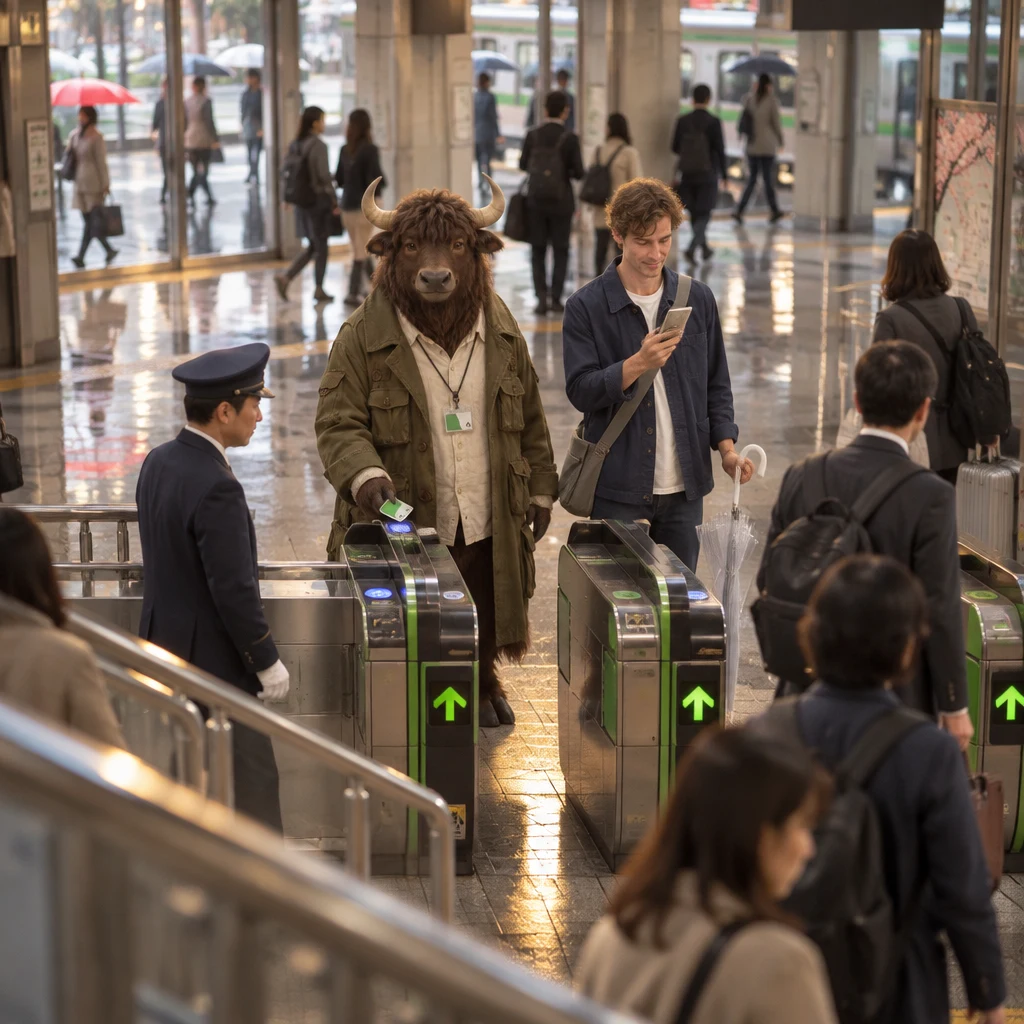
Leo walks to Nippori with Goro. The yak's Suica hangs on a cord, ready for the gate.
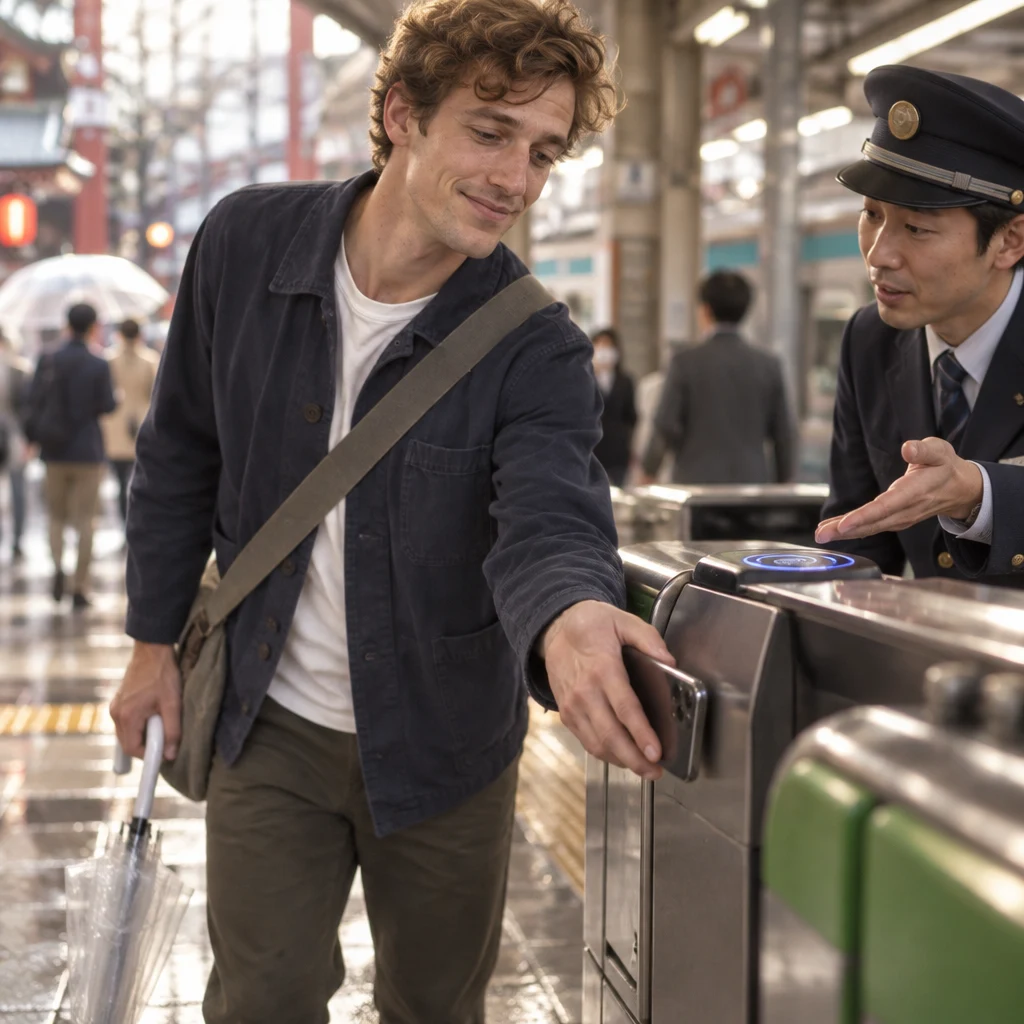
Leo holds his phone and aims at the wrong side of the ticket gate.
You will ask if Suica works, find the gates, and check the platform and exit. You will also ask about transfers and train destinations.
By the end of this lesson
Enter the metro, tap a transit card, and find the platform and exit.
- Suicaで乗れますか。Can I ride with Suica?
- 改札はどこですか。Where are the ticket gates?
- 何番線ですか。Which platform number is it?
- 何番出口ですか。Which exit number is it?
- 乗り換えはありますか。Is there a transfer?
- この電車は___に行きますか。Does this train go to ___?
Scene — the gates at Nippori
Nippori station is busy after the rain. Goro stands at the ticket gates with his Suica on a cord.
Leo holds his phone up, then taps the wrong side of the gate. A staff member waits by the reader.
Yellow lines mark the platform edge. No station names can be read on the signs.
Learn — card, gates, platform
These six lines get you through a Tokyo station: the card, the gates, the platform, and the exit.
You can also ask about a transfer and where a train goes.
Suicaで乗れますか。
Can I ride with Suica?
When to use it: Ask this at the gate before you tap your card.
Learn it as one piece to ask about Suica.
Say it: The u in ます is almost silent.
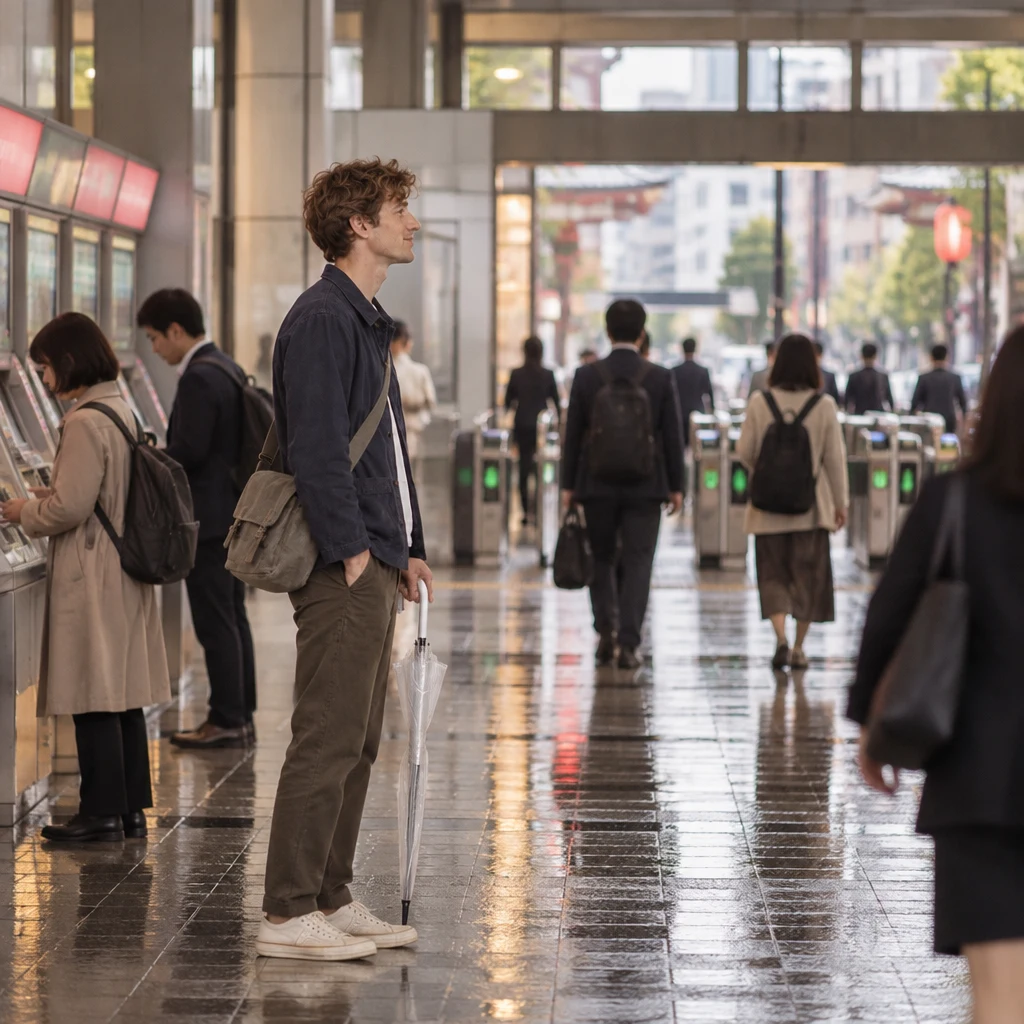
改札はどこですか。
Where are the ticket gates?
When to use it: Ask this when you cannot see the ticket gates.
Learn it as one piece to find the ticket gates.
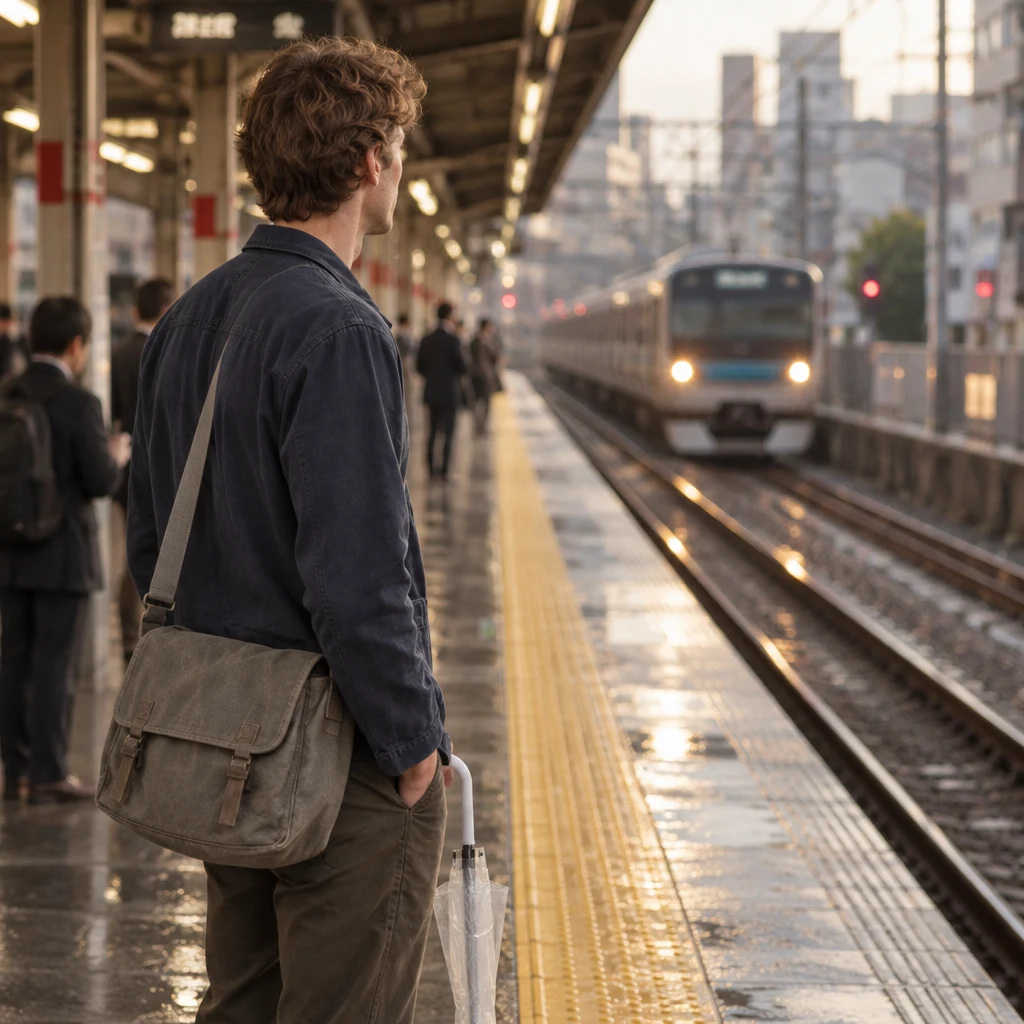
何番線ですか。
Which platform number is it?
When to use it: Ask this to find which platform you need.
Learn it as one piece to ask the platform number.
Say it: Give ん in 番 its own beat.
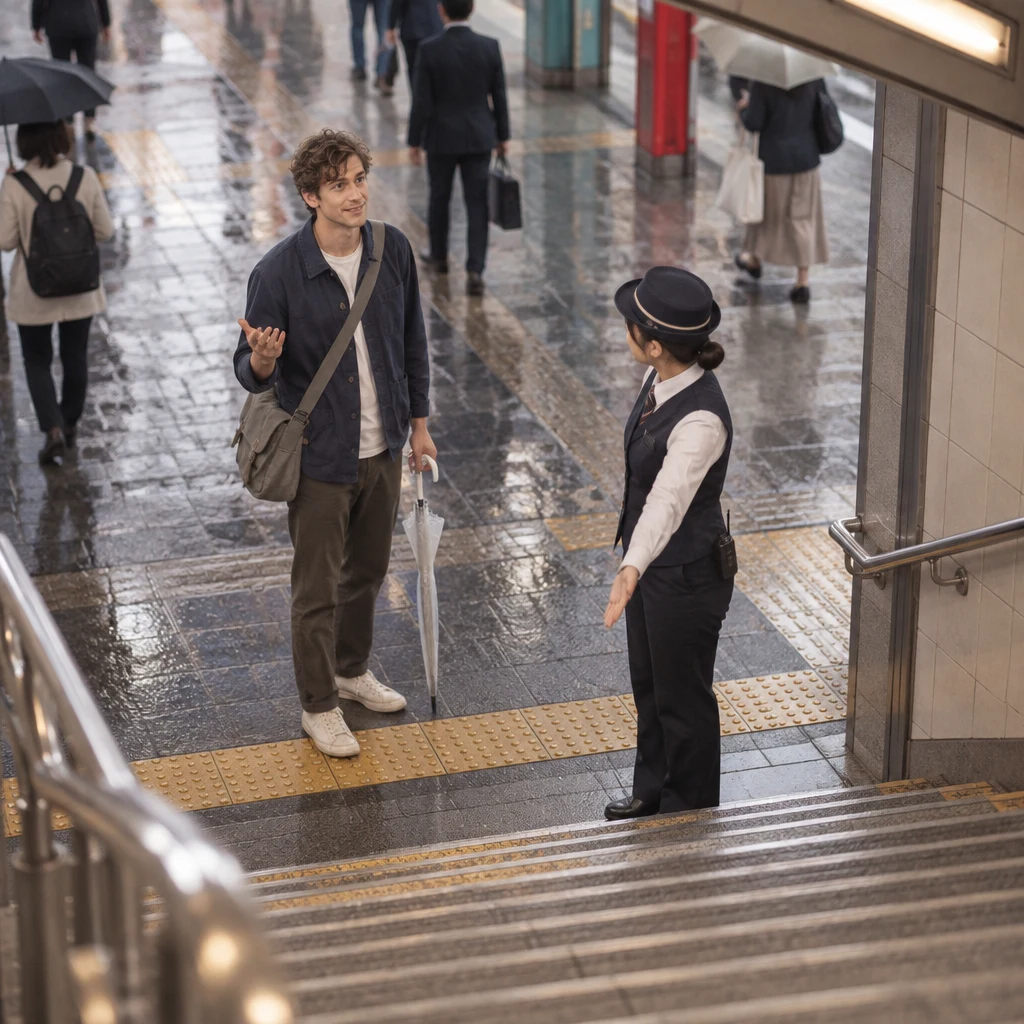
何番出口ですか。
Which exit number is it?
When to use it: Ask this when you need the exit number.
Learn it as one piece to ask the exit number.
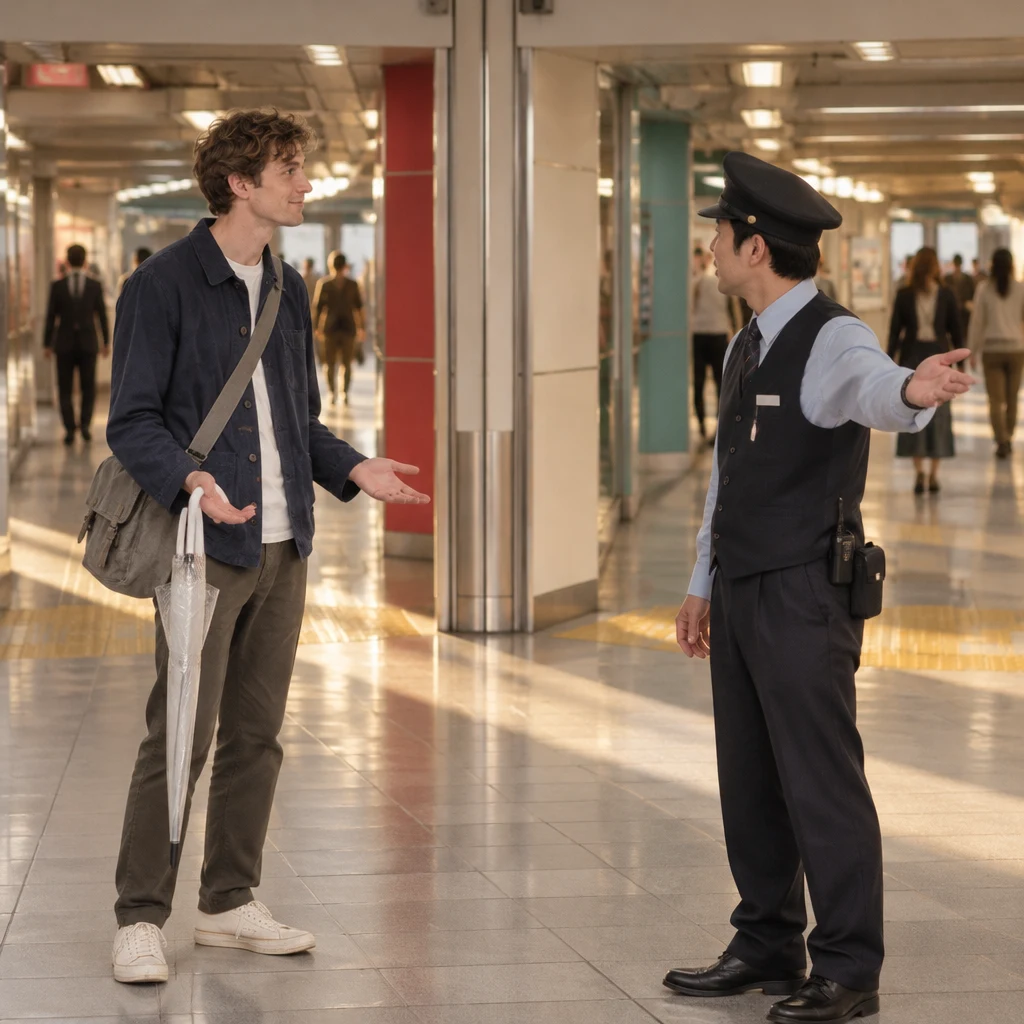
乗り換えはありますか。
Is there a transfer?
When to use it: Ask this if you must change trains.
Learn it as one piece to ask about a transfer.

この電車は___に行きますか。
Does this train go to ___?
When to use it: Ask this to check a train's destination.
Learn it as one piece to check where a train goes.
Story — the wrong side of the gate
Leo and Goro reach Nippori. The yak taps his Suica; Leo aims at the wrong side of the gate.
Highlighted phrases are the new lines. Turn on Show English if you want a gloss.
- After the rain, Nippori is busy. Goro's Suica hangs on a cord.
 Leo改札はどこですか。Where are the ticket gates?
- Staffこちらへどうぞ。This way, please.
- LeoSuicaで乗れますか。Can I ride with Suica?
- Staffはい、使えます。Yes, you can use it.
- Goro taps the card on his cord. Leo taps his phone on the wrong side. Goro points to the reader.
- Leo何番線ですか。Which platform number is it?
- Staff三番線です。It's platform three.
- Leoこの電車は上野に行きますか。Does this train go to Ueno?
- Staffはい、上野に行きます。Yes, it goes to Ueno.
- Leo乗り換えはありますか。Is there a transfer?
- Staffいいえ、ありません。No, there isn't.
- Later, at Ueno, Leo checks the station map with the staff member.
- Leo何番出口ですか。Which exit number is it?
- Staff二番出口です。It's exit number two.
Practice — pick the station line
Ten short tasks wait in this round. You will listen, match meanings, fill a gap, and build a line.
Each one is small, so you move on quickly.
0 of 10 done
What did you hear?
What did you hear?
Match the pairs
Japanese
改札はどこですか。Drop the English here何番線ですか。Drop the English here何番出口ですか。Drop the English hereEnglish
What do you say?
What do you say?
Before asking your question, you need a polite way to get the staff member's attention.
Fill the gap
Fill the gap
Where are the ticket gates?
改札____どこですか。
What does it mean?
What does it mean?
乗り換えはありますか。
Build the line
Build the line
Which platform number is it?
。
Tap the words in order.
What do you say?
What do you say?
A train is at the platform. Ask whether it goes to Ueno.
Swap the word
Swap the word
You want the exit number, not the platform.
____ですか。
Find the mistake
Find the mistake
What did you hear?
What did you hear?
Say it — your turn at the gate
You are Leo at Nippori station. When the cue is yours, say the line to the staff member.
Listen first if you want to hear it. This is a practice recording, not a pronunciation score.
- Leo (you)Get the staff member's attention politely.
Get the staff member's attention politely.
すみません。
Excuse me (to get someone's attention)
0 of 4 said
Recap — what you can say now
| Japanese | English | Play |
|---|---|---|
| Suicaで乗れますか。 | Can I ride with Suica? | |
| 改札はどこですか。 | Where are the ticket gates? | |
| 何番線ですか。 | Which platform number is it? | |
| 何番出口ですか。 | Which exit number is it? | |
| 乗り換えはありますか。 | Is there a transfer? | |
| この電車は___に行きますか。 | Does this train go to ___? |
Save your progress — it’s free
Keep your place in the course and see which lines you’ve learned.
Want the next lesson in your inbox?
Get the next lesson by email, one a day.
Join the newsletterDaily lesson emails are coming soon. Newsletter subscribers get them first.
Keep practicing with Yak Cards
Keep these station lines in your pocket. Open the Yak Cards for this lesson and run them on the train.
A short Yak Cards round on the platform keeps the gates and exits ready.
Open Yak Cards