
New here? This is lesson 226 of a free 240-lesson Traditional Chinese course.
The noise next door in Traditional Chinese
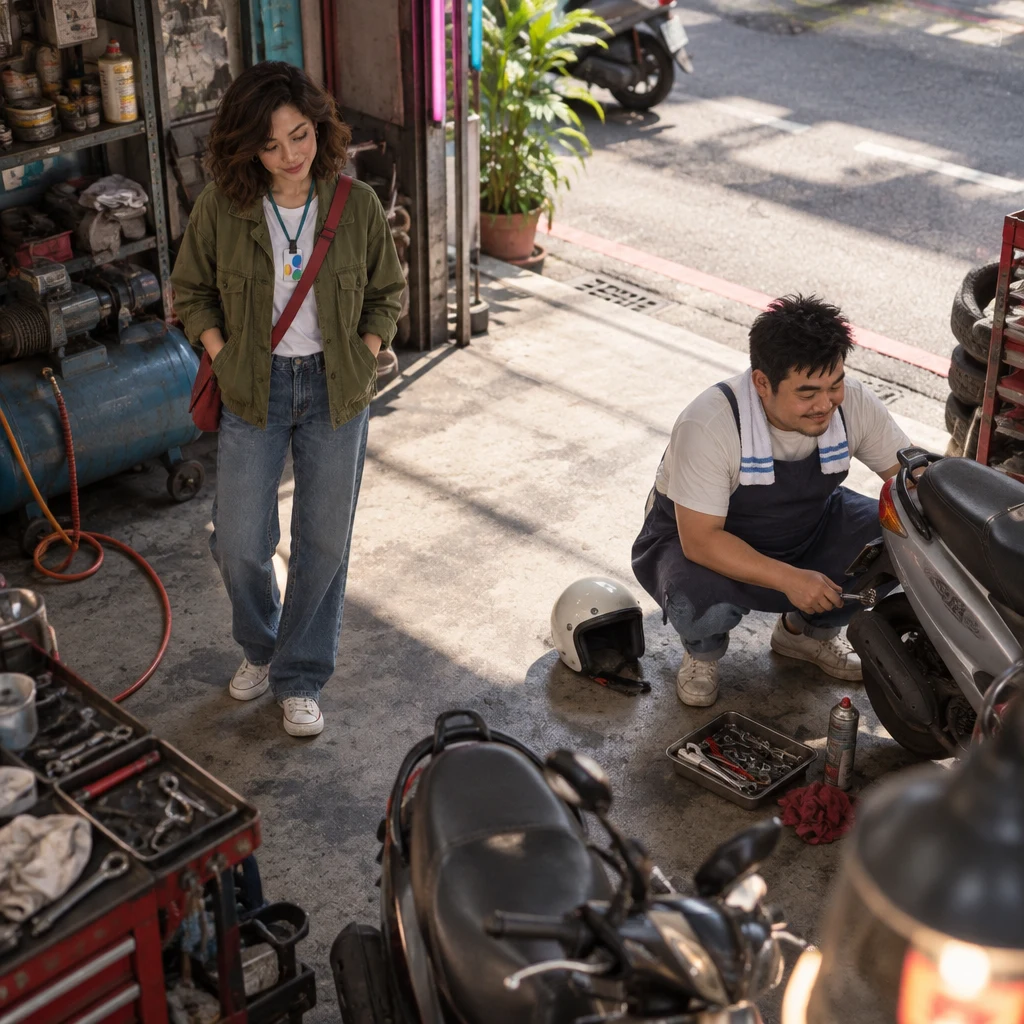
The scooter shop under Maya's apartment starts its compressor at six. She needs sleep, but she also needs neighbors she can still greet.
Learn six lines for raising a noise problem without turning it into a fight. Soften the complaint, see their side, and ask for a plan.
A-Jie knows the shop. He walks over with her. A-Li's soy milk stays unfinished on the back table.
By the end of this lesson
Raise a noise problem with a neighbor without turning it into a fight.
- 最近晚上有點吵It's been a bit noisy at night lately.
- 可以請你小聲一點嗎?Could you keep it down?
- 我不是在責怪你I'm not blaming you.
- 我知道你也很辛苦I know you're having a hard time too.
- 我們可以想個辦法嗎?Can we think of a solution?
- 謝謝你願意聽Thanks for being willing to listen.
Scene — the shop downstairs
Maya lives above the scooter shop on Banyan Lane. Before sunrise the compressor starts, and the whole stairwell hums.
She stops at Banyan Breakfast first. Auntie Lin sees the tired look. A-Jie offers to come along so the talk stays friendly.
A-Li stays at the back table on two stools. His soy milk is still unfinished; that is not a puzzle to solve today.

Learn — a calm neighbor ask
Here are six everyday lines that help you raise a noise problem and still keep a neighbor on your side.
Listen to each line, then say it out loud. Notice how the ask stays soft: you name the noise, you refuse blame, and you look for a plan.

最近晚上有點吵
It's been a bit noisy at night lately.
When to use it: Name a recent night-time noise without sounding angry.
有點 softens 吵, so the complaint stays mild.

可以請你小聲一點嗎?
Could you keep it down?
When to use it: Ask someone politely to lower their volume.
可以...嗎 turns the request into a question, not an order.
Say it: The 一 before a third-tone syllable takes a falling fourth tone.

我不是在責怪你
I'm not blaming you.
When to use it: Soften a complaint so the other person does not feel attacked.
不是在 plus a verb means you are not doing that action.
Say it: 不 rises before a fourth-tone 是.
我知道你也很辛苦
I know you're having a hard time too.
When to use it: Show you see the other person's effort before you ask for change.
也 marks that their hardship is shared, so the request feels fair.

我們可以想個辦法嗎?
Can we think of a solution?
When to use it: Invite the other person to solve the problem with you.
個 is the measure word that sits between 想 and 辦法.

謝謝你願意聽
Thanks for being willing to listen.
When to use it: Thank someone who stayed and heard you out.
願意 marks that they chose to listen, not that they had to.
Story — talking to the shop
Listen as Maya tells Auntie Lin about the early compressor, then walks next door with A-Jie.
She raises the problem without blaming the shop, and they look for a time that works.
 Auntie Lin美女,沒睡飽喔?Didn't get enough sleep, beautiful?
 Maya最近晚上有點吵。It's been a bit noisy at night lately.
 A-Li樓下那間機車行嗎?The scooter shop downstairs?
- Maya對,壓縮機常常六點就開始。Yes, the compressor often starts at six.
- Auntie Lin阿傑認識老闆,等他來。A-Jie knows the owner; wait for him.
- A-Jie comes in from a scooter run and sets his helmet down.
 A-Jie怎麼了?What's wrong?
- Maya我想跟他們說,可是不想吵架。I want to talk to them, but I don't want a fight.
- A-Jie走,我陪你去。Come on, I'll go with you.
- They stop at the scooter shop under Maya's stairs.
- Maya不好意思。Excuse me.
- Staff怎麼了?What's wrong?
- Maya最近晚上有點吵。It's been a bit noisy at night lately.
- Maya可以請你小聲一點嗎?Could you keep it down?
- Staff是我們太大聲喔?Are we too loud?
- Maya我不是在責怪你。I'm not blaming you.
- Maya我知道你也很辛苦。I know you're having a hard time too.
- Staff對,壓縮機早上六點就要開。Right, the compressor has to start at six in the morning.
- Maya可是六點還是很早。But six is still really early.
- Maya我們可以想個辦法嗎?Can we think of a solution?
- A-Jie晚一點再開,好不好?Start it a bit later, okay?
- Staff好喔,我跟老闆講。All right, I'll tell the owner.
- Maya謝謝你願意聽。Thanks for being willing to listen.
- Back at Banyan Breakfast, A-Li is still at the back table.
- A-Li豆漿還沒喝完。The soy milk still isn't finished.
Practice — keep the door friendly
Work through these quick exercises and choose the line that best fits each small neighbor moment without a fight.
After each answer, read why the other choices do not fit, then say the right line out loud.
0 of 11 done
What does it mean?
What does it mean?
最近晚上有點吵
What do you say?
What do you say?
The early compressor is already named. Ask the shop, politely, to lower the volume.
Fill the gap
Fill the gap
I'm not blaming you.
我不是在____你
Build the line
Build the line
I know you're having a hard time too.
Tap the words in order.
What did you hear?
What did you hear?
Pick the reply
Staff says:
Pick the reply
好喔,我聽你說。
All right, I'm listening.
And you reply with:
Swap the word
Swap the word
The shop is still loud. Swap the word so you ask them to keep it down.
可以請你____一點嗎?
What do you say?
What do you say?
You have just opened the shop door. Start with a polite excuse-me before any complaint.
Match the pairs
Traditional Chinese
最近晚上有點吵Drop the English here可以請你小聲一點嗎?Drop the English here我不是在責怪你Drop the English here謝謝你願意聽Drop the English hereEnglish
Pick the reply
Staff says:
Pick the reply
那要怎麼辦?
So what should we do?
And you reply with:
Fill the gap
Fill the gap
Sorry to trouble you.
____你了
Say it — your turn next door
You play Maya at the scooter shop. Listen to each cue, then say the line that keeps the talk calm.
Tap the microphone to speak. Replay the other person's line if you need the wording again.
- Maya and A-Jie stand at the scooter shop door.
- Staff有什麼事嗎?Is something the matter?
- Maya (you)Tell him nights have been a bit loud lately.
Tell him nights have been a bit loud lately.
最近晚上有點吵
It's been a bit noisy at night lately.
0 of 6 said
Recap — what you can say now
| Traditional Chinese | English | Play |
|---|---|---|
| 最近晚上有點吵 | It's been a bit noisy at night lately. | |
| 可以請你小聲一點嗎? | Could you keep it down? | |
| 我不是在責怪你 | I'm not blaming you. | |
| 我知道你也很辛苦 | I know you're having a hard time too. | |
| 我們可以想個辦法嗎? | Can we think of a solution? | |
| 謝謝你願意聽 | Thanks for being willing to listen. |
Save your progress — it’s free
Keep your place in the course and see which lines you’ve learned.
Want the next lesson in your inbox?
Get the next lesson by email, one a day.
Join the newsletterDaily lesson emails are coming soon. Newsletter subscribers get them first.
Keep practicing with Yak Cards
Today's neighbor lines are in Yak Cards with more ways to raise a problem without a fight.
Review a few of these cards before you talk to a neighbor.
Open Yak Cards