
New here? This is lesson 191 of a free 240-lesson Traditional Chinese course.
Linking what you say in Traditional Chinese
Maya has a short report to practise, so she tries it on Auntie Lin at Banyan Breakfast. A-Li listens from two stools, soy milk still unfinished.
These lines help you link two points: contrast, same time, a result, and a problem. You also return to an earlier point without starting over.
Listen for the two third tones in 所以. After this, your report will sound joined, not chopped.
By the end of this lesson
Link two points with contrast, timing, a result, or a problem, and return to an earlier point.
- 另一方面On the other hand.
- 同時At the same time.
- 這樣的話In that case.
- 回到剛剛講的Back to what we said.
- 所以___So ___.
- 問題是___The problem is ___.
Scene — a short report at breakfast
Late morning at Banyan Breakfast, Maya stands by the counter with notes in her hand. Auntie Lin wipes a table and agrees to listen.
A-Li sits on two stools with his soy milk. Maya needs to join her points; nobody is solving the slip today.

Learn — linking what you say
Six linking phrases for a short report. Hear each one, then say it.
Notice how 所以 starts a result, and 問題是 names the sticking point.

另一方面
On the other hand.
When to use it: Use this when you add a contrasting second point.
It comes after the first side, then the second side starts.

同時
At the same time.
When to use it: Use this when two things are true together.
This adds a second point, not a contrast.

這樣的話
In that case.
When to use it: Use this after a condition, then say what follows.
的話 marks the case; the next clause is what you do.
Say it: 的 is a light neutral tone before 話.

回到剛剛講的
Back to what we said.
When to use it: Use this to return after a side comment.
剛剛 points to the earlier talk you now pick up.
Say it: The last 的 is a light neutral tone.

所以___
So ___.
When to use it: Use this to give the result after a reason.
Put the result in the blank right after 所以.
Say it: Two third tones; the first one rises.
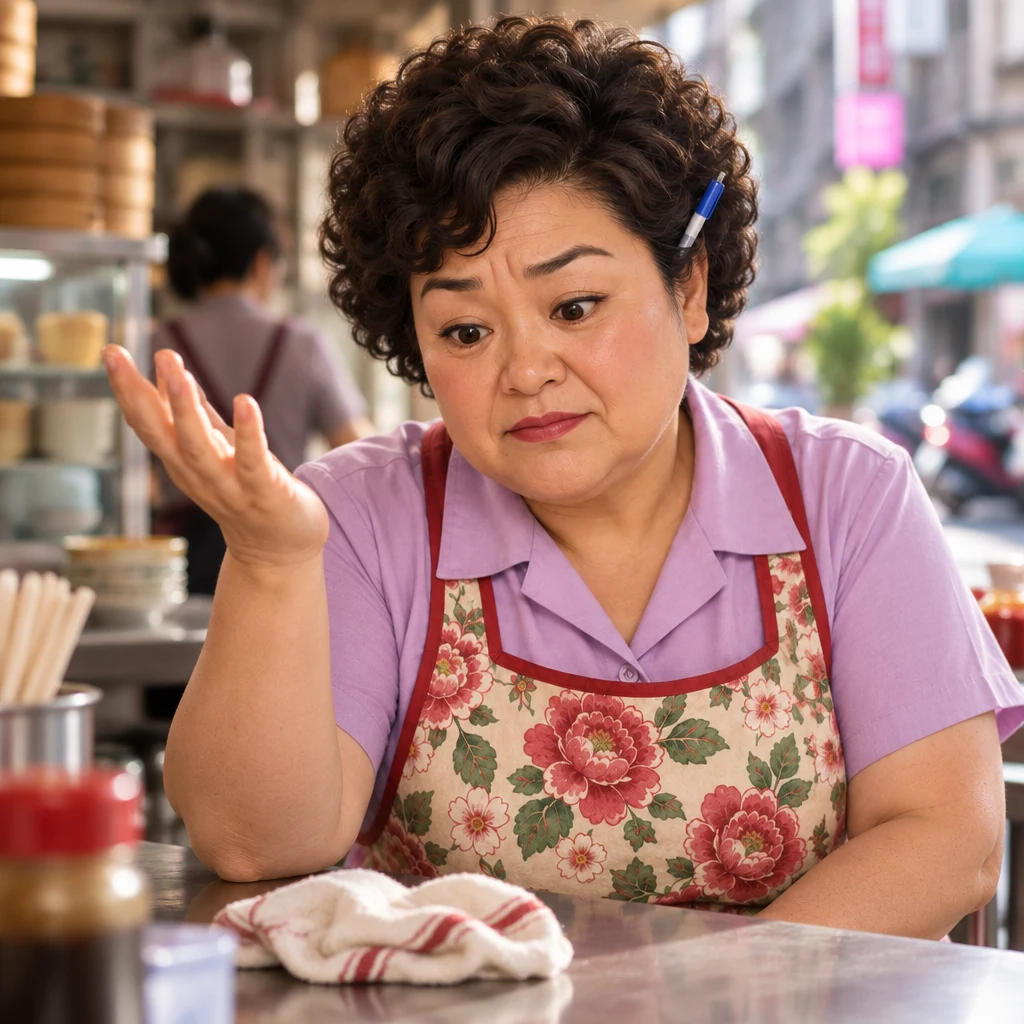
問題是___
The problem is ___.
When to use it: Use this to name the sticking point after some setup.
是 links 問題 to the issue you then name.
Story — Maya practises on Auntie Lin
Listen to Maya practise a short report at Banyan Breakfast. Auntie Lin is her audience, and A-Li stays on two stools.
She joins her points, then comes back to the deadline.
 Auntie Lin美女,你在唸什麼?What are you reciting, beautiful?
 Maya我在練習報告,你聽一下好不好?I'm practising a report; will you listen for a bit?
- Auntie Lin好啊,你說。Sure, go ahead.
- Maya這個案子要快,另一方面品質也要顧到。This project has to be fast; on the other hand, quality still has to be looked after.
- Auntie Lin對啊,只顧快客人會唸。Right, if you only rush, customers will complain.
- Maya同時,設計稿也得過關。At the same time, the design draft has to pass too.
 A-Li豆漿還沒喝完,你繼續說。The soy milk still isn't finished; keep going.
- Maya這樣的話,我先講期限。In that case, I'll talk about the deadline first.
- Auntie Lin期限是什麼時候?When is the deadline?
- Maya期限是禮拜五。The deadline is Friday.
- Auntie Lin那來得及嗎?Will you make it in time?
- Maya問題是時間不太夠。The problem is there isn't quite enough time.
- Auntie Lin那你怎麼辦?So what will you do?
- Maya所以我們先做最重要的。So we'll do the most important parts first.
- A-Li欸,剛剛那個快跟亂呢?Hey, what about that fast-and-messy point from just now?
- Maya回到剛剛講的,要快,可是不能亂。Back to what we said: it has to be fast, but it can't get messy.
- Auntie Lin簡單來說,就是先做重點。我明白了。In short, just do the main points first. I understand.
- Maya謝謝阿姨。Thanks, Auntie.
Practice — join two points
Try ten quick exercises with these linking phrases. Choose the line that joins each pair of points.
After each answer, read why the others do not fit, then say the line again.
0 of 10 done
What does it mean?
What does it mean?
另一方面
What do you say?
What do you say?
The design draft has to pass, and the team is reviewing it during the same meeting. Link these as happening together.
Build the line
Build the line
Back to what we said.
Tap the words in order.
Fill the gap
Fill the gap
The problem is ___.
____是___
What did you hear?
What did you hear?
Pick the reply
Auntie Lin says:
Pick the reply
那你怎麼辦?
So what will you do?
And you reply with:
Match the pairs
Traditional Chinese
另一方面Drop the English here同時Drop the English here這樣的話Drop the English here回到剛剛講的Drop the English hereEnglish
Swap the word
Swap the word
After someone names a condition, complete the phrase that means in that case.
這樣____
What does it mean?
What does it mean?
簡單來說
Pick the reply
Auntie Lin says:
Pick the reply
簡單來說,就是先做重點。
In short, just do the main points first.
And you reply with:
Say it — your linking lines
You play Maya and practise the report with Auntie Lin. Listen to each cue, then say each line of the report out loud.
Tap the microphone to speak. You can replay her line before your turn.
- Maya practises her short report with Auntie Lin at the counter.
- Auntie Lin好啊,你說。Sure, go ahead.
- Maya (you)Start the report: the work has to be fast, but quality still matters.
Start the report: the work has to be fast, but quality still matters.
另一方面
On the other hand.
0 of 6 said
Recap — what you can say now
| Traditional Chinese | English | Play |
|---|---|---|
| 另一方面 | On the other hand. | |
| 同時 | At the same time. | |
| 這樣的話 | In that case. | |
| 回到剛剛講的 | Back to what we said. | |
| 所以___ | So ___. | |
| 問題是___ | The problem is ___. |
Save your progress — it’s free
Keep your place in the course and see which lines you’ve learned.
Want the next lesson in your inbox?
Get the next lesson by email, one a day.
Join the newsletterDaily lesson emails are coming soon. Newsletter subscribers get them first.
Keep practicing with Yak Cards
Today's linking phrases are in Yak Cards with more lines for joining two points.
Review a few linking cards each day so the joins come easily.
Open Yak Cards