
New here? This is lesson 218 of a free 240-lesson Traditional Chinese course.
Link a story in Traditional Chinese
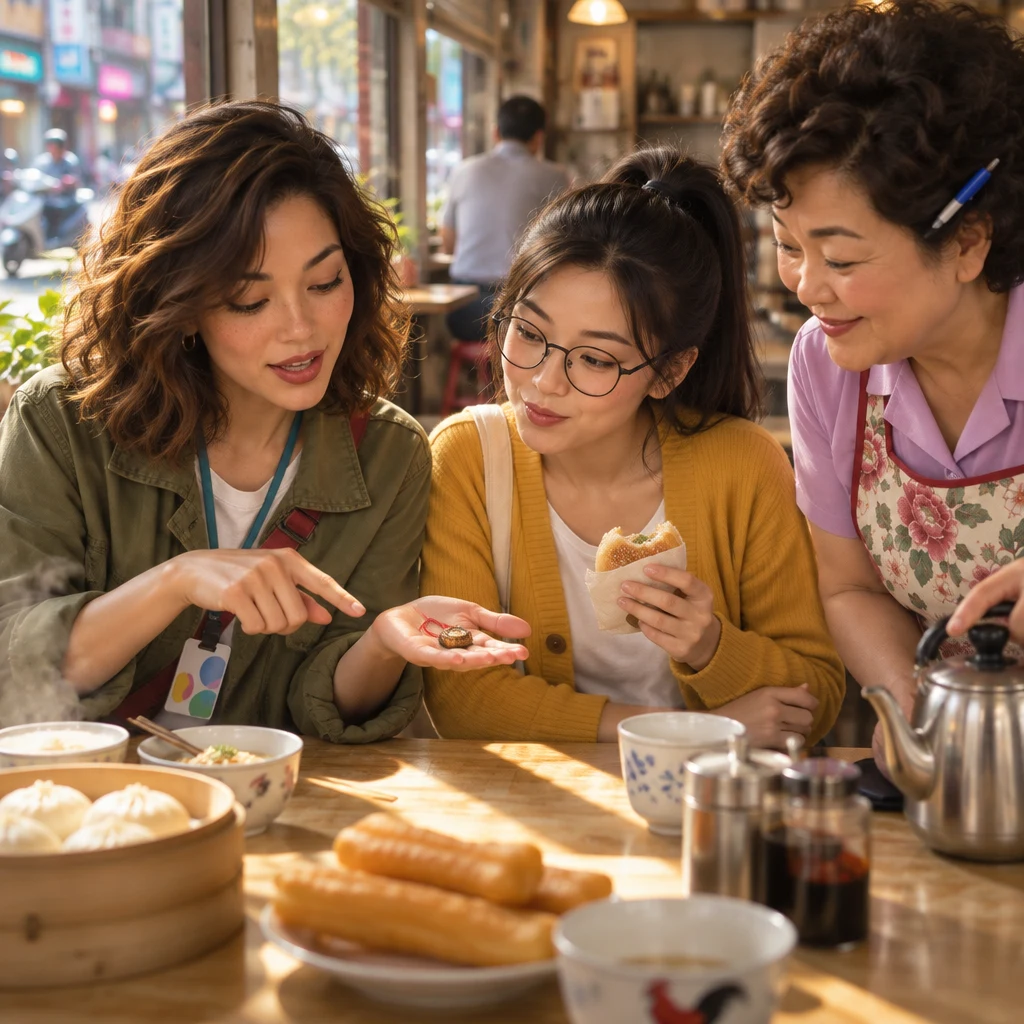
Maya and Yi-Jun sit at Banyan Breakfast and retell the Tainan weekend. Auntie Lin wants the story in order, but the talk keeps sliding to noodles, photos, and the temple.
Learn six linking phrases so you can correct an assumption, pick up a thread, change topic, come back, add a point, or lead with the takeaway.
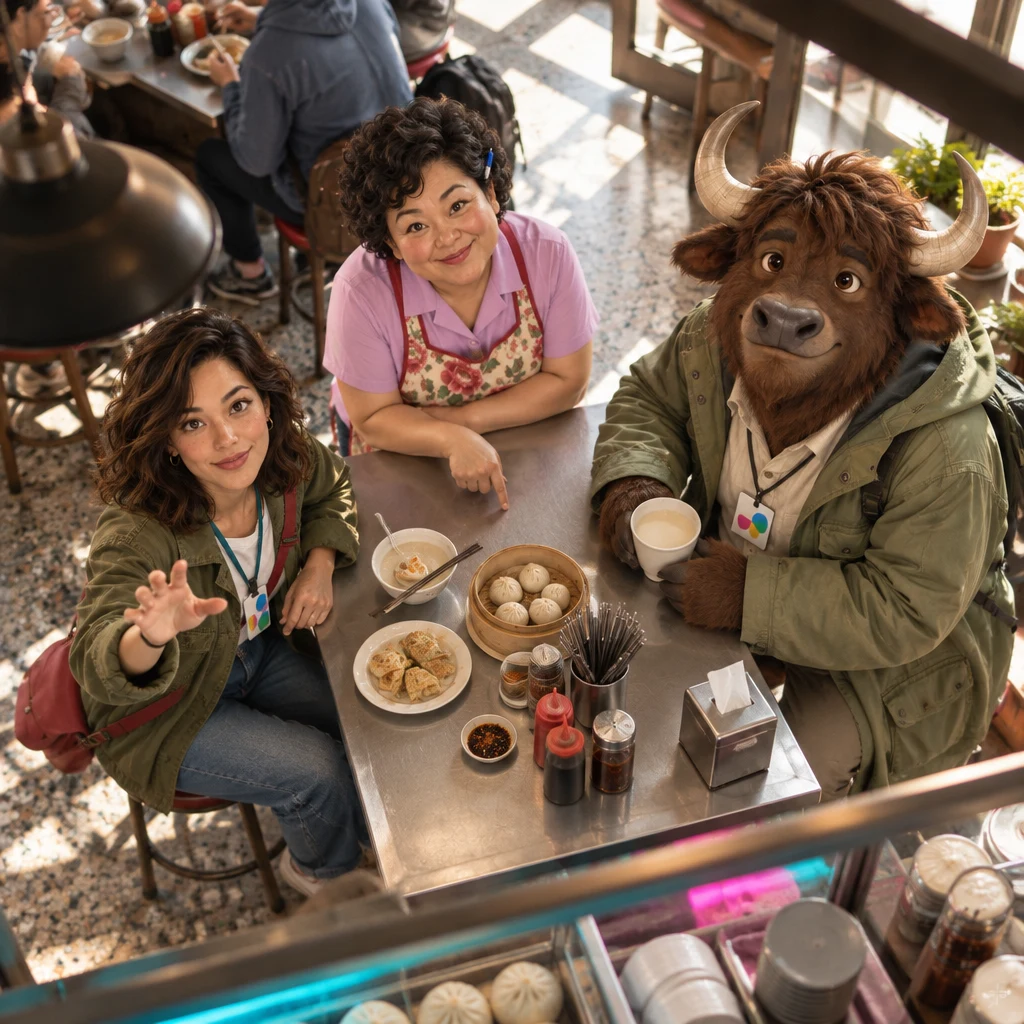
A-Li listens from two stools. His soy milk stays unfinished, and nobody reads a fortune today.
By the end of this lesson
Link a story with phrases for a true detail, a related comment, a new topic, a return, an extra point, and a takeaway first.
- 事實上In fact.
- 說到這個Speaking of which.
- 換個話題Changing the subject.
- 回到我剛剛說的Back to what I said.
- 另外一點是___Another point is ___.
- 先講結論Conclusion first.
Scene — a Tainan retelling
Late morning at Banyan Breakfast in Da'an. Maya and Yi-Jun have come back from Tainan, and Auntie Lin wants to hear the weekend in order.
A-Li sits on two stools with his soy milk still unfinished. The story will wander, then come back; nothing about a slip gets settled today.

Learn — phrases that link a story
These six phrases help you move through a story without losing the listener.
Listen, then say each line. Notice which phrases restart a topic and which come back.
事實上
In fact.
When to use it: Use this when the real situation differs from what someone just assumed.
It often opens the next clause, and then you state the true detail.

說到這個
Speaking of which.
When to use it: Use this to hang a new comment on something just mentioned.
Keep the same topic; do not use it to start a brand-new subject.

換個話題
Changing the subject.
When to use it: Use this when you want to leave this topic and open another.
個 measures 話題, so the three words move together as one chunk.
Say it: 個 is often a light neutral tone after 換.
回到我剛剛說的
Back to what I said.
When to use it: Use this after a side comment, when you want your earlier point again.
的 turns 我剛剛說 into the thing you are returning to.
Say it: The second syllable of 剛剛 is often a light neutral tone.

另外一點是___
Another point is ___.
When to use it: Use this to add a second point after you have already made one.
Fill the blank with the extra point, usually a whole clause.
Say it: 一 is a falling tone before the third-tone 點.

先講結論
Conclusion first.
When to use it: Use this when you want the takeaway before the supporting details.
先 tells the listener the conclusion comes before the rest of the story.
Story — telling the weekend
Listen as Maya and Yi-Jun tell Auntie Lin about Tainan. The story slips to food and photos, then comes back.
A-Li asks for the conclusion. His soy milk is still there.
 Auntie Lin美女,臺南好玩嗎?How was Tainan, beautiful?
 Yi-Jun事情是這樣的,我們坐高鐵去的。Here's what happened: we took the high-speed rail there.
 Maya事實上,我們到臺南後一開始就搭錯車了。Actually, once we got to Tainan, we took the wrong ride at first.
- Auntie Lin後來呢?And then?
- Maya我們下一站下車,再轉去市區。We got off at the next stop and transferred into the city.
- Yi-Jun說到這個,擔仔麵真的很好吃。Speaking of which, the danzai noodles were really good.
- Maya那家很有名,要排隊。That place is famous; you have to queue.
 A-Li隊伍很長喔。The line was long.
- A-Li looks up from the cup he still has not finished.
- Yi-Jun換個話題,廟也很值得去。Changing the subject, the temple is worth going to as well.
- Auntie Lin哪一間?Which one?
- Yi-Jun是赤崁樓旁邊的祀典武廟。It's the Martial Temple beside Chihkan Tower.
- Maya回到我剛剛說的,我們先搭錯車,後來才去廟。Back to what I said: we took the wrong train first, and only then went to the temple.
- Yi-Jun另外一點是那裡跟臺北很不一樣。Another point is that it's very different from Taipei.
- A-Li先講結論,你們還會再去嗎?Conclusion first: will you go again?
- Maya會啊,下次想多待一天。Yes, next time I want to stay one more day.
- Yi-Jun其實沒那麼誇張,只是很熱。It wasn't actually that dramatic; it was just hot.
- Auntie Lin好喔,下次帶照片來給我看。Okay, bring the photos for me to see next time.
- A-Li豆漿還沒喝完。The soy milk still isn't finished.
Practice — keep the thread
Work through eleven short tasks that use these linking phrases in a Tainan retelling.
Pick, build, and fill gaps. After each answer, read why the other choices fail.
0 of 11 done
What does it mean?
What does it mean?
事實上
What do you say?
What do you say?
Yi-Jun just named the famous noodle shop. Add a comment that stays on that.
Build the line
Build the line
Changing the subject.
Tap the words in order.
Fill the gap
Fill the gap
Back to what I said.
回到我____說的
What did you hear?
What did you hear?
Match the pairs
Traditional Chinese
事實上Drop the English here說到這個Drop the English here換個話題Drop the English here先講結論Drop the English hereEnglish
Swap the word
Swap the word
Yi-Jun just mentioned the noodles. Hang a comment on that same topic.
說到____
What do you say?
What do you say?
Yi-Jun mentioned the wrong train and then stopped. Ask what happened next.
Fill the gap
Fill the gap
Another point is ___.
另外____是___
Pick the reply
Yi-Jun says:
Pick the reply
聽起來好誇張喔!
That sounds so over the top!
And you reply with:
What do you say?
What do you say?
Auntie Lin asked how the Tainan trip went. Begin from the first event with the usual story opener.
Say it — your linking lines
You play Maya and keep the Tainan story moving. Listen to each cue, then say the linking line out loud.
Tap the microphone to speak. You can replay the other person's line before your turn.
- You are Maya at Banyan Breakfast, keeping the Tainan story in order.
- Yi-Jun那趟很順利吧?That trip went smoothly, right?
- Maya (you)Once you arrived, the first ride was not as smooth as she thinks.
Once you arrived, the first ride was not as smooth as she thinks.
事實上
In fact.
0 of 6 said
Recap — what you can say now
| Traditional Chinese | English | Play |
|---|---|---|
| 事實上 | In fact. | |
| 說到這個 | Speaking of which. | |
| 換個話題 | Changing the subject. | |
| 回到我剛剛說的 | Back to what I said. | |
| 另外一點是___ | Another point is ___. | |
| 先講結論 | Conclusion first. |
Save your progress — it’s free
Keep your place in the course and see which lines you’ve learned.
Want the next lesson in your inbox?
Get the next lesson by email, one a day.
Join the newsletterDaily lesson emails are coming soon. Newsletter subscribers get them first.
Keep practicing with Yak Cards
Today's linking phrases are in Yak Cards with more lines for keeping a story moving.
Review a few linking cards each day so the jumps in a story feel natural.
Open Yak Cards