
New here? This is lesson 5 of a free 240-lesson Traditional Chinese course.
Please and thank you in Traditional Chinese
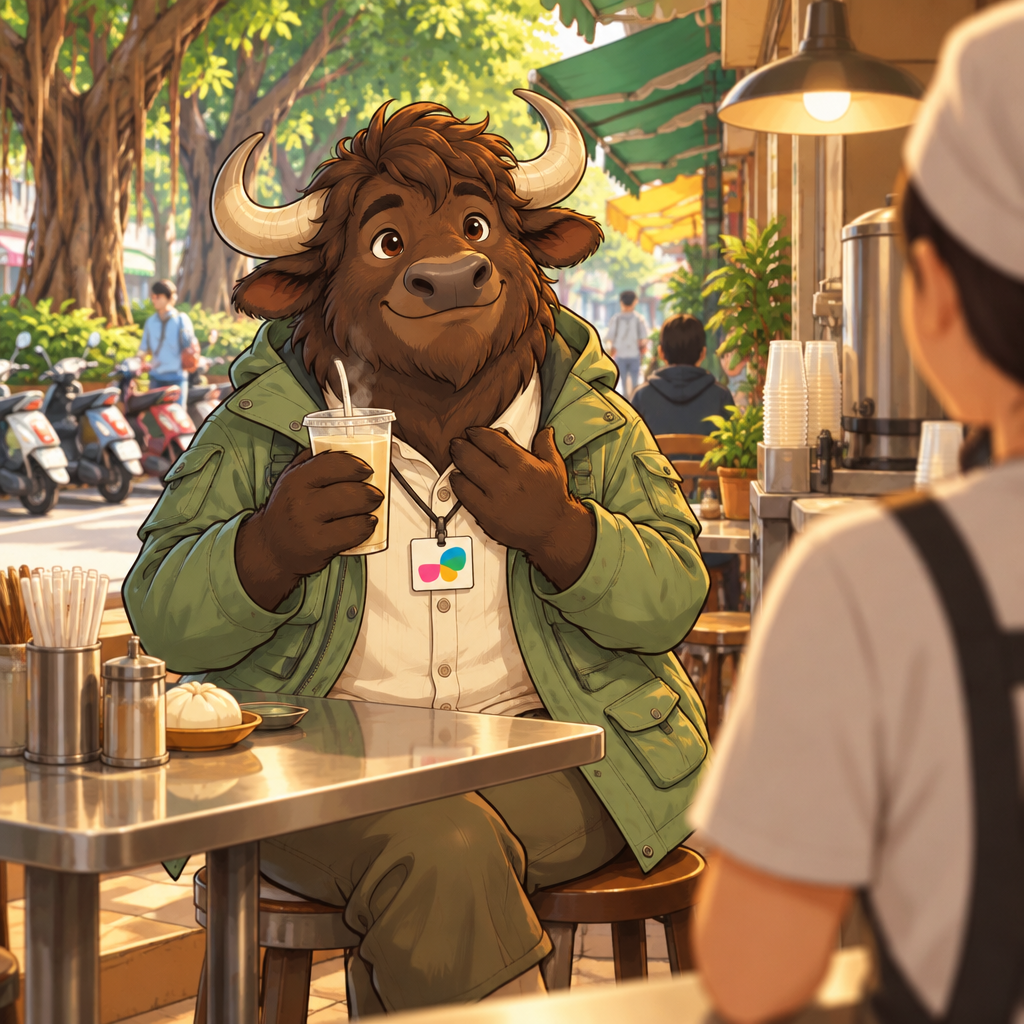
At Banyan Breakfast, you hand Auntie Lin some coins and get an egg pancake in return. A-Li is nearby with his soy milk, still unfinished.
Learn a polite way to ask for something, say thank you in a few ways, and respond when someone thanks you.
Listen for 不客氣: 不 changes its tone before a falling tone. A-Li's thank-you comes before anyone gives him anything.
By the end of this lesson
Ask for something politely, thank someone, and respond when someone thanks you.
- 請給我___Please give me ___.
- 謝謝Thank you.
- 謝謝你Thank you (to you).
- 非常謝謝Thank you very much.
- 不客氣You're welcome.
- 沒問題No problem.
Scene — a breakfast order
Morning at Banyan Breakfast. Maya has coins ready at the counter, and Auntie Lin is preparing an egg pancake.
A-Li is at the back table with his soy milk. Before anyone brings him anything, he says thank you.

Learn — polite requests and thanks
Use a polite request at the breakfast counter, then choose a simple or warmer thank-you. Listen to Auntie Lin's replies.
The request has a blank for the thing you want. Learn each complete phrase as one piece.

請給我___
Please give me ___.
When to use it: Use this polite request when asking someone to give you something.
Learn this polite request as one piece.

謝謝
Thank you.
When to use it: Say this when someone helps you or gives you something.

謝謝你
Thank you (to you).
When to use it: Use this to thank the person you are speaking to.
非常謝謝
Thank you very much.
When to use it: Say this to give someone a warmer thank-you.

不客氣
You're welcome.
When to use it: Say this after someone thanks you.
Say it: 不 becomes rising before the falling tone in 客氣.

沒問題
No problem.
When to use it: Use this friendly reply when someone thanks you.
Story — coins and an early thank-you
Maya orders breakfast at Banyan Breakfast and pays Auntie Lin. Nearby, A-Li thanks everyone before anyone has given him anything.
Listen for the polite request and the different ways they thank and answer one another.
 Auntie Lin美女,早安!Good morning, beautiful!
- Auntie Lin請坐。Please sit down.
 Maya請給我一份蛋餅。Please give me an egg pancake.
- Maya places her coins on the counter, and Auntie Lin hands her an egg pancake.
- Auntie Lin好喔,蛋餅來了。Sure, here comes your egg pancake.
- Maya謝謝你。Thank you (to you).
- Auntie Lin不客氣。You're welcome.
- Maya非常謝謝。Thank you very much.
- Auntie Lin沒問題。No problem.
- Auntie Lin阿犛,你的豆漿還沒喝完喔。A-Li, you haven't finished your soy milk yet.
 A-Li謝謝。Thank you.
Practice — ask and respond politely
Try nine short exercises with requests, thanks, and familiar greetings. Choose a response that fits the moment, or put the words in order.
For the missing-word question, use the English meaning to find the one word that completes the line.
0 of 9 done
What do you say?
What do you say?
You are at the breakfast counter. Ask Auntie Lin for an egg pancake politely.
What does it mean?
What does it mean?
謝謝
Build the line
Build the line
Thank you (to you).
Tap the words in order.
Fill the gap
Fill the gap
Thank you very much.
____謝謝
Match the pairs
Traditional Chinese
請給我___Drop the English here謝謝Drop the English here非常謝謝Drop the English here不客氣Drop the English here沒問題Drop the English hereEnglish
What did you hear?
What did you hear?
Pick the reply
Auntie Lin says:
Pick the reply
可以幫我拿一下嗎?
Can you help me carry this?
And you reply with:
What do you say?
What do you say?
You arrive at the breakfast shop in the morning. Greet Auntie Lin.
What do you say?
What do you say?
Auntie Lin is about to take a break. Invite her to sit down.
Say it — your turn at the counter
You are Maya at the breakfast counter. Ask Auntie Lin for an egg pancake, then thank her and respond naturally.
Listen to each cue and say your line out loud. A-Li is nearby, still waiting for his drink.
- Maya is ready to order at the counter.
- Maya (you)Fill the blank with an egg pancake, then ask Auntie Lin politely.
Fill the blank with an egg pancake, then ask Auntie Lin politely.
請給我___
Please give me ___.
0 of 3 said
Recap — what you can say now
| Traditional Chinese | English | Play |
|---|---|---|
| 請給我___ | Please give me ___. | |
| 謝謝 | Thank you. | |
| 謝謝你 | Thank you (to you). | |
| 非常謝謝 | Thank you very much. | |
| 不客氣 | You're welcome. | |
| 沒問題 | No problem. |
Save your progress — it’s free
Keep your place in the course and see which lines you’ve learned.
Want the next lesson in your inbox?
Get the next lesson by email, one a day.
Join the newsletterDaily lesson emails are coming soon. Newsletter subscribers get them first.
Keep practicing with Yak Cards
Today's polite requests and thank-yous are in Yak Cards with more useful lines for everyday errands.
Review a few cards each day so these polite replies come naturally.
Open Yak Cards