
New here? This is lesson 158 of a free 240-lesson Traditional Chinese course.
What do you think in Traditional Chinese
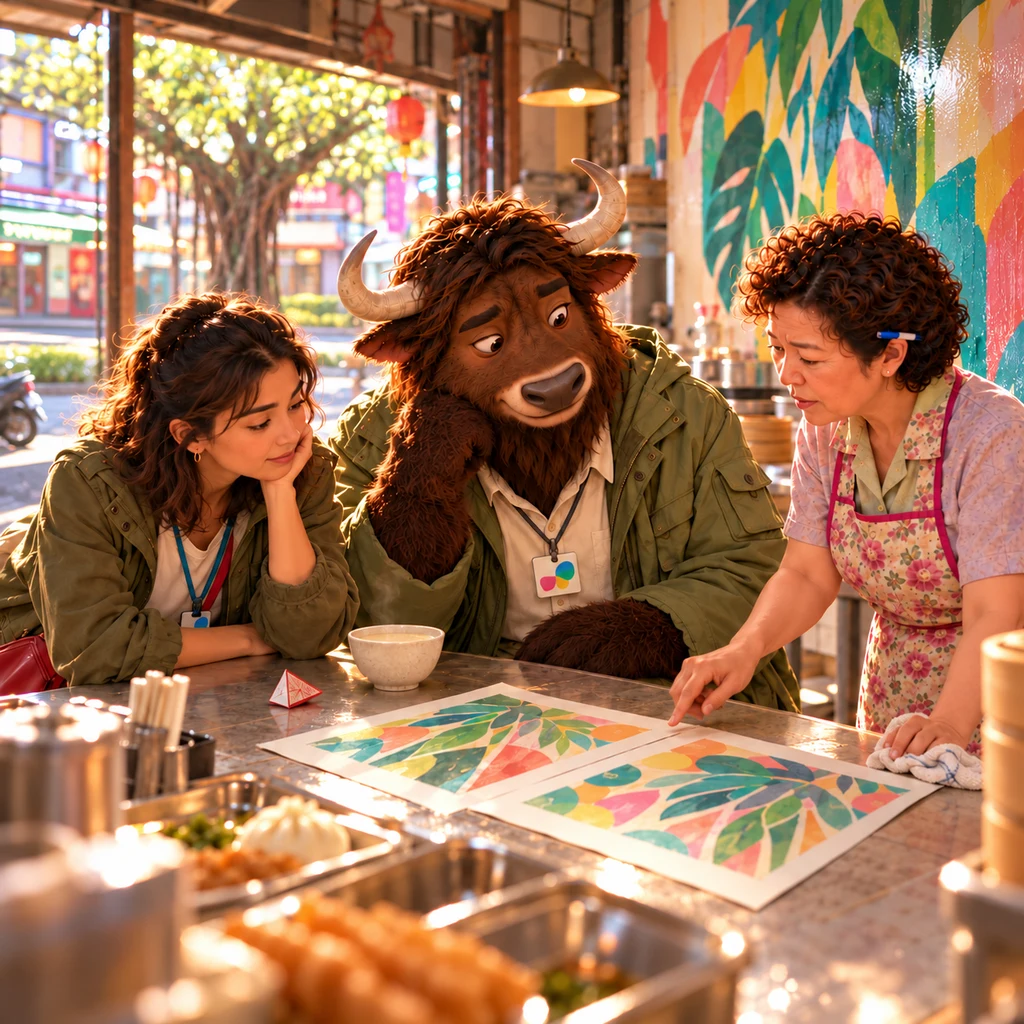
A new mural appeared on the wall by Banyan Breakfast. Maya wants Auntie Lin's opinion, and A-Li has a view of his own from two stools.
Learn how to ask what someone thinks, give a personal view, and choose one option. You can also call something a good idea, or say it is not very good.
Keep the fortune slip in the till. A-Li's soy milk stays unfinished.
By the end of this lesson
Ask what someone thinks, give a personal view, say which option you prefer, and call an idea good or not very good.
- 你覺得這個怎麼樣?What do you think of this?
- 我個人覺得這比較好Personally I think this is better.
- 我比較想選這個I'd rather choose this.
- 我覺得這是個好主意I think it's a good idea.
- 我覺得這不太好I don't think it's very good.
- 你對這件事有什麼看法?What's your view on this?
Scene — a new mural
Morning at Banyan Breakfast. A new mural covers the wall by the door, still smelling of paint. Two paper sketches sit on the counter.
Maya asks Auntie Lin what she thinks. A-Li listens from two stools, soy milk unfinished. Nobody opens the fortune slip.
Learn — asking what people think
Here are six lines for asking opinions and giving your own. Listen, then say each one out loud.
Notice 覺得 for a view, and 對這件事有什麼看法 when you want a fuller take.

你覺得這個怎麼樣?
What do you think of this?
When to use it: Ask this when you want someone's opinion of something in front of you.
覺得 plus 怎麼樣 asks for a view, and the question word stays in place.
Say it: 麼 is often neutral; 樣 has fourth tone.

我個人覺得這比較好
Personally I think this is better.
When to use it: Use this to give your own view when two options are on the table.
個人 marks the view as yours, which softens disagreement a little.

我比較想選這個
I'd rather choose this.
When to use it: Say this when you pick one option over another.
比較 before 想選 shows you prefer this choice, not that it is better.

我覺得這是個好主意
I think it's a good idea.
When to use it: Use this when you like a plan or suggestion.
個 is the measure word that sits before 主意 in this chunk.

我覺得這不太好
I don't think it's very good.
When to use it: Use this to give a mild negative opinion without sounding harsh.
不太 softens the no; it is gentler than a flat 不好.
Say it: 不 changes tone before the fourth-tone syllable in 太.

你對這件事有什麼看法?
What's your view on this?
When to use it: Ask this when you want a fuller view of a matter, not just a thing.
對 marks the topic; 什麼 stays in place and you do not add 嗎.
Story — opinions at breakfast
Listen as Maya asks Auntie Lin about the new mural. Two sketches still sit on the counter, and A-Li has not finished his drink.
Notice who is asked, and who answers.
- Maya stops at the new mural by the shop door.
 Maya林阿姨,牆上那幅畫是新的嗎?Auntie Lin, is that painting on the wall new?
 Auntie Lin對啊,昨天剛畫完。Yes, they only finished painting it yesterday.
- Maya你覺得這個怎麼樣?What do you think of this?
- Auntie Lin顏色太亮了。The colors are too bright.
- Maya你為什麼會這樣想?Why do you think so?
- Auntie Lin顏色太亮,看久了眼睛會累。我覺得這不太好。The colors are too bright, and looking too long tires your eyes. I don't think it's very good.
- Maya那這張草圖呢?What about this sketch, then?
- Auntie Lin我個人覺得這比較好。Personally I think this is better.
 A-Li我比較想選這個。I'd rather choose this one.
- Maya我覺得這是個好主意。I think it's a good idea.
- Auntie Lin好主意,可是淡一點更好。Good idea, but paler would be better.
- Maya你對這件事有什麼看法?What's your view on this?
- A-Li巷子會比較有趣。The lane will be more interesting.
- Auntie Lin豆漿還在桌上喔。The soy milk is still on the table.
Practice — give your view
Work through these exercises to ask for a view and to give one of your own. Pick the line that fits each moment.
After each answer, read why the others do not fit, then say the line again.
0 of 11 done
What does it mean?
What does it mean?
你覺得這個怎麼樣?
What do you say?
What do you say?
The neighborhood painted the shop wall. You think that plan is a good idea.
Build the line
Build the line
Personally I think this is better.
Tap the words in order.
Fill the gap
Fill the gap
I don't think it's very good.
我____這不太好
What did you hear?
What did you hear?
Pick the reply
A-Li says:
Pick the reply
你要選哪一個?
Which one do you want to pick?
And you reply with:
Swap the word
Swap the word
Ask A-Li for his view on the mural as a neighborhood matter.
你____這件事有什麼看法?
Match the pairs
Traditional Chinese
你覺得這個怎麼樣?Drop the English here我個人覺得這比較好Drop the English here我覺得這是個好主意Drop the English here我覺得這不太好Drop the English hereEnglish
What do you say?
What do you say?
You suggested paler colors. Check whether Auntie Lin thinks that is okay.
What does it mean?
What does it mean?
好主意
Pick the reply
Auntie Lin says:
Pick the reply
我覺得這不太好。
I don't think it's very good.
And you reply with:
Say it — your opinions
You play Maya. Ask what people think of the mural, then give your own view out loud.
Tap the microphone to speak. You can replay the other person's line before your turn.
- Maya stands with Auntie Lin in front of the new mural.
- Maya (you)Ask Auntie Lin what she thinks of the mural.
Ask Auntie Lin what she thinks of the mural.
你覺得這個怎麼樣?
What do you think of this?
0 of 5 said
Recap — what you can say now
| Traditional Chinese | English | Play |
|---|---|---|
| 你覺得這個怎麼樣? | What do you think of this? | |
| 我個人覺得這比較好 | Personally I think this is better. | |
| 我比較想選這個 | I'd rather choose this. | |
| 我覺得這是個好主意 | I think it's a good idea. | |
| 我覺得這不太好 | I don't think it's very good. | |
| 你對這件事有什麼看法? | What's your view on this? |
Save your progress — it’s free
Keep your place in the course and see which lines you’ve learned.
Want the next lesson in your inbox?
Get the next lesson by email, one a day.
Join the newsletterDaily lesson emails are coming soon. Newsletter subscribers get them first.
Keep practicing with Yak Cards
Today's opinion lines are in Yak Cards with more ways to say what you think.
Review a few opinion cards each day so asking and answering feels natural.
Open Yak Cards