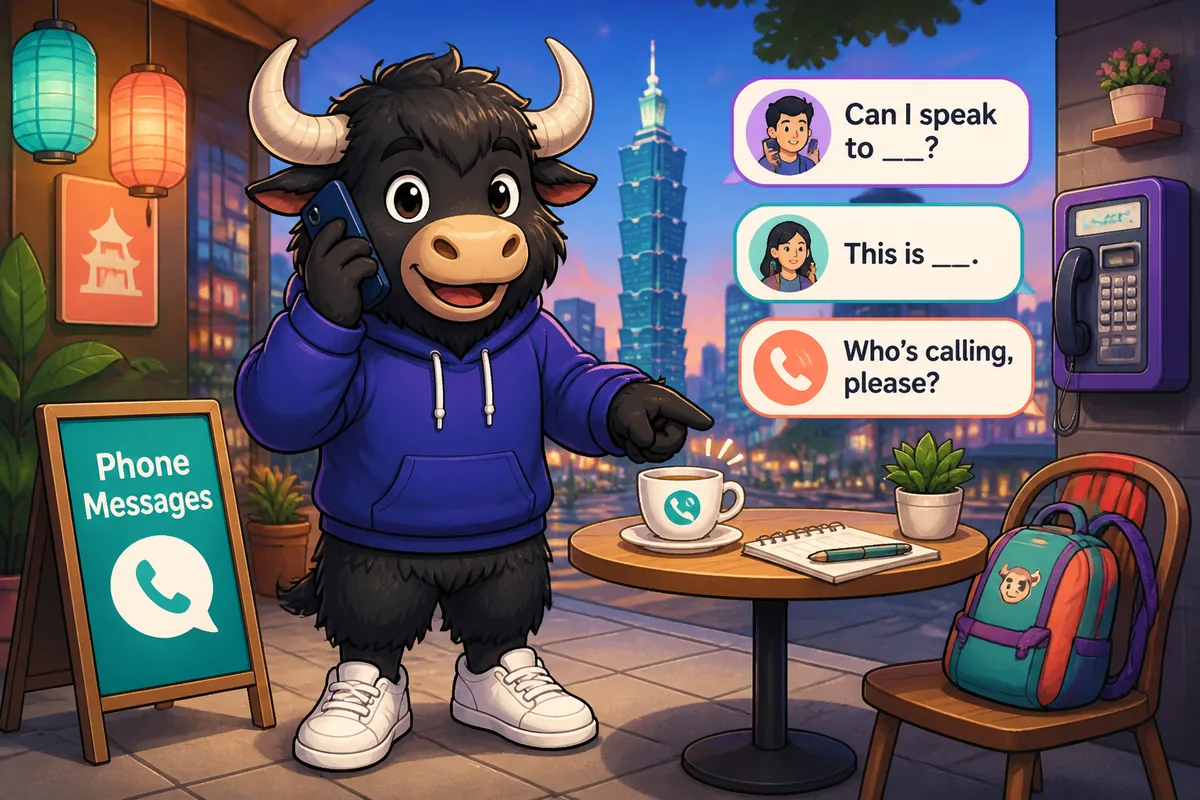
請問可以找___嗎?
Qǐngwèn kěyǐ zhǎo ___ ma?
Can I speak to ___?
Meaning: 請問可以找___嗎? (Qǐngwèn kěyǐ zhǎo ___ ma?) means “Can I speak to ___?”
When to use: Use it when you call and want to be connected to a specific person.
Tip: Do not translate word by word as “Can I find ___?” On the phone, 找 (zhǎo) naturally means “speak to / get.”
Examples ▼ 請問可以找 Sarah 嗎?
Qǐngwèn kěyǐ zhǎo Sarah ma?
Can I speak to Sarah?
請問可以找 David 嗎?我是 Anna。
Qǐngwèn kěyǐ zhǎo David ma? Wǒ shì Anna.
Can I speak to David? This is Anna.
我是___
Wǒ shì ___.
This is ___.
Meaning: 我是___。 (Wǒ shì ___.) means “This is ___.”
When to use: Use it to identify yourself on the phone.
Examples ▼ 我是 Anna
Wǒ shì Anna.
This is Anna.
您好,我是 David。
Nín hǎo, wǒ shì David.
Hello, this is David.
請問您是哪位
Qǐngwèn nín shì nǎ wèi?
Who's calling, please?
Meaning: 請問您是哪位? (Qǐngwèn nín shì nǎ wèi?) means “Who’s calling, please?”
When to use: Use it politely when you answer the phone and need to know the caller’s identity.
Tip: 哪位 (nǎ wèi) is the polite phone-style way to ask “who.” Avoid using 你是誰? (Nǐ shì shéi?) here; it can sound too direct.
Examples ▼ 請問您是哪位
Qǐngwèn nín shì nǎ wèi?
Who’s calling, please?
不好意思,請問您是哪位?
Bù hǎoyìsi, qǐngwèn nín shì nǎ wèi?
Sorry, who’s calling, please?
請問___在嗎?
Qǐngwèn ___ zài ma?
Is ___ there?
Meaning: 請問___在嗎? (Qǐngwèn ___ zài ma?) means “Is ___ there?”
When to use: Use it to check if someone is available to take your call.
Examples ▼ 請問 Anna 在嗎?
Qǐngwèn Anna zài ma?
Is Anna there?
請問 Mike 在嗎?我是 Sarah。
Qǐngwèn Mike zài ma? Wǒ shì Sarah.
Is Mike there? This is Sarah.
___現在不方便接電話。
___ xiànzài bù fāngbiàn jiē diànhuà.
___ is not available right now.
Meaning: ___現在不方便接電話。 (___ xiànzài bù fāngbiàn jiē diànhuà.) means “___ is not available right now.”
When to use: Use it when answering for someone who cannot take the call at the moment.
Examples ▼ Sarah 現在不方便接電話。
Sarah xiànzài bù fāngbiàn jiē diànhuà.
Sarah is not available right now.
David 現在不方便接電話,需要幫您留言嗎?
David xiànzài bù fāngbiàn jiē diànhuà, xūyào bāng nín liúyán ma?
David is not available right now. Can I take a message?
需要幫您留言嗎?
Xūyào bāng nín liúyán ma?
Can I take a message?
Meaning: 需要幫您留言嗎? (Xūyào bāng nín liúyán ma?) means “Can I take a message?”
When to use: Use it when someone is not available and you want to offer to write down a message.
Examples ▼ 需要幫您留言嗎?
Xūyào bāng nín liúyán ma?
Can I take a message?
Anna 現在不方便接電話,需要幫您留言嗎?
Anna xiànzài bù fāngbiàn jiē diànhuà, xūyào bāng nín liúyán ma?
Anna is not available right now. Can I take a message?
可以請___回電給我嗎?
Kěyǐ qǐng ___ huídiàn gěi wǒ ma?
Could you ask ___ to call me back?
Meaning: 可以請___回電給我嗎? (Kěyǐ qǐng ___ huídiàn gěi wǒ ma?) means “Could you ask ___ to call me back?”
When to use: Use it when leaving a message and you want the person to return your call.
Examples ▼ 可以請 Sarah 回電給我嗎?
Kěyǐ qǐng Sarah huídiàn gěi wǒ ma?
Could you ask Sarah to call me back?
我想留個言,可以請 David 回電給我嗎?
Wǒ xiǎng liú ge yán, kěyǐ qǐng David huídiàn gěi wǒ ma?
I’d like to leave a message. Could you ask David to call me back?
我的電話是___。
Wǒ de diànhuà shì ___.
My number is ___.
Meaning: 我的電話是___。 (Wǒ de diànhuà shì ___.) means “My number is ___.”
When to use: Use it when giving your phone number in a message.
Examples ▼ 我的電話是 0912-345-678。
Wǒ de diànhuà shì líng jiǔ yī èr-sān sì wǔ-liù qī bā.
My number is 0912-345-678.
請跟 Anna 說我有打來。我的電話是 0988-123-456。
Qǐng gēn Anna shuō wǒ yǒu dǎ lái. Wǒ de diànhuà shì líng jiǔ bā bā-yī èr sān-sì wǔ liù.
Please tell Anna I called. My number is 0988-123-456.
不好意思,我打錯了。
Bù hǎoyìsi, wǒ dǎ cuò le.
Sorry, I have the wrong number.
Meaning: 不好意思,我打錯了。 (Bù hǎoyìsi, wǒ dǎ cuò le.) means “Sorry, I have the wrong number.”
When to use: Use it when you realize you called the wrong person or wrong number.
Tip: 打錯了 (dǎ cuò le) is the natural phrase for dialing wrong. You do not need to say “wrong phone” directly.
Examples ▼ 不好意思,我打錯了。
Bù hǎoyìsi, wǒ dǎ cuò le.
Sorry, I have the wrong number.
不好意思,我打錯了。我晚點再打。
Bù hǎoyìsi, wǒ dǎ cuò le. Wǒ wǎn diǎn zài dǎ.
Sorry, I have the wrong number. I’ll call again later.
我晚點再打給你。
Wǒ wǎn diǎn zài dǎ gěi nǐ.
I'll call back later.
Meaning: 我晚點再打給你。 (Wǒ wǎn diǎn zài dǎ gěi nǐ.) means “I’ll call you back later.”
When to use: Use it when you cannot talk now or will try again later.
Examples ▼ 我現在不方便,我晚點再打給你。
Wǒ xiànzài bù fāngbiàn, wǒ wǎn diǎn zài dǎ gěi nǐ.
It’s not convenient for me right now. I’ll call you back later.
不好意思,我晚點再打給你。
Bù hǎoyìsi, wǒ wǎn diǎn zài dǎ gěi nǐ.
Sorry, I’ll call you back later.
我想留個言
Wǒ xiǎng liú ge yán.
I'd like to leave a message.
Meaning: 我想留個言。 (Wǒ xiǎng liú ge yán.) means “I’d like to leave a message.”
When to use: Use it when the person is not available and you want to leave a message.
Examples ▼ 我想留個言
Wǒ xiǎng liú ge yán.
I’d like to leave a message.
Sarah 現在不方便接電話。好,那我想留個言。
Sarah xiànzài bù fāngbiàn jiē diànhuà. Hǎo, nà wǒ xiǎng liú ge yán.
Sarah is not available right now. Okay, then I’d like to leave a message.
留言內容是___。
Liúyán nèiróng shì ___.
The message is ___.
Meaning: 留言內容是___。 (Liúyán nèiróng shì ___.) means “The message is ___.”
When to use: Use it to clearly state the content of your phone message.
Examples ▼ 留言內容是:請回電給我。
Liúyán nèiróng shì: qǐng huídiàn gěi wǒ.
The message is: please call me back.
留言內容是:明天的會議改時間。
Liúyán nèiróng shì: míngtiān de huìyì gǎi shíjiān.
The message is: tomorrow’s meeting time has changed.
請跟___說我有打來。
Qǐng gēn ___ shuō wǒ yǒu dǎ lái.
Please tell ___ I called.
Meaning: 請跟___說我有打來。 (Qǐng gēn ___ shuō wǒ yǒu dǎ lái.) means “Please tell ___ I called.”
When to use: Use it when you only need the person to know that you called.
Examples ▼ 請跟 Sarah 說我有打來。
Qǐng gēn Sarah shuō wǒ yǒu dǎ lái.
Please tell Sarah I called.
請跟 David 說我有打來,我晚點再打給他。
Qǐng gēn David shuō wǒ yǒu dǎ lái, wǒ wǎn diǎn zài dǎ gěi tā.
Please tell David I called. I’ll call him again later.
You call and want to speak to Sarah. What should you say? 請問可以找 Sarah 嗎? Sarah 現在不方便接電話。 不好意思,我打錯了。
Someone calls, and you want to ask who is calling. Which phrase fits? 我的電話是 0912-345-678。 我晚點再打給你。 請問您是哪位
Sarah cannot answer the phone. What can Anna say? 請問 Sarah 在嗎? 我是 Sarah。 Sarah 現在不方便接電話。
You realize you called the wrong number. What should you say? 不好意思,我打錯了。 需要幫您留言嗎? 我想留個言
Hello, can I speak to Mike? A:您好,這裡是 Mike 的辦公室。B:___ Mike 嗎?
A: Nín hǎo, zhèlǐ shì Mike de bàngōngshì. B: ___ Mike ma?
請問可以找 留言內容是 需要幫您留言嗎 我打錯了
David is not available right now. Can I take a message? David 現在不方便接電話。___?
David xiànzài bù fāngbiàn jiē diànhuà. ___?
請問 David 在嗎 我的電話是 需要幫您留言嗎 我是 Anna
Could you ask Anna to call me back? A:Anna 現在不方便接電話。B:可以請 Anna ___?
A: Anna xiànzài bù fāngbiàn jiē diànhuà. B: Kěyǐ qǐng Anna ___?
在嗎 是哪位 打錯了 回電給我嗎
請問可以找___嗎? Qǐngwèn kěyǐ zhǎo ___ ma? 我是___ Wǒ shì ___. 請問您是哪位 Qǐngwèn nín shì nǎ wèi? 請問___在嗎? Qǐngwèn ___ zài ma? ___現在不方便接電話。 ___ xiànzài bù fāngbiàn jiē diànhuà. 需要幫您留言嗎? Xūyào bāng nín liúyán ma? 可以請___回電給我嗎? Kěyǐ qǐng ___ huídiàn gěi wǒ ma? 我的電話是___。 Wǒ de diànhuà shì ___. Can I speak to ___? This is ___. Who’s calling, please? Is ___ there? ___ is not available right now. Can I take a message? Could you ask ___ to call me back? My number is ___.
不好意思,我打錯了。 Bù hǎoyìsi, wǒ dǎ cuò le. 我晚點再打給你。 Wǒ wǎn diǎn zài dǎ gěi nǐ. 我想留個言 Wǒ xiǎng liú ge yán. 留言內容是___。 Liúyán nèiróng shì ___. 請跟___說我有打來。 Qǐng gēn ___ shuō wǒ yǒu dǎ lái. Sarah 現在不方便接電話。 Sarah xiànzài bù fāngbiàn jiē diànhuà. Sorry, I have the wrong number. I’ll call you back later. I’d like to leave a message. The message is ___. Please tell ___ I called. Sarah is not available right now.
Recording stays on your device only. Check speech uses your browser's speech tools when available.
Say this phrase out loud:
請問可以找___嗎?
Qǐngwèn kěyǐ zhǎo ___ ma?
Can I speak to ___?
Check speech
Record Play back
Say this phrase out loud:
我是___
Wǒ shì ___.
This is ___.
Check speech
Record Play back
Say this phrase out loud:
請問您是哪位
Qǐngwèn nín shì nǎ wèi?
Who's calling, please?
Check speech
Record Play back
Say this phrase out loud:
請問___在嗎?
Qǐngwèn ___ zài ma?
Is ___ there?
Check speech
Record Play back
Say this phrase out loud:
___現在不方便接電話。
___ xiànzài bù fāngbiàn jiē diànhuà.
___ is not available right now.
Check speech
Record Play back
Say this phrase out loud:
需要幫您留言嗎?
Xūyào bāng nín liúyán ma?
Can I take a message?
Check speech
Record Play back
Say this phrase out loud:
可以請___回電給我嗎?
Kěyǐ qǐng ___ huídiàn gěi wǒ ma?
Could you ask ___ to call me back?
Check speech
Record Play back
Say this phrase out loud:
我的電話是___。
Wǒ de diànhuà shì ___.
My number is ___.
Check speech
Record Play back
Say this phrase out loud:
不好意思,我打錯了。
Bù hǎoyìsi, wǒ dǎ cuò le.
Sorry, I have the wrong number.
Check speech
Record Play back
Say this phrase out loud:
我晚點再打給你。
Wǒ wǎn diǎn zài dǎ gěi nǐ.
I'll call you back later.
Check speech
Record Play back
Say this phrase out loud:
我想留個言
Wǒ xiǎng liú ge yán.
I'd like to leave a message.
Check speech
Record Play back
Say this phrase out loud:
留言內容是___。
Liúyán nèiróng shì ___.
The message is ___.
Check speech
Record Play back
Say this phrase out loud:
請跟___說我有打來。
Qǐng gēn ___ shuō wǒ yǒu dǎ lái.
Please tell ___ I called.
Check speech
Record Play back