
New here? This is lesson 138 of a free 240-lesson Traditional Chinese course.
Phone, charger and Wi-Fi in Traditional Chinese
At a Taipei café, your phone suddenly goes dark while you are trying to get online. A-Li notices and offers help from one of his many pockets.
Learn to say your phone has no battery, ask to borrow a charger, and ask for the Wi-Fi password.
Then explain a slow connection or no reception, and offer to turn on a hotspot. A-Li's soy milk is still unfinished.
By the end of this lesson
Explain common phone and internet problems, ask to borrow a charger, ask for the Wi-Fi password, and offer a hotspot.
- 我的手機沒電了My phone is out of battery.
- 可以借我充電器嗎?May I borrow a charger?
- Wi-Fi 密碼是什麼?What's the Wi-Fi password?
- 網路很慢The internet is slow.
- 我沒有收訊I don't have reception.
- 我來開個熱點I'll turn on a hotspot.
Scene — a café phone problem
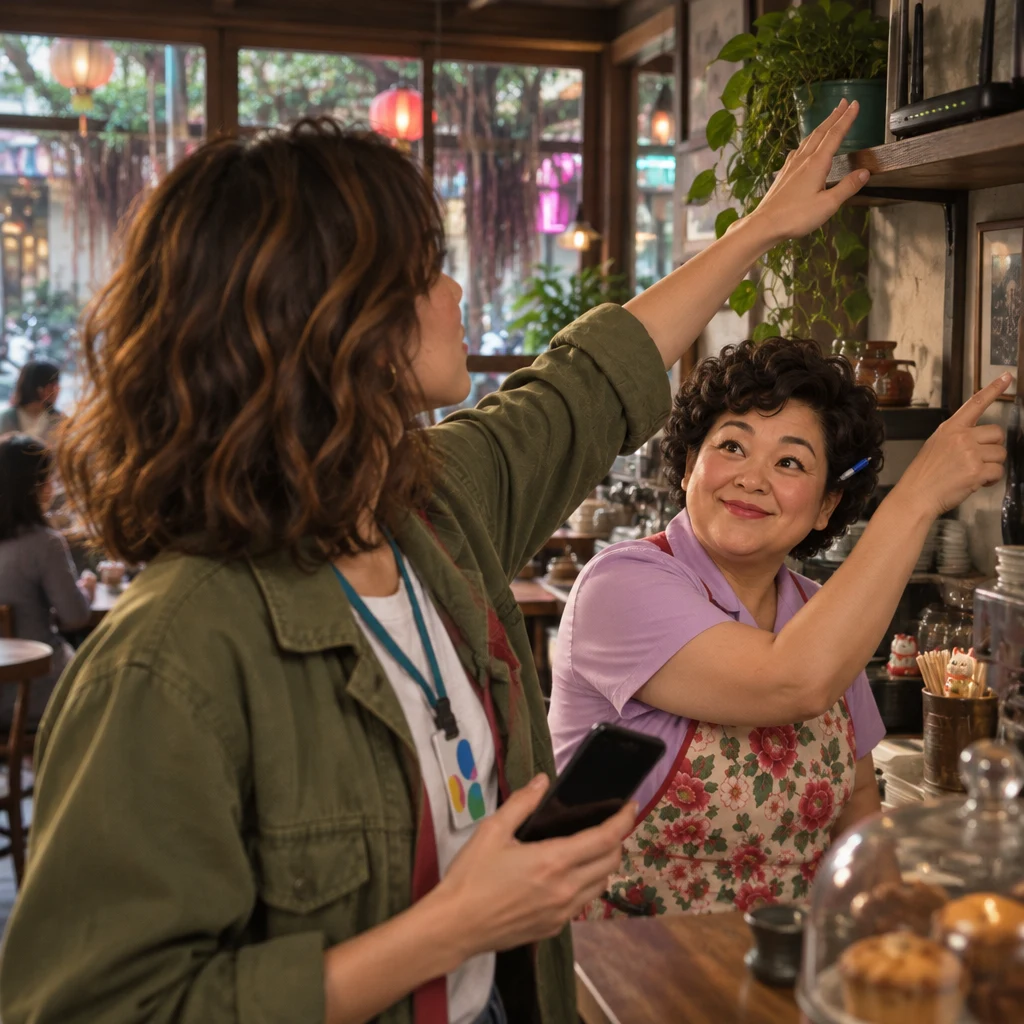
Late afternoon at a small café near Banyan Lane, Maya is trying to send a work message when her phone shuts off. The shop Wi-Fi is slow, and the signal inside is weak.
A-Li is nearby with his unfinished soy milk. He checks a pocket, finds a cable, and offers to help; nothing about the fortune slip is explained.

Learn — phone and internet help
These six lines cover common café phone problems: a dead battery, a charger, Wi-Fi, slow internet, reception, and a hotspot.
Notice how questions ask for information, while short statements explain the problem.

我的手機沒電了
My phone is out of battery.
When to use it: Use this when your phone has run out of battery.
了 marks a change of state: the battery ran out, so the phone is now dead.

可以借我充電器嗎?
May I borrow a charger?
When to use it: Use this polite question when asking someone to lend you a charger.
可以 makes this borrowing request polite; 嗎 turns it into a yes-or-no question.
Wi-Fi 密碼是什麼?
What's the Wi-Fi password?
When to use it: Ask this when you want to connect to a place's Wi-Fi.
什麼 asks what; question words stay in the position of the information they ask about.

網路很慢
The internet is slow.
When to use it: Use this to describe a slow internet connection.
很 commonly links a subject to an adjective in a simple description.

我沒有收訊
I don't have reception.
When to use it: Say this when your phone has no reception.
沒有 before 收訊 says you lack reception, not that you missed a message.

我來開個熱點
I'll turn on a hotspot.
When to use it: Offer this when someone needs an internet connection.
個 is the measure word used before 熱點 in this phrase.
Story — a cable in A-Li's pocket
Maya is at a café near Banyan Lane when her phone runs out of battery. Auntie Lin and A-Li help her get connected.
A-Li finds a cable in one of his pockets. His soy milk remains unfinished, and the fortune slip stays a mystery.
 Maya不好意思,我的手機沒電了。Excuse me, my phone is out of battery.
- Maya可以借我充電器嗎?May I borrow a charger?
 Auntie Lin好喔,阿犛,你有充電器嗎?Sure. A-Li, do you have a charger?
 A-Li有,口袋裡有一條線。Yes, there's a cable in my pocket.
- Maya好,謝謝,我先充一下電。Okay, thanks. I'll charge my phone first.
- MayaWi-Fi 密碼是什麼?What's the Wi-Fi password?
- Auntie Lin密碼在櫃檯旁邊喔。The password is beside the counter.
- Maya網路很慢。The internet is slow.
- Auntie Lin今天店裡人多,可能比較慢。It's crowded in the café today, so it may be slower.
- Maya我沒有收訊。I don't have reception.
- A-Li我來開個熱點。I'll turn on a hotspot.
- Maya謝謝。Thank you.
- A-Li好喔,這條線先借你用。Sure, you can use this cable for now.
- Maya我先充一下電,再試試看。I'll charge it a little first, then try again.
Practice — get connected
Try eight exercises for phone trouble at a café. Listen, choose a useful response, and put words in the right order.
Each item has one best answer for the situation. Review the explanations, then say the lines aloud.
0 of 8 done
What does it mean?
What does it mean?
我的手機沒電了
What do you say?
What do you say?
Your phone is dead. Ask the café owner if you may borrow a charger.
Build the line
Build the line
The internet is slow.
Tap the words in order.
Fill the gap
Fill the gap
I don't have reception.
我沒有____
What did you hear?
What did you hear?
Pick the reply
Auntie Lin says:
Pick the reply
網路很慢
The internet is slow.
And you reply with:
What do you say?
What do you say?
You want to get the café owner's attention before asking a question.
Pick the reply
Auntie Lin says:
Pick the reply
充電器在這裡,拿去用吧。
The charger is here; go ahead and use it.
And you reply with:
Say it — ask and offer help
You play Maya at the café. Listen to Auntie Lin and A-Li, then answer with the line that fits each moment.
Speak each line aloud and keep the conversation moving. You can replay the other person's turn before you respond.
- Maya notices that her phone has stopped working.
- Auntie Lin你的手機怎麼了?What's wrong with your phone?
- Maya (you)Explain that your phone has run out of battery.
Explain that your phone has run out of battery.
我的手機沒電了
My phone is out of battery.
0 of 6 said
Recap — what you can say now
| Traditional Chinese | English | Play |
|---|---|---|
| 我的手機沒電了 | My phone is out of battery. | |
| 可以借我充電器嗎? | May I borrow a charger? | |
| Wi-Fi 密碼是什麼? | What's the Wi-Fi password? | |
| 網路很慢 | The internet is slow. | |
| 我沒有收訊 | I don't have reception. | |
| 我來開個熱點 | I'll turn on a hotspot. |
Save your progress — it’s free
Keep your place in the course and see which lines you’ve learned.
Want the next lesson in your inbox?
Get the next lesson by email, one a day.
Join the newsletterDaily lesson emails are coming soon. Newsletter subscribers get them first.
Keep practicing with Yak Cards
Keep these useful phone and internet lines in Yak Cards.
Review the questions and problem descriptions so you can use them when your connection acts up.
Open Yak Cards