
New here? This is lesson 16 of a free 240-lesson Traditional Chinese course.
Bigger numbers in Traditional Chinese
At Banyan Breakfast, the bill shows a number Maya has not seen before. Auntie Lin reads it aloud twice, while A-Li counts on his hooves.
Learn numbers from eleven to twelve hundred, and recognize amounts in dollars. Then practice hearing a number, reading a bill, and talking about change.
The amounts stay practical and familiar. A-Li is still distracted by counting, and his soy milk remains unfinished.
By the end of this lesson
Say numbers from eleven to twelve hundred and understand a bill and its change.
- 十一Eleven.
- 二十五Twenty-five.
- 一百塊One hundred dollars.
- 兩百三十Two hundred thirty.
- 一千二Twelve hundred.
- 找你五十塊Here's fifty dollars in change.
Scene — the bill at the counter
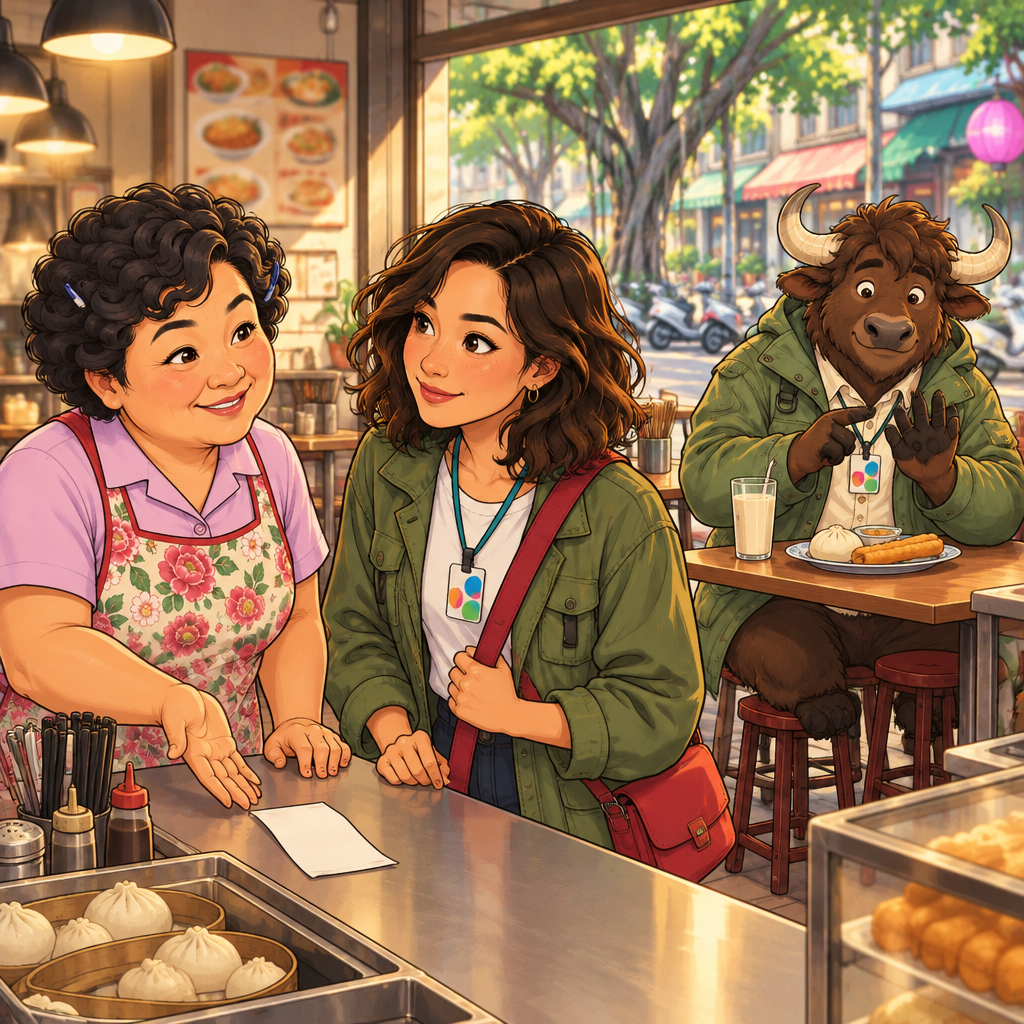
At Banyan Breakfast in Da'an, Auntie Lin puts a bill on the counter and reads the amount aloud twice for Maya and A-Li. A-Li watches from his usual table and counts on his hooves.
Another customer waits nearby for change. The numbers are ordinary, even when they grow large, and A-Li's soy milk is still unfinished.
Learn — numbers beyond ten
These six chunks help you say larger numbers and understand money amounts. Listen to each one, then say it aloud.
Notice how 一 sounds before 百 and 千. Learn the other number chunks as whole pieces.

十一
Eleven.
When to use it: Use this number when counting or naming an amount.
Learn it as one piece.

二十五
Twenty-five.
When to use it: Use this number when counting or naming an amount.
Learn it as one piece.

一百塊
One hundred dollars.
When to use it: Use this for an amount of one hundred dollars.
Learn it as one piece.
Say it: 一 takes a falling tone before 百.

兩百三十
Two hundred thirty.
When to use it: Use this number when naming a count or amount.
Learn it as one piece.
一千二
Twelve hundred.
When to use it: Use this casual number for twelve hundred.
Learn it as one piece.
Say it: 一 takes a falling tone before 千.

找你五十塊
Here's fifty dollars in change.
When to use it: Use this when giving someone fifty dollars in change.
Learn it as one piece.
Story — counting at breakfast
A bill at Banyan Breakfast gives Maya a chance to hear a larger number. Auntie Lin reads the amount twice, and A-Li counts on his hooves.
A customer is waiting for change while the neighbors talk about other everyday amounts.
 Maya你好。Hello.
 Auntie Lin帳單一百三十五塊。一百三十五。The bill is one hundred thirty-five dollars. One hundred thirty-five.
 A-Li我用蹄子數到十一。I count to eleven on my hooves.
- Maya一百塊。再給你三十五塊。One hundred dollars. I'll give you another thirty-five dollars.
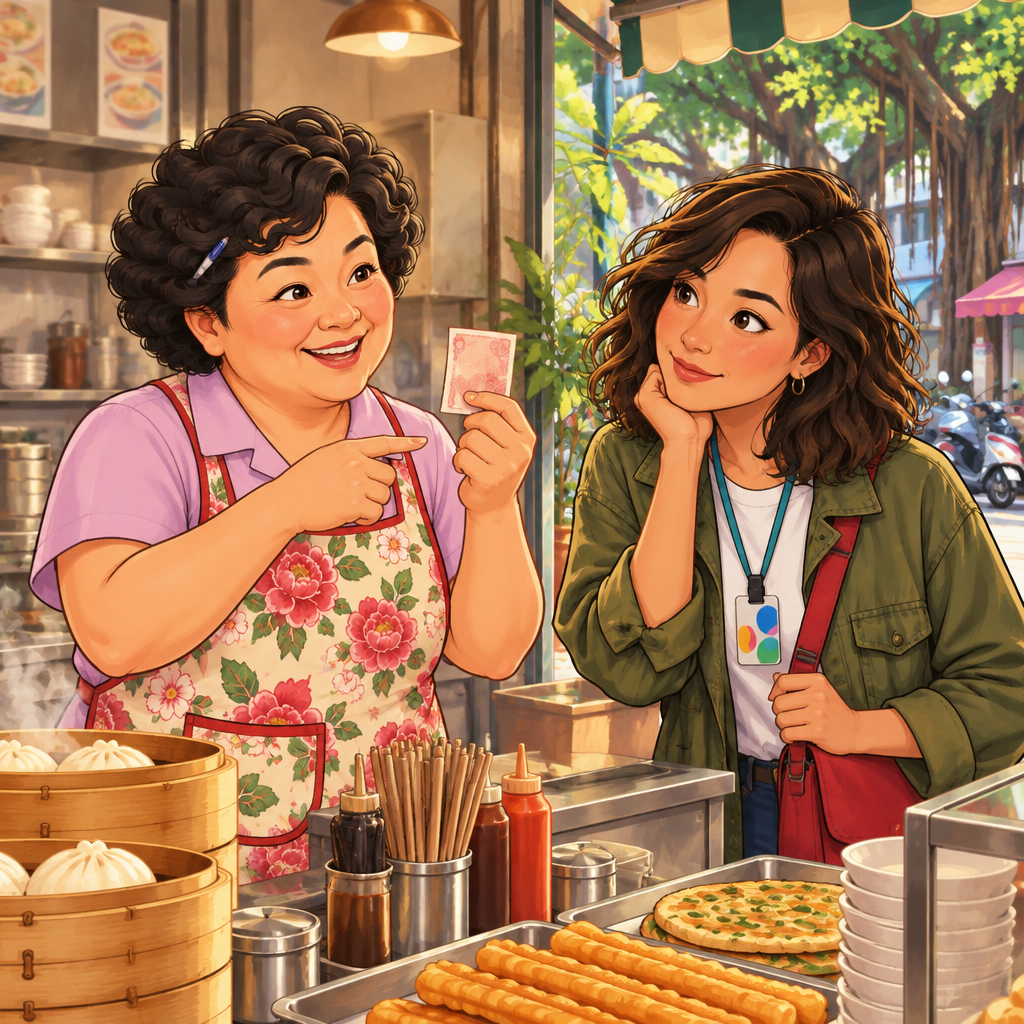
- Auntie Lin早餐兩百三十塊。找你五十塊。The breakfast is two hundred thirty dollars. Here's fifty dollars in change.
- A-Li二十五。一千二?好貴喔。Twenty-five. Twelve hundred? That's expensive.
Practice — read the amounts
Try ten short exercises with number words, amounts, and change. Listen carefully, choose the fitting number, and build a few lines.
Some choices are familiar greetings from earlier lessons, so keep the situation in mind.
0 of 10 done
What does it mean?
What does it mean?
你好
What do you say?
What do you say?
Say the exact phrase “Good morning” to Auntie Lin at her breakfast shop.
What do you say?
What do you say?
Auntie Lin asks you to count to eleven. Say the number.
Build the line
Build the line
Twenty-five.
Tap the words in order.
Fill the gap
Fill the gap
One hundred dollars.
一____塊
Match the pairs
Traditional Chinese
十一Drop the English here二十五Drop the English here兩百三十Drop the English here一千二Drop the English hereEnglish
What did you hear?
What did you hear?
Swap the word
Swap the word
Change the amount to fifty dollars in this phrase.
找你____塊
Pick the reply
Auntie Lin says:
Pick the reply
這台新腳踏車多少錢?
How much is this new bicycle?
And you reply with:
What do you say?
What do you say?
Auntie Lin asks what number the table's breakfast costs. Say two hundred thirty.
Say it — your turn at the counter
You are Maya at Banyan Breakfast. Listen to Auntie Lin, A-Li, and a customer, then say the number or amount that fits.
Speak each answer aloud and keep the short chunks together. The final turn is yours.
- Maya helps Auntie Lin with the bill and counts with A-Li.
- Auntie Lin這些零錢一共多少?How much are these coins altogether?
- Maya (you)Say the total is twenty-five dollars.
Say the total is twenty-five dollars.
二十五
Twenty-five.
0 of 4 said
Recap — what you can say now
| Traditional Chinese | English | Play |
|---|---|---|
| 十一 | Eleven. | |
| 二十五 | Twenty-five. | |
| 一百塊 | One hundred dollars. | |
| 兩百三十 | Two hundred thirty. | |
| 一千二 | Twelve hundred. | |
| 找你五十塊 | Here's fifty dollars in change. |
Save your progress — it’s free
Keep your place in the course and see which lines you’ve learned.
Want the next lesson in your inbox?
Get the next lesson by email, one a day.
Join the newsletterDaily lesson emails are coming soon. Newsletter subscribers get them first.
Keep practicing with Yak Cards
Today's number chunks are in Yak Cards with more useful lines for everyday errands.
Review the number cards aloud so amounts become easier to recognize.
Open Yak Cards