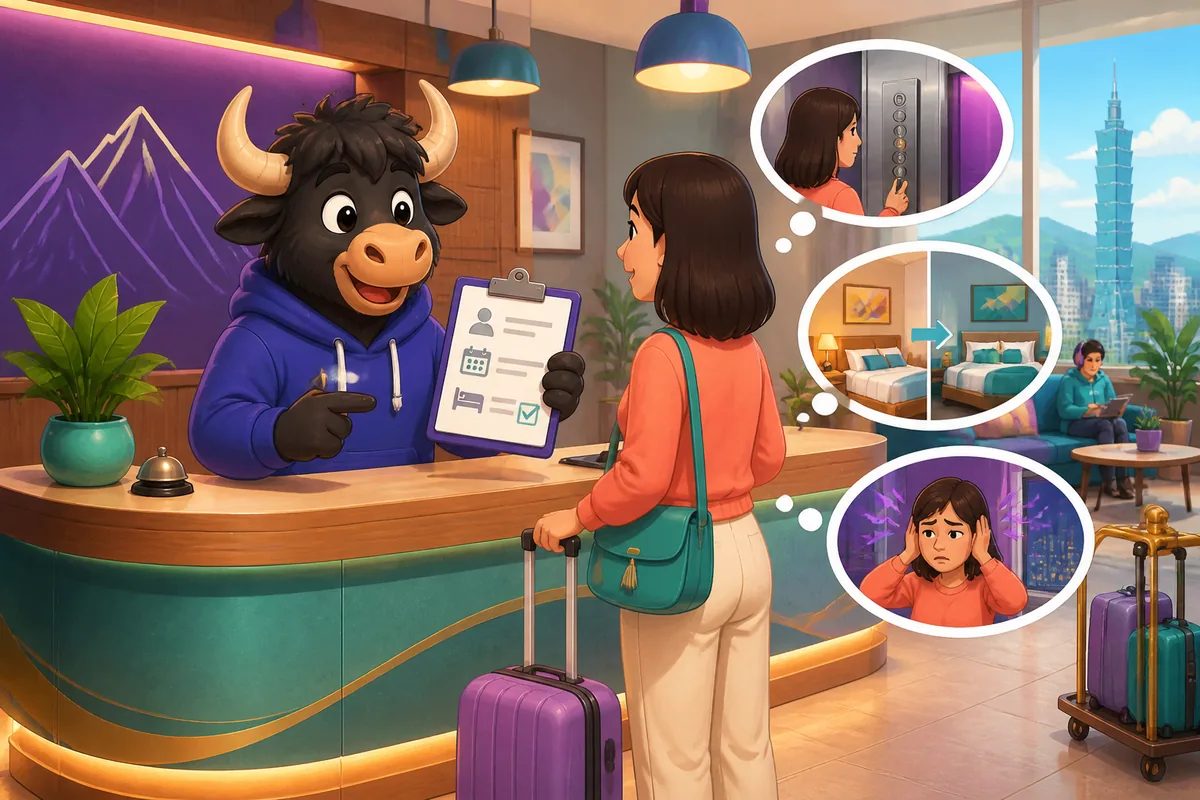
Welcome back, traveler. Today we’re taking your Taiwan Mandarin to the hotel front desk—where a few calm phrases can save a lot of suitcase-dragging.
Level A2: In this lesson, you’ll practice practical hotel phrases for checking whether your room is ready, asking what floor it’s on, reporting noise or broken air conditioning, and requesting things like a wake-up call or late check-out. It’s a small “room service” boost for your speaking confidence—Yak Yacker promises not to charge a resort fee.
After this lesson you'll be able to:
Ask room basics with 我的房間在幾樓? (Wǒ de fángjiān zài jǐ lóu?) and 我的房間好了嗎? (Wǒ de fángjiān hǎo le ma?).
Politely request help with 可以幫我換房間嗎? (Kěyǐ bāng wǒ huàn fángjiān ma?) and 可以延後退房嗎? (Kěyǐ yánhòu tuìfáng ma?).
Report common hotel problems like 房間太吵了。 (Fángjiān tài chǎo le.) and 冷氣壞了。 (Lěngqì huài le.).
Say your stay length and ask about hotel services using 我訂的是___晚。 (Wǒ dìng de shì ___ wǎn.), 可以幫我安排___的morning call嗎? (Kěyǐ bāng wǒ ānpái ___ de morning call ma?), and 有停車位嗎? (Yǒu tíngchēwèi ma?).
Ready? Let's go!
When you tap play on phrases, we track your progress through this lesson.
1. Reading + Listening Practice
Hear core phrases, repeat aloud.
我的房間在幾樓?
Wǒ de fángjiān zài jǐ lóu?
What floor is my room on?
Meaning: 我的房間在幾樓? (Wǒ de fángjiān zài jǐ lóu?) means “What floor is my room on?”
When to use: Use it during check-in when you have your room number but want to know the floor.
不好意思,我的房間在幾樓?
Bù hǎoyìsi, wǒ de fángjiān zài jǐ lóu?
Excuse me, what floor is my room on?
請問,我的房間在幾樓?
Qǐngwèn, wǒ de fángjiān zài jǐ lóu?
May I ask, what floor is my room on?
可以幫我換房間嗎?
Kěyǐ bāng wǒ huàn fángjiān ma?
Could I change rooms?
Meaning: 可以幫我換房間嗎? (Kěyǐ bāng wǒ huàn fángjiān ma?) means “Could I change rooms?”
When to use: Use it politely at the front desk when your room has a problem or you need a different room.
房間太吵了,可以幫我換房間嗎?
Fángjiān tài chǎo le, kěyǐ bāng wǒ huàn fángjiān ma?
The room is too noisy. Could I change rooms?
不好意思,可以幫我換房間嗎?
Bù hǎoyìsi, kěyǐ bāng wǒ huàn fángjiān ma?
Sorry, could I change rooms?
房間太吵了
Fángjiān tài chǎo le.
The room is too noisy.
Meaning: 房間太吵了。 (Fángjiān tài chǎo le.) means “The room is too noisy.”
When to use: Use it to clearly but politely tell hotel staff there is a noise problem.
不好意思,房間太吵了。
Bù hǎoyìsi, fángjiān tài chǎo le.
Sorry, the room is too noisy.
房間太吵了,可以幫我換房間嗎?
Fángjiān tài chǎo le, kěyǐ bāng wǒ huàn fángjiān ma?
The room is too noisy. Could I change rooms?
冷氣壞了
Lěngqì huài le.
The air conditioning isn't working.
Meaning: 冷氣壞了。 (Lěngqì huài le.) means “The air conditioning isn’t working.”
When to use: Use it when the AC in your hotel room is broken or not working properly.
Tip: In Taiwan, 冷氣 (lěngqì) is the everyday word for air conditioning. 空調 (kōngtiáo) is understandable, but it can sound less casual.
不好意思,冷氣壞了。
Bù hǎoyìsi, lěngqì huài le.
Sorry, the air conditioning isn’t working.
我的房間冷氣壞了。
Wǒ de fángjiān lěngqì huài le.
The air conditioning in my room isn’t working.
可以幫我安排___的morning call嗎?
Kěyǐ bāng wǒ ānpái ___ de morning call ma?
Could I get a wake-up call at ___?
Meaning: 可以幫我安排___的morning call嗎? (Kěyǐ bāng wǒ ānpái ___ de morning call ma?) means “Could I get a wake-up call at ___?”
When to use: Use it at a hotel when you want the front desk to arrange a wake-up call. Put the time in the blank.
Tip: In many Taiwan hotels, people really do say morning call. Keep it in the phrase instead of translating it word by word.
Could I get a wake-up call at 6:30 tomorrow morning?
有停車位嗎
Yǒu tíngchēwèi ma?
Is parking available?
Meaning: 有停車位嗎? (Yǒu tíngchēwèi ma?) means “Is parking available?”
When to use: Use it before or during check-in if you are driving and need a parking space.
請問,有停車位嗎?
Qǐngwèn, yǒu tíngchēwèi ma?
May I ask, is parking available?
我們有開車,有停車位嗎?
Wǒmen yǒu kāichē, yǒu tíngchēwèi ma?
We drove here. Is parking available?
我訂的是___晚。
Wǒ dìng de shì ___ wǎn.
My booking is for ___ nights.
Meaning: 我訂的是___晚。 (Wǒ dìng de shì ___ wǎn.) means “My booking is for ___ nights.”
When to use: Use it at check-in to tell the hotel how many nights you booked.
我訂的是兩晚
Wǒ dìng de shì liǎng wǎn.
My booking is for two nights.
你好,我訂的是三晚。
Nǐ hǎo, wǒ dìng de shì sān wǎn.
Hi, my booking is for three nights.
我的房間好了嗎?
Wǒ de fángjiān hǎo le ma?
Is my room ready?
Meaning: 我的房間好了嗎? (Wǒ de fángjiān hǎo le ma?) means “Is my room ready?”
When to use: Use it when you arrive early or return to the front desk and want to ask if you can enter the room now.
請問,我的房間好了嗎?
Qǐngwèn, wǒ de fángjiān hǎo le ma?
May I ask, is my room ready?
不好意思,我的房間好了嗎?
Bù hǎoyìsi, wǒ de fángjiān hǎo le ma?
Excuse me, is my room ready?
可以延後退房嗎?
Kěyǐ yánhòu tuìfáng ma?
Can I get a late check-out?
Meaning: 可以延後退房嗎? (Kěyǐ yánhòu tuìfáng ma?) means “Can I get a late check-out?”
When to use: Use it when you want permission to check out later than the normal time.
請問,可以延後退房嗎?
Qǐngwèn, kěyǐ yánhòu tuìfáng ma?
May I ask, can I get a late check-out?
明天可以延後退房嗎?
Míngtiān kěyǐ yánhòu tuìfáng ma?
Can I get a late check-out tomorrow?
我被鎖在房間外面了。
Wǒ bèi suǒ zài fángjiān wàimiàn le.
I locked myself out of my room.
Meaning: 我被鎖在房間外面了。 (Wǒ bèi suǒ zài fángjiān wàimiàn le.) means “I locked myself out of my room.”
When to use: Use it when your key card does not work or you cannot get back into your hotel room.
Tip: This phrase sounds dramatic in English, but it is natural in Mandarin. 被鎖在房間外面 (bèi suǒ zài fángjiān wàimiàn) means you are locked outside the room.
不好意思,我被鎖在房間外面了。
Bù hǎoyìsi, wǒ bèi suǒ zài fángjiān wàimiàn le.
Sorry, I locked myself out of my room.
我的房卡不能用,我被鎖在房間外面了。
Wǒ de fángkǎ bù néng yòng, wǒ bèi suǒ zài fángjiān wàimiàn le.
My key card doesn’t work. I locked myself out of my room.
2. Conversational Listening Practice
Hear phrases in a real mini-conversation.
Anna is checking in at a hotel front desk. David is helping her with her reservation and room requests.
Anna
你好,我訂的是兩晚。我的房間好了嗎?
Nǐ hǎo, wǒ dìng de shì liǎng wǎn. Wǒ de fángjiān hǎo le ma?
Hi, my booking is for two nights. Is my room ready?
David
好了,這是你的房卡。
Hǎo le, zhè shì nǐ de fángkǎ.
It’s ready. Here is your key card.
Anna
謝謝。我的房間在幾樓?
Xièxie. Wǒ de fángjiān zài jǐ lóu?
Thanks. What floor is my room on?
David
在八樓。請問你有開車嗎?
Zài bā lóu. Qǐngwèn nǐ yǒu kāichē ma?
It’s on the eighth floor. May I ask if you drove here?
Anna
有。有停車位嗎?
Yǒu. Yǒu tíngchēwèi ma?
Yes. Is parking available?
David
有,在地下二樓。
Yǒu, zài dìxià èr lóu.
Yes, on basement level two.
Anna
太好了。可以幫我安排明天七點的morning call嗎?
Tài hǎo le. Kěyǐ bāng wǒ ānpái míngtiān qī diǎn de morning call ma?
Great. Could I get a wake-up call at seven tomorrow?
3. Guided Practice
Quizzes and matching to lock in meaning.
You want to ask what floor your room is on. What should you say?
Your room is very noisy and you want a different room. Which phrase is best?
How do you say your booking is for two nights?
Your key card does not work and you cannot enter your room. What should you say?
Sorry, the air conditioning isn’t working.
不好意思,房間很熱,___
Bù hǎoyìsi, fángjiān hěn rè, ___
May I ask, can I get a late check-out?
請問,我明天想晚一點離開,___
Qǐngwèn, wǒ míngtiān xiǎng wǎn yìdiǎn líkāi, ___
Hi, my booking is for two nights.
櫃檯:請問您住幾晚?客人:___
Guìtái: Qǐngwèn nín zhù jǐ wǎn? Kèrén: ___
Match the core phrases
Match the extra phrases
4. Speaking Practice
Say phrases yourself (mic/recording).
Recording stays on your device only. Check speech uses your browser's speech tools when available.