
New here? This is lesson 217 of a free 238-lesson Spanish course.
Free Spanish CourseLesson 217 of 238
I don't buy that in Spanish
Yako has a grand version of the card story, and today it finally meets Justin's doubt.
You'll learn to say you're not convinced, ask where a claim comes from, and offer to check it.
These are the tools for arguing kindly in Mexican Spanish, and the card stays exactly where it is.
By the end of this lesson
Say you aren't convinced and ask where a claim comes from.
- No me convenceI'm not convinced
- ¿De dónde sale eso?Where does that come from?
- Suena bien, pero ___It sounds good, but ___
- Yo no lo veo asíI don't see it that way
- Habría que comprobarloSomeone would need to check it
- Puede ser, no digo que noCould be, I'm not saying it isn't
Scene — the prophet version
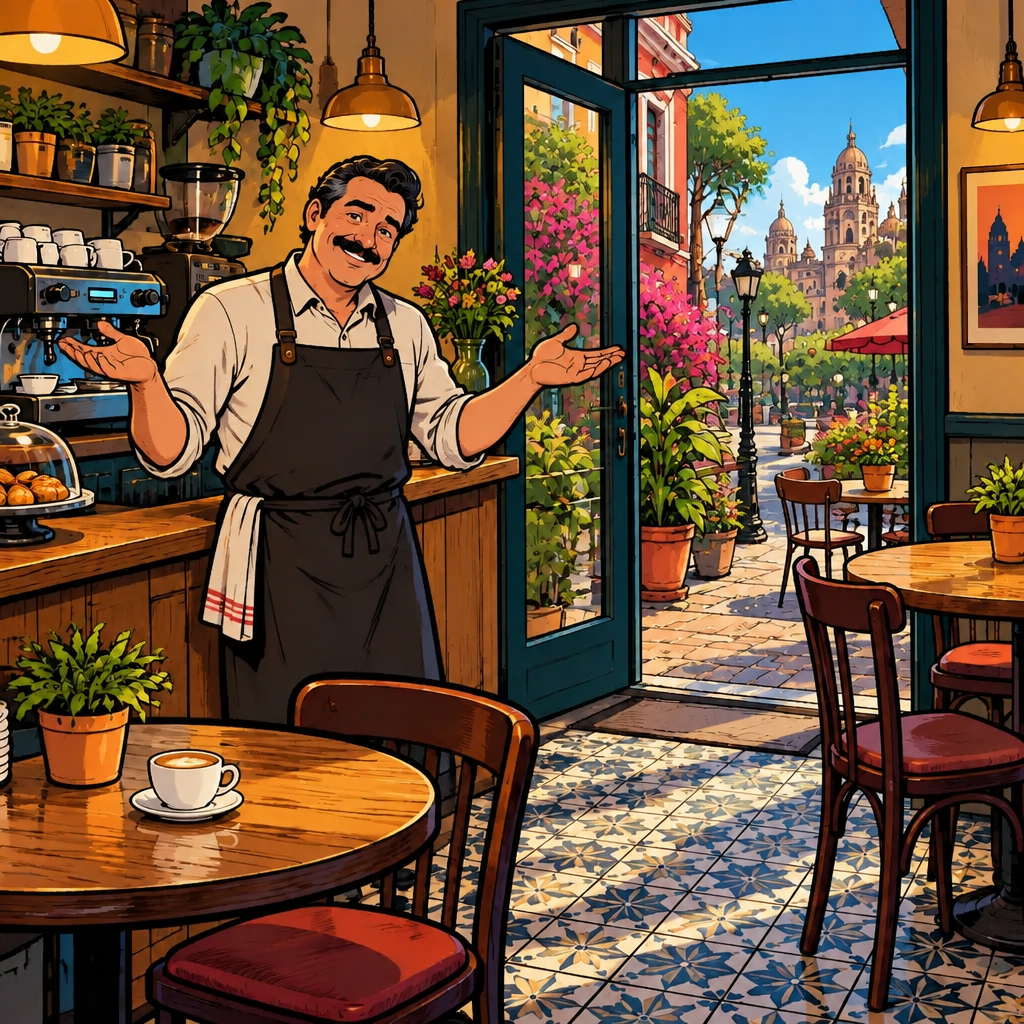
The same corner of Café Laurel, mid-afternoon. Yako has spent ten minutes retelling his prophet version of the card story, with hoof gestures.
Justin has heard it all before. Today, in a completely ordinary voice, he is going to push back. Michael is polishing cups behind the counter, listening to everything.

Learn — sourced doubt
Six lines that doubt without fighting. Some soften the blow, some ask for sources, and one admits you might be wrong.
Notice how polite pushback sounds in Mexico: firm, but never harsh.

No me convence
I'm not convinced
When to use it: Say this when someone's story or argument doesn't persuade you, said plainly and without heat.
Convencer works like gustar: the thing convinces you, so Spanish says it 'doesn't convince me'.
Say it: con-ben-SER, with the stress on the final syllable.

¿De dónde sale eso?
Where does that come from?
When to use it: Ask this to question where a claim or rumor comes from, not a physical place.
Salir here means to come from a source, like where a story 'comes out of'. It's the everyday Mexican way to ask for sourcing.

Suena bien, pero ___
It sounds good, but ___
When to use it: Use this to compliment an idea first, then deliver your objection after pero.
Fill the blank with your reason: Suena bien, pero no es verdad. Softening first is very Mexican.
Say it: SWEH-nah bee-EHN, PEH-roh.

Yo no lo veo así
I don't see it that way
When to use it: Say this when your view of a situation is simply different from someone else's.
The yo adds weight: it flags that this is your personal take, not a fact about the world.

Habría que comprobarlo
Someone would need to check it
When to use it: Suggest this when a claim should be verified before anyone believes it.
Habría que is impersonal: it says checking should happen without naming who. It's a polite way to say 'prove it'.
Puede ser, no digo que no
Could be, I'm not saying it isn't
When to use it: Use this to leave the door open without agreeing, a half-yes that stays neutral.
The phrase avoids a blunt yes or no: you acknowledge possibility without claiming the idea is true.
Story — a pocket and a pastry
Justin keeps his voice ordinary the whole time; that's the joke, because Yako's story is anything but.
Watch for the highlighted lines of doubt, and notice that nothing gets solved. The card stays put.
- Yako finishes his prophet version with a slow, dignified hoof gesture.
 YakoY así, el yak supo que la tarjeta era sagrada. Por eso la guardo.And so, the yak knew the card was sacred. That's why I keep it.
 JustinNo me convence.I'm not convinced.
- Yako¿Neta? Es la historia oficial del yak.No way, really? It's the yak's official history.
- Justin¿De dónde sale eso?Where does that come from?
- YakoDe la tradición yak. Muy antigua. Muy seria.From yak tradition. Very ancient. Very serious.
- JustinSuena bien, pero una tradición no es una prueba.It sounds good, but a tradition isn't proof.
- YakoEl yak no miente, el yak se distrae.The yak doesn't lie, the yak gets distracted.
- Yako pats a pocket, very slowly, with one hoof.
 MichaelCuesta creerlo, Yako. Yo vi la lata; estaba vacía.That's hard to believe, Yako. I saw the tin; it was empty.
- YakoLa lata no importa. La tarjeta sí.The tin doesn't matter. The card does.
- JustinYo no lo veo así.I don't see it that way.
- MichaelPuede ser, no digo que no. Pero la lata era mi lata.Could be, I'm not saying it isn't. But the tin was my tin.
- JustinHabría que comprobarlo.Someone would need to check it.
- YakoCompruébalo con una concha. Ahorita no.Check it with a pastry. Not right now.
- Michael sets down a warm pastry, and Yako's whole prophetic defense evaporates.
- Yako¿Eso es hojaldre? Nunca dudé de ti, Michael.Is that puff pastry? I never doubted you, Michael.
- JustinSigue sin convencerme, Yako.It still doesn't convince me, Yako.
- YakoYa, pero primero el hojaldre.Fine, but the pastry first.
Practice — push back politely
You'll listen, match, rebuild, and swap your way through these six lines of doubt.
Watch for the small words: yo, que, no. They carry the tone.
0 of 10 done
What did you hear?
What did you hear?
Match the pairs
Spanish
¿De dónde sale eso?Drop the English hereYo no lo veo asíDrop the English hereHabría que comprobarloDrop the English here¿Neta?Drop the English hereEnglish
What do you say?
What do you say?
Yako says his prophet story is official yak history, but he never says who told it. Ask him where the claim comes from.
Fill the gap
Fill the gap
Could be, I'm not saying it isn't
Puede ser, no ____ que no
Swap the word
Swap the word
Last week you told Yako the prophet story did convince you. Today, after hearing it again, it doesn't.
____ convence
Pick the reply
Yako says:
Pick the reply
Bueno, igual y me equivoqué en un detalle.
Well, maybe I got one detail wrong.
And you reply with:
Build the line
Build the line
I don't see it that way
Tap the words in order.
True or false?
True or false?
This line means you yourself promise to check it right away.
What does it mean?
What does it mean?
Cuesta creerlo
What did you hear?
What did you hear?
Say it — ask for the source
Now you're Justin, and the prophet version is coming at you again. Push back the way he did: ordinary voice, no heat.
Tap the microphone when it's your turn, and tap ▶ first if you want the model. Your recording stays on your device.
- YakoLa tarjeta eligió al yak. Es la historia oficial.The card chose the yak. It's the official history.
- Justin (you)Say, plainly and without heat, that the story doesn't persuade you.
Say, plainly and without heat, that the story doesn't persuade you.
No me convence
I'm not convinced
0 of 5 said
Recap — what you can say now
| Spanish | English | Play |
|---|---|---|
| No me convence | I'm not convinced | |
| ¿De dónde sale eso? | Where does that come from? | |
| Suena bien, pero ___ | It sounds good, but ___ | |
| Yo no lo veo así | I don't see it that way | |
| Habría que comprobarlo | Someone would need to check it | |
| Puede ser, no digo que no | Could be, I'm not saying it isn't |
Save your progress — it’s free
Keep your place in the course and see which lines you’ve learned.
Want the next lesson in your inbox?
Get the next lesson by email, one a day.
Join the newsletterDaily lesson emails are coming soon. Newsletter subscribers get them first.
Keep practicing with Yak Cards
Want these lines of polite doubt in your pocket? Grab the Yak Cards for this lesson and practice pushing back anywhere.
A daily round with the Yak Cards keeps your doubt polite and your questions sharp.
Open Yak Cards