
New here? This is lesson 40 of a free 238-lesson Spanish course.
Free Spanish CourseLesson 40 of 238
It's your turn in Spanish
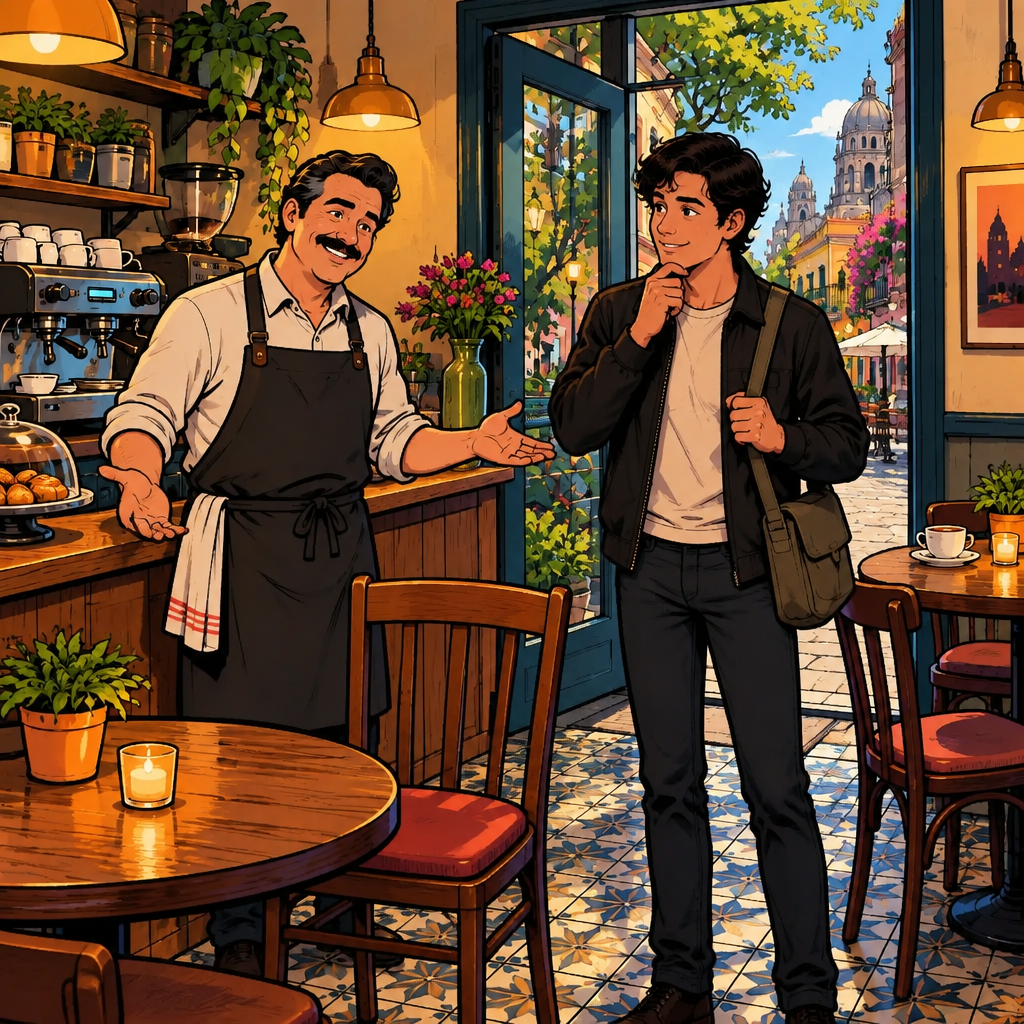
Justin and Michael are moving chairs at Café Laurel. Yako watches from his usual two chairs, which aren't part of the job.
You'll say you're ready, take turns, and announce that something's done. These lines help when you're sharing any small task.
There's also something to write down, but Michael won't explain his note.
By the end of this lesson
Say you're ready, explain whose turn it is, announce completion, and ask someone to write something down.
- Ya quedóIt's done
- ListoReady
- ¿Estamos listos?Are we ready?
- Me toca ___It's my turn to ___
- Te toca ___It's your turn to ___
- ¿Quién sigue?Who's next?
- ApúntaloWrite it down
- Hay que ___We've got to ___
Scene — one chair at a time
It's afternoon at Café Laurel. Justin and Michael are arranging chairs, with one missing at a table and an extra one by the door.
Yako, a brown yak, watches from two chairs. Michael has a pen and a napkin ready.

Learn — ready, next, done
There are eight lines to learn. Tap ▶ and say each one out loud.
For the lines with blanks, add the action you're taking turns doing.

Ya quedó
It's done
When to use it: Say this when a task is finished or something is fixed.
Learn it as one piece for announcing that the job is done.

Listo
Ready
When to use it: Use this short answer when you're ready to begin.

¿Estamos listos?
Are we ready?
When to use it: Check whether everyone is ready before starting a shared task.

Me toca ___
It's my turn to ___
When to use it: Say which action it's your turn to do.
Fill the blank with an action, like mover la silla: move the chair.

Te toca ___
It's your turn to ___
When to use it: Tell someone which action it's their turn to do.
Me points to your turn; te points to the other person's turn.
¿Quién sigue?
Who's next?
When to use it: Ask who takes the next turn.

Apúntalo
Write it down
When to use it: Ask someone to write down a detail so it isn't forgotten.
Say it: Stress PUN: ah-POON-tah-loh.
Hay que ___
We've got to ___
When to use it: Say what needs doing without naming whose turn it is.
Add an action, like mover las sillas: move the chairs.
Story — a note for the yak
Watch how Justin and Michael share the work and move from ready to done. The highlights show your new lines.
Use Show English if you need help following the mysterious napkin.
 MichaelHay que mover las sillas.We've got to move the chairs.
 Justin¿Estamos listos?Are we ready?
- MichaelListo.Ready.
- Justin points to the empty place at the table.
- JustinFalta una silla.A chair is missing.
- MichaelSobra una silla aquí.There's an extra chair here.
- Michael points to the spare chair by the door, then to Justin.
- MichaelTe toca mover la silla.It's your turn to move the chair.
- JustinMe toca mover la silla.It's my turn to move the chair.
- Justin puts the spare chair at the table. Yako keeps both of his chairs.
- JustinYa quedó.It's done.
- Justin¿Quién sigue?Who's next?
- MichaelMe toca escribir.It's my turn to write.
- Michael gestures toward Yako's two chairs and holds up his pen.
- JustinApúntalo.Write it down.
- Michael writes “para el yak” (for the yak) on a napkin, but won't explain why.
- JustinGracias por tu ayuda.Thanks for your help.
Practice — take your turn
Try ten short exercises with listening, matching, and choosing what to say.
Keep trying or use the skip button. Each explanation helps you spot the difference.
0 of 10 done
What did you hear?
What did you hear?
Match the pairs
Spanish
ListoDrop the English hereMe toca ___Drop the English hereTe toca ___Drop the English hereEnglish
What do you say?
What do you say?
Before starting the chair-moving task, ask whether your whole group is ready.
What does it mean?
What does it mean?
Apúntalo
Fill the gap
Fill the gap
Who's next?
¿____ sigue?
What do you say?
What do you say?
The chairs need moving. Say what needs doing without assigning anyone a turn.
What does it mean?
What does it mean?
Aquí mero
What do you say?
What do you say?
Michael helped you arrange the chairs. Thank him specifically for his help.
True or false?
True or false?
This can be a short answer when someone asks whether you're ready.
Build the line
Build the line
Are we ready?
¿ ?
Tap the words in order.
Say it — finish the job
Play Justin, who speaks first, and finish the chair task with Michael. Tap the microphone to answer, or ▶ for the model.
Your recording stays on your device. You can also use the skip button.
- Justin (you)Ask whether you're all ready.
Ask whether you're all ready.
¿Estamos listos?
Are we ready?
0 of 5 said
Recap — what you can say now
| Spanish | English | Play |
|---|---|---|
| Ya quedó | It's done | |
| Listo | Ready | |
| ¿Estamos listos? | Are we ready? | |
| Me toca ___ | It's my turn to ___ | |
| Te toca ___ | It's your turn to ___ | |
| ¿Quién sigue? | Who's next? | |
| Apúntalo | Write it down | |
| Hay que ___ | We've got to ___ |
Save your progress — it’s free
Keep your place in the course and see which lines you’ve learned.
Want the next lesson in your inbox?
Get the next lesson by email, one a day.
Join the newsletterDaily lesson emails are coming soon. Newsletter subscribers get them first.
Keep practicing with Yak Cards
Keep these shared-task lines handy with your Yak Cards. Practice moving from ready to done.
Try saying whose turn it is during a small task tomorrow. The napkin mystery can wait.
Open Yak Cards