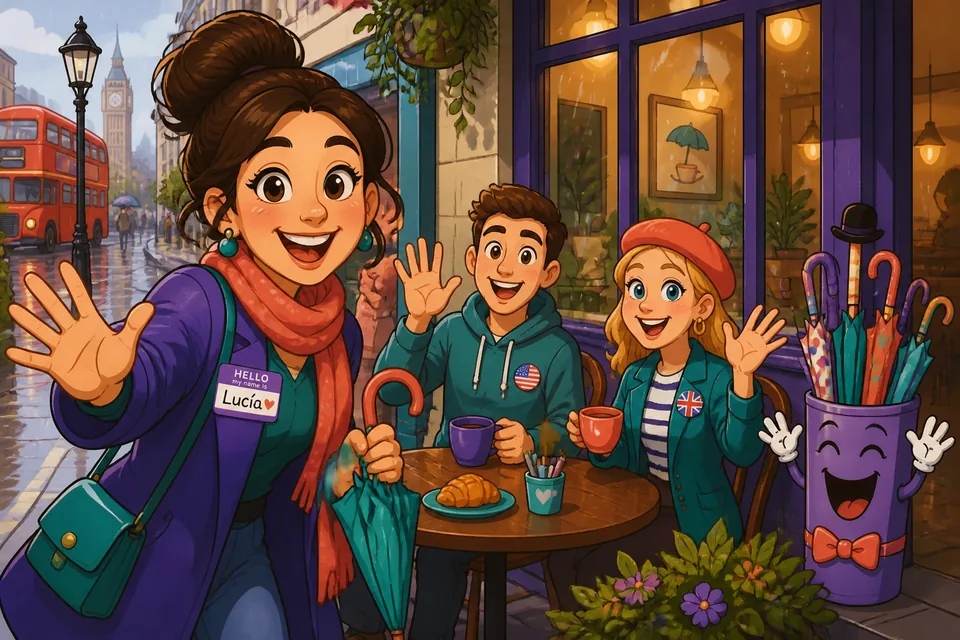
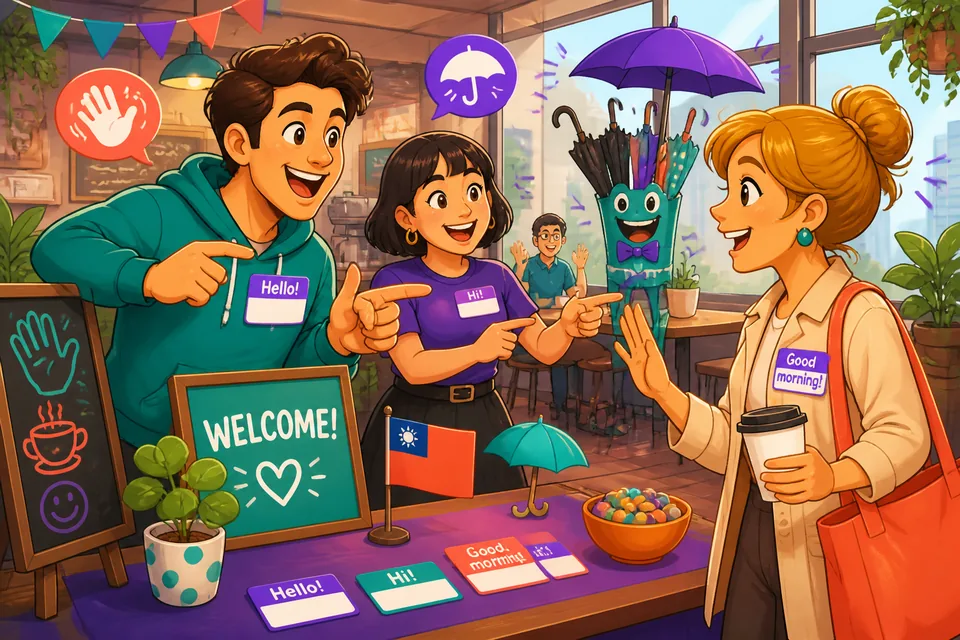
Welcome to Lesson 1 — your first step into Spanish greetings! In Yak Yacker lessons you listen, practice, and speak: hear short phrases, try quick exercises, then say them out loud.
Level A1: In this short lesson you'll learn basic Spanish greetings and simple ways to start a conversation: say hello, choose a time-based greeting, ask and answer "what's your name?", and politely ask to join. This CEFR-aligned set is perfect for first encounters and friendly openings.
After this lesson you'll be able to:
Learn and use common Spanish greetings (Hola, Buenos días, Buenas tardes, Buenas noches).
Ask and answer names: ¿Cómo te llamas? — Soy ___.
Use polite starters: ¿Tienes un minuto? and ¿Me puedo unir?
Ready? Let's go!
When you tap play on phrases, we track your progress through this lesson.
1. Reading + Listening Practice
Hear core phrases, repeat aloud.
Hola
Hello.
Meaning: Hello.
When to use: Use as a neutral, common way to say hello at any time.
Hola
Hello.
Hola, ¿cómo estás?
Hello, how are you?
Hola
Hi.
Meaning: Hi.
When to use: Use when greeting casually; tone and context make it friendly or informal.
Hola, David.
Hi, David.
Hola, ¿qué tal?
Hi, how's it going?
Buenos días.
Good morning.
Meaning: Good morning.
When to use: Use this standard greeting in the morning hours.
Buenos días, buenos días a todos.
Good morning, good morning everyone.
Buenos días, ¿cómo amaneciste?
Good morning, how did you wake up?
Buenas tardes.
Good afternoon.
Meaning: Good afternoon.
When to use: Use this greeting from after midday until early evening.
Buenas tardes, ¿cómo estuvo tu día?
Good afternoon, how was your day?
Buenas tardes, señor.
Good afternoon, sir.
Buenas noches.
Good evening.
Meaning: Good evening.
When to use: Use in the evening; it can also be used to say goodbye at night.
Buenas noches, que descanses.
Good night, rest well.
Buenas noches, ¿todo bien?
Good evening, everything okay?
¿Cómo estás?
How are you?
Meaning: How are you?
When to use: Use to ask someone how they are; informal tú form. For a formal person use ¿Cómo está?
Tip: Beginners sometimes say ¿Cómo eres? which asks about personality instead of how someone is.
¿Cómo estás?
How are you?
Hola, ¿cómo estás hoy?
Hi, how are you today?
Bien, gracias.
I'm good, thanks.
Meaning: I'm good, thanks.
When to use: Use as a short, natural response to ¿Cómo estás?.
Bien, gracias. ¿Y tú?
I'm good, thanks. And you?
Bien, gracias. Todo bien.
I'm good, thanks. All good.
Soy ___
I'm ___.
Meaning: I'm ___.
When to use: Use to introduce your name: Soy Carlos. It's a simple, direct way to say your name.
Tip: Learners sometimes try to translate word-for-word from English and say "Yo soy Ana" when "Soy Ana" is more natural for short introductions.
Soy Ana
I'm Ana.
Hola, soy Miguel.
Hi, I'm Miguel.
¿Cómo te llamas?
What's your name?
Meaning: What's your name?
When to use: Use to ask someone their name in informal situations; formal is ¿Cómo se llama?.
¿Cómo te llamas?
What's your name?
Disculpa, ¿cómo te llamas?
Excuse me, what's your name?
¿Me puedo unir?
Can I join you?
Meaning: Can I join you?
When to use: Use this polite question to enter a conversation or group. For sitting at a table you might say: ¿Me puedo sentar con ustedes?
Tip: Some learners say "Puedo unirme?" which sounds direct; the reflexive form ¿Me puedo unir? is more polite and natural here.
¿Me puedo unir a tu mesa?
Can I join your table?
Perdón, ¿me puedo unir?
Excuse me, can I join?
Hola
Hey.
Meaning: Hey.
When to use: Use as a neutral, friendly opener—safer than other casual interjections.
Hola, ¡hey! Bienvenido.
Hello, hey! Welcome.
Hola. ¿Todo bien?
Hey. Everything good?
¿Eres ___?
Are you ___?
Meaning: Are you ___?
When to use: Use to check identity in informal situations: ¿Eres María? For formal, use ¿Es usted ___?.
¿Eres María?
Are you María?
¿Eres el profesor nuevo?
Are you the new teacher?
¿Tienes un minuto?
Do you have a minute?
Meaning: Do you have a minute?
When to use: Use as a polite way to start a short interaction; formal is ¿Tiene un minuto?.
¿Tienes un minuto para hablar?
Do you have a minute to talk?
Hola, ¿tienes un minuto?
Hi, do you have a minute?
2. Conversational Listening Practice
Hear phrases in a real mini-conversation.
Quick meeting at a café
Anna
Hola
Hi.
David
Buenos días. ¿Cómo estás?
Good morning. How are you?
Anna
Bien, gracias. ¿Y tú?
I'm good, thanks. And you?
David
Bien. ¿Cómo te llamas?
Good. What's your name?
Anna
Soy Anna.
I'm Anna.
Anna
¿Me puedo unir?
Can I join you?
3. Guided Practice
Quizzes and matching to lock in meaning.
How do you say "Good morning." in Spanish?
Which phrase politely asks 'Can I join you?'
Choose the Spanish for 'What's your name?'
You meet someone at night. Which greeting fits best?
You would say 'Buenos días.' in the morning.
You meet a neighbor at 9 AM. You say: ___.
Ask '¿Me puedo unir?' when you want to join a group.
You see a small group and want to join. You ask: ___.
You can say 'Soy Ana.' to say 'I'm Ana.'
Someone asks your name. You answer: ___.
Match the core phrases
Match the extra phrases
4. Speaking Practice
Say phrases yourself (mic/recording).
Recording stays on your device only. Check speech uses your browser's speech tools when available.