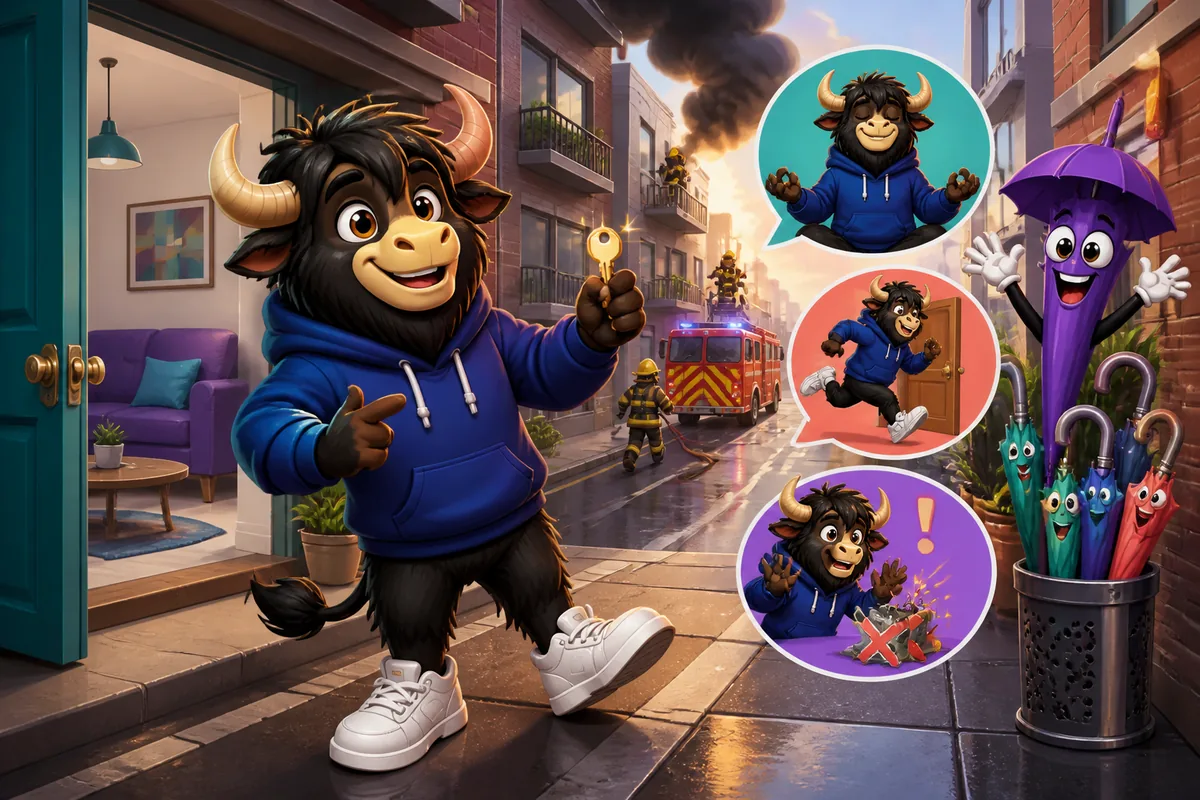
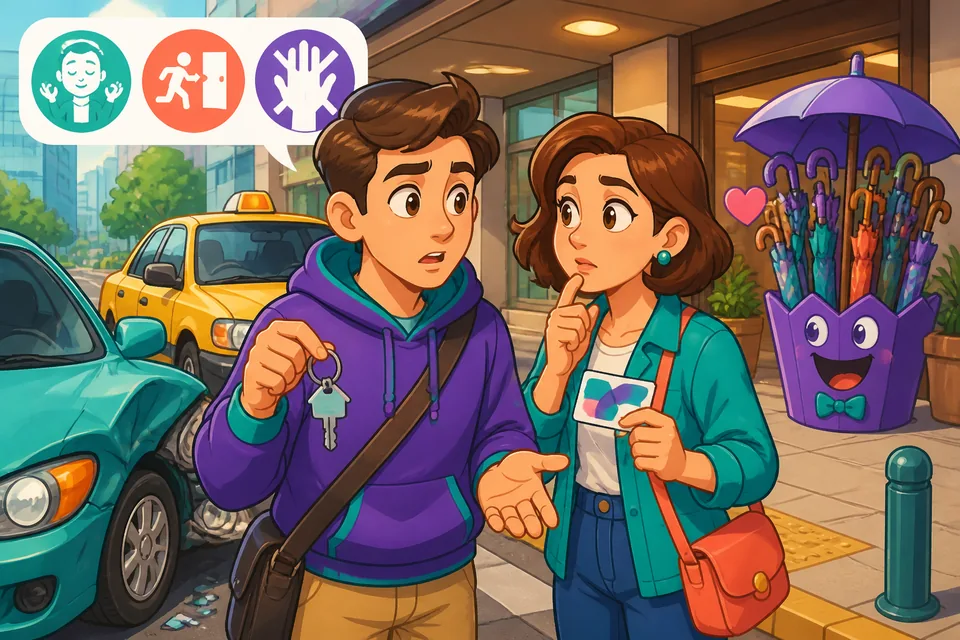
Short and focused — today we practice Spanish phrases for emergencies. Read, listen, then say each line out loud to build confidence.
Level A2: In this lesson (137) you'll learn and practice short, urgent Spanish phrases to report accidents, call for help, and warn others — for example, Mantén la calma, Necesito una ambulancia, and Sal de ahí ahora. This CEFR-aligned mini-lesson focuses on hearing the phrases in a short conversation, using them in quick practice items, and saying them yourself.
After this lesson you'll be able to:
Recognize and use basic emergency commands and reports in everyday Spanish.
Be able to tell someone you're bleeding or point to where it hurts.
Practice Level A2 phrases to request an ambulance and report an accident.
Ready? Let's go!
When you tap play on phrases, we track your progress through this lesson.
1. Reading + Listening Practice
Hear core phrases, repeat aloud.
Mantén la calma.
Stay calm.
Meaning: Stay calm.
When to use: Use to help someone keep calm during an emergency; informal (tú).
Tip: Don't mix up formal vs. informal: for usted say 'Mantenga la calma.'
Mantén la calma, voy a ayudarte.
Stay calm, I'll help you.
Por favor, mantén la calma y respira.
Please stay calm and breathe.
Sal de ahí ahora.
Get out now.
Meaning: Get out now.
When to use: Tell someone to leave a dangerous place immediately; informal (tú).
Tip: Beginners sometimes understate the urgency; include 'ahora' to be clear.
Sal de ahí ahora, es peligroso.
Get out now, it's dangerous.
¡Sal de ahí ahora! Hay humo adentro.
Get out now! There's smoke inside.
No lo toques.
Don't touch it.
Meaning: Don't touch it.
When to use: Warn someone not to touch a dangerous object or unknown item; informal (tú).
No lo toques, podría explotar.
Don't touch it, it could explode.
No lo toques hasta que lleguen los expertos.
Don't touch it until the experts arrive.
Hubo un accidente.
There was an accident.
Meaning: There was an accident.
When to use: Report that an accident happened; useful when telling a responder or bystander.
Hubo un accidente en la esquina.
There was an accident at the corner.
Hubo un accidente y hay personas heridas.
There was an accident and people are hurt.
No puedo mover mi ___.
I can't move my ___.
Meaning: I can't move my ___.
When to use: Use to say you cannot move a body part (e.g., brazo, pierna, cuello).
Tip: Remember to add the body part (brazo, pierna); otherwise the sentence is incomplete.
No puedo mover mi brazo.
I can't move my arm.
No puedo mover mi pierna después de la caída.
I can't move my leg after the fall.
Necesito una ambulancia.
I need an ambulance.
Meaning: I need an ambulance.
When to use: Say when urgent medical transport is required.
Necesito una ambulancia, hay una persona inconsciente.
I need an ambulance, there's an unconscious person.
Por favor, necesito una ambulancia ahora.
Please, I need an ambulance now.
Me duele aquí.
It hurts here.
Meaning: It hurts here.
When to use: Point to the painful area and say this to indicate where you feel pain.
Me duele aquí, debajo de la costilla.
It hurts here, under the rib.
Me duele aquí en la cabeza.
It hurts here on my head.
Estoy sangrando.
I'm bleeding.
Meaning: I'm bleeding.
When to use: Report active bleeding so helpers know it's urgent.
Estoy sangrando, necesito algo para parar la sangre.
I'm bleeding, I need something to stop the blood.
Por favor, ayúdame, estoy sangrando mucho.
Please help me, I'm bleeding a lot.
Me falta mi ___.
My ___ is missing.
Meaning: My ___ is missing.
When to use: Report a missing essential item or person (use a noun after 'mi').
Me falta mi teléfono después del accidente.
My phone is missing after the accident.
Me falta mi hijo, no lo encuentro.
My child is missing, I can't find him.
2. Conversational Listening Practice
Hear phrases in a real mini-conversation.
At the site of a small traffic accident
Anna
Hubo un accidente.
There was an accident.
David
Mantén la calma. ¿Estás herida?
Stay calm. Are you hurt?
Anna
Estoy sangrando y me duele aquí.
I'm bleeding and it hurts here.
David
No lo toques. Necesito una ambulancia.
Don't touch it. I need an ambulance.
Anna
No puedo mover mi pierna.
I can't move my leg.
David
¡Sal de ahí ahora! Voy a llamar ayuda.
Get out now! I'm going to call for help.
3. Guided Practice
Quizzes and matching to lock in meaning.
Which Spanish phrase warns someone 'Don't touch it.'?
You are bleeding. Which phrase do you say in Spanish?
Which phrase means 'I can't move my arm.'?
You see someone inside a burning car. Which urgent command tells them to leave immediately?
You call: 'I need an ambulance.'
You speak to an emergency operator: '___' when someone needs urgent transport.
You indicate the painful spot: 'It hurts here.'
After being hit, you point to your shoulder and say, '___'.
You order: 'Get out now!'
The building is unstable; you shout to a friend inside: '___'!
Match the core phrases
Match the extra phrases
4. Speaking Practice
Say phrases yourself (mic/recording).
Recording stays on your device only. Check speech uses your browser's speech tools when available.