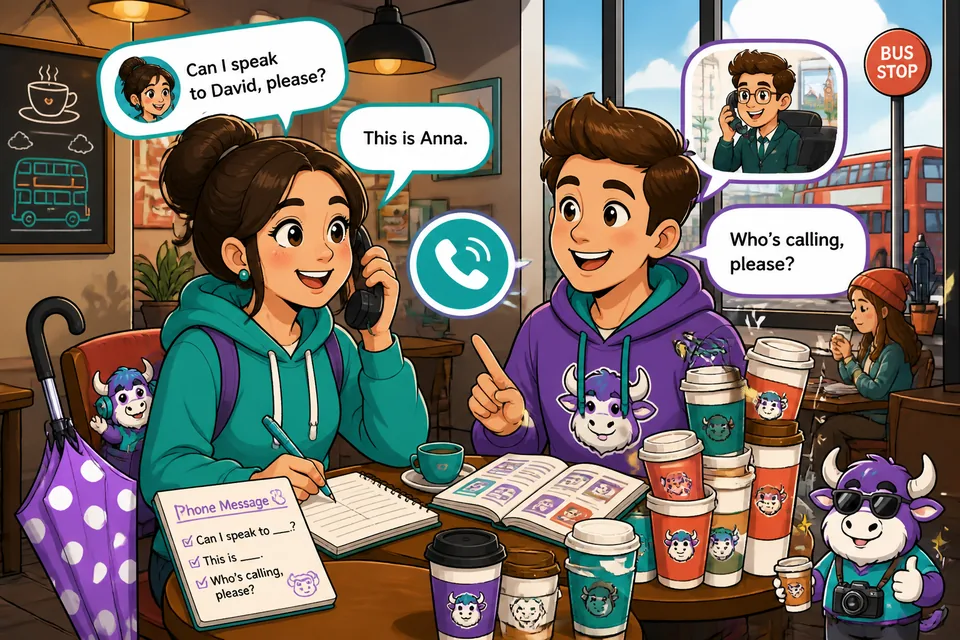
Welcome — ready to handle quick phone calls? This lesson gives you useful phone phrases so you can ask for someone, leave a message, or say you'll call back. Practice listening, trying short quizzes, and speaking the lines aloud.
Level A2: In this short lesson you'll practice common phone phrases used to ask for someone, identify yourself, leave messages, and say you dialed the wrong number. These are natural, everyday lines for phone calls in Latin American Spanish — perfect for handling messages or asking someone to call back. This CEFR-aligned pack focuses on practical frames you can use right away.
After this lesson you'll be able to:
Ask to speak to someone and check if they are available on the phone.
Identify yourself and offer or leave a short phone message.
Say that someone can't answer, that you have the wrong number, or that you'll call later.
Practice polite requests like asking someone to return a call (A2 level).
Ready? Let's go!
When you tap play on phrases, we track your progress through this lesson.
1. Reading + Listening Practice
Hear core phrases, repeat aloud.
¿Puedo hablar con ___?
Can I speak to ___?
Meaning: Can I speak to ___?
When to use: Use this at the start of a call when you want to talk to a specific person (name goes in the blank).
On the line I ask, "¿Puedo hablar con Carla?"
Asking to speak with Carla.
If you need Juan, call and say, "¿Puedo hablar con Juan?"
Requesting to speak to Juan.
Habla ___.
This is ___.
Meaning: This is ___.
When to use: Say this after someone asks who is calling; you can use your name in the blank.
Tip: Beginners sometimes use "Soy ___" on the phone; "Habla ___" is a common, natural phone intro.
When someone asks, say, "Habla Marta."
Identifying yourself as Marta.
At work you might say, "Habla David."
A simple way to say, 'This is David.'
¿Quién llama, por favor?
Who's calling, please?
Meaning: Who's calling, please?
When to use: A polite way for the person answering to ask who is on the line.
Tip: Some learners think only "¿De parte de quién?" is correct — both are used; "¿Quién llama, por favor?" is perfectly polite.
When you call a business they may ask, "¿Quién llama, por favor?"
Polite request for the caller's name.
If the phone is answered, you can expect, "¿Quién llama, por favor?"
A common short question when someone picks up.
¿Está ___?
Is ___ there?
Meaning: Is ___ there?
When to use: Use this to check if the person you want is available right now.
You can ask, "¿Está Laura?" if you want to speak with Laura.
Checking if Laura is on the phone.
When calling a house, try, "¿Está el señor Gómez?"
Asking if Mr. Gómez is there.
___ no puede contestar ahora.
___ is not available right now.
Meaning: ___ is not available right now.
When to use: Use this to tell a caller that the person is unable to answer at the moment.
"María no puede contestar ahora," dijo la recepcionista.
Telling the caller María can't answer now.
If busy, say, "El señor Pérez no puede contestar ahora."
Explaining someone is unavailable.
¿Quieres dejarle un mensaje?
Can I take a message?
Meaning: Can I take a message?
When to use: Offer this when the person is absent and you can pass along information.
If someone is out, ask, "¿Quieres dejarle un mensaje?"
Offering to take a message (informal tú).
On the phone you might say, "¿Quieres dejarle un mensaje?"
A friendly offer to record a message.
¿Podrías pedirle a ___ que me devuelva la llamada?
Could you ask ___ to call me back?
Meaning: Could you ask ___ to call me back?
When to use: Use this polite request to ask a third person to pass along a callback request.
"¿Podrías pedirle a José que me devuelva la llamada?" — a polite request.
Asking someone to request José to call back.
If busy, say, "¿Podrías pedirle a Ana que me devuelva la llamada, por favor?"
Polite way to ask for a callback.
Mi número es ___.
My number is ___.
Meaning: My number is ___.
When to use: Give your phone number when leaving a message so they can call you back.
"Mi número es 55-1234-5678," dije para que me llamaran.
Providing a phone number for a callback.
When leaving details, say, "Mi número es 555-987-000."
Telling your phone number.
Perdón, me equivoqué de número.
Sorry, I have the wrong number.
Meaning: Sorry, I have the wrong number.
When to use: Say this quickly if you realize you called the wrong person.
"Perdón, me equivoqué de número," y cuelgo la llamada.
Apologizing for dialing the wrong number.
If a number is incorrect, say, "Perdón, me equivoqué de número."
A polite short apology on the phone.
Te marco más tarde.
I'll call back later.
Meaning: I'll call back later.
When to use: Use this when you plan to try calling again at a later time.
"Te marco más tarde," le digo cuando la persona está ocupada.
Telling someone you'll call them later.
If they ask to call later, reply, "Te marco más tarde."
A casual way to promise a later call.
Quisiera dejar un mensaje.
I'd like to leave a message.
Meaning: I'd like to leave a message.
When to use: Use this polite phrase to tell the listener you want to leave a message for someone.
"Quisiera dejar un mensaje," digo con cortesía.
Politely saying you'd like to leave a message.
If the person is unavailable, say, "Quisiera dejar un mensaje, por favor."
A polite way to offer a message.
El mensaje es: ___.
The message is ___.
Meaning: The message is ___.
When to use: Use this to introduce the actual content you want the person to receive.
"El mensaje es: Llamé por la factura," le digo al recepcionista.
Introducing the message content.
"El mensaje es: Regresa mi llamada cuando puedas," escribo en el papel.
Stating the exact message to leave.
Por favor, dile a ___ que llamé.
Please tell ___ I called.
Meaning: Please tell ___ I called.
When to use: Ask the person answering to pass along the simple information that you called.
"Por favor, dile a Marta que llamé," le pido a la secretaria.
Requesting that Marta be told you called.
"Por favor, dile a Juan que llamé esta tarde," digo al contestador.
Asking someone to pass on that you called this afternoon.
2. Conversational Listening Practice
Hear phrases in a real mini-conversation.
Anna calls David's office to leave a message.
Anna
¿Puedo hablar con David?
Can I speak to David?
David
Lo siento, David no puede contestar ahora.
Sorry, David can't answer right now.
Anna
Quisiera dejar un mensaje. Mi número es 555-1234.
I'd like to leave a message. My number is 555-1234.
David
Por favor, dile a David que llamaste. ¿Quieres dejar el mensaje?
Please tell David you called. Do you want to leave the message?
3. Guided Practice
Quizzes and matching to lock in meaning.
How do you ask, 'Can I speak to Laura?' on the phone?
Which phrase means 'Who's calling, please?'
Which option politely offers to take a message?
If you realize you dialed the wrong person, what do you say?
You would say 'Habla Ana.' to identify yourself.
Someone answers and asks, "¿Quién llama, por favor?" You reply: ___.
You politely say 'Quisiera dejar un mensaje.' to leave a message.
You call the office and are told, "Lo siento, Carla no puede contestar ahora." You answer: ___.
You politely ask, '¿Podrías pedirle a él que me devuelva la llamada?'
You want someone to call you back. Which do you say? ___.
Match the core phrases
Match the extra phrases
4. Speaking Practice
Say phrases yourself (mic/recording).
Recording stays on your device only. Check speech uses your browser's speech tools when available.
Say this phrase out loud:
¿Puedo hablar con ___?
Can I speak to ___?
Say this phrase out loud:
Habla ___.
This is ___.
Say this phrase out loud:
¿Quién llama, por favor?
Who's calling, please?
Say this phrase out loud:
¿Está ___?
Is ___ there?
Say this phrase out loud:
___ no puede contestar ahora.
___ is not available right now.
Say this phrase out loud:
¿Quieres dejarle un mensaje?
Can I take a message?
Say this phrase out loud:
¿Podrías pedirle a ___ que me devuelva la llamada?