
New here? This is lesson 89 of a free 238-lesson Spanish course.
Free Spanish CourseLesson 89 of 238
Brothers and sisters in Spanish
It's a slow afternoon at Café Laurel, and Amanda has a friendly question for Justin about family.
You'll learn to ask about brothers, sisters, and kids, then describe your family in a few natural chunks.
You'll also say who lives with you and use a phone photo to keep the conversation short and real.
By the end of this lesson
Ask about family and say whether you have siblings, children, and who you live with.
- ¿Tienes hermanos?Do you have brothers or sisters?
- Tengo ___ hermanosI've got ___ brothers
- Soy hijo únicoI'm an only child
- ¿Tienes hijos?Do you have kids?
- ¿Cuántos son en tu familia?How many are you in your family?
- Mi familia es ___My family is ___
Scene — a family photo
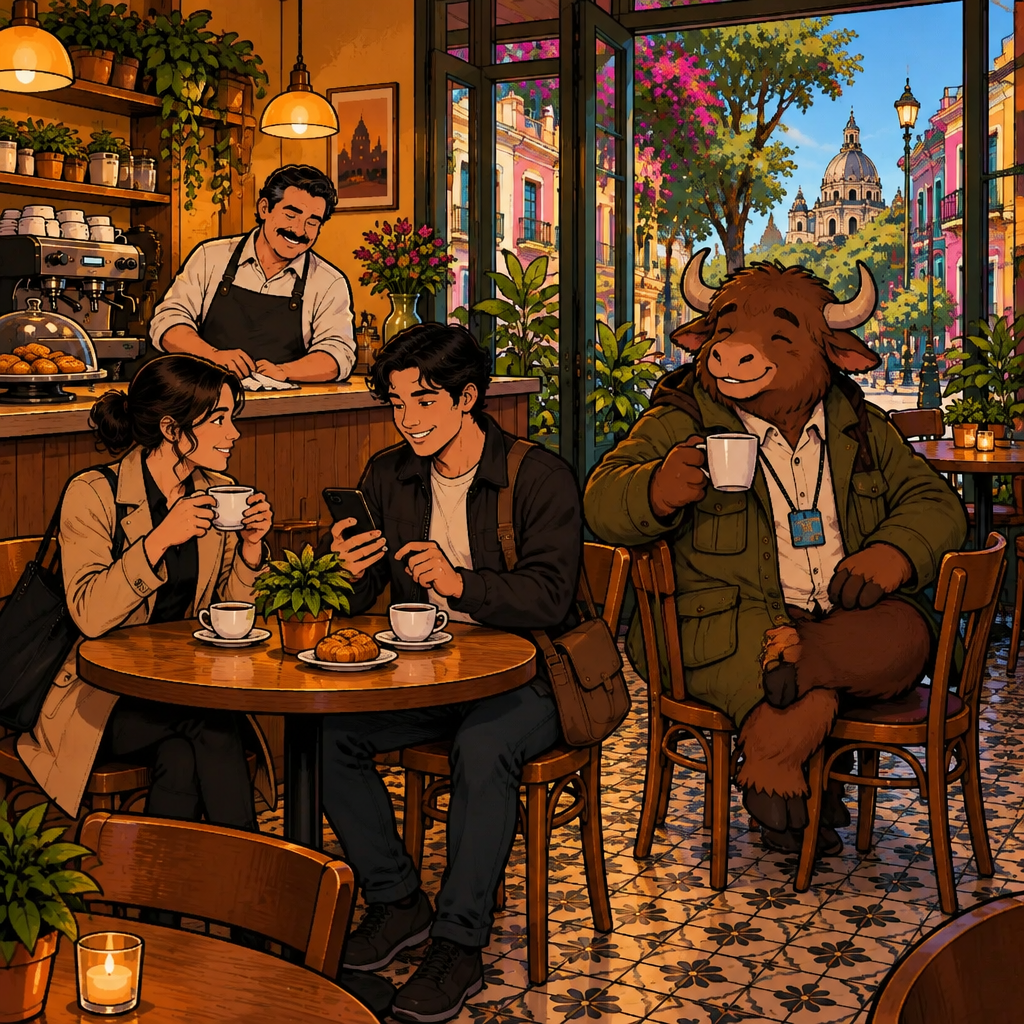
It's a slow café afternoon at Café Laurel. Amanda sits with Justin while Michael wipes the counter and Yako balances on his two chairs.
Justin opens a photo on his phone when Amanda asks about his family. He answers briefly instead of giving a long speech.
Learn — family questions
These six lines cover family questions you'll hear often, plus simple answers about siblings, children, and family size.
The frame line lets you add one useful description.

¿Tienes hermanos?
Do you have brothers or sisters?
When to use it: Ask this to find out whether someone has brothers or sisters.
Hermanos can refer to brothers or to a mixed group of brothers and sisters.
Say it: TYEH-nehs ehr-MAH-nohs

Tengo ___ hermanos
I've got ___ brothers
When to use it: Use this frame to say how many brothers or siblings you have.
Add a number in the blank, such as dos or tres.

Soy hijo único
I'm an only child
When to use it: Say this when you have no brothers or sisters.
Hijo único is masculine; a woman says hija única.
Say it: soy EE-hoh OO-nee-koh

¿Tienes hijos?
Do you have kids?
When to use it: Ask this when you want to know whether someone has children.
Hijos can mean sons or children, including a mixed group.

¿Cuántos son en tu familia?
How many are you in your family?
When to use it: Ask this to find out how many people are in someone's family.
Cuántos agrees with the people you are counting.
Say it: KWAN-tohs sohn ehn too fah-MEE-lyah

Mi familia es ___
My family is ___
When to use it: Use this frame to give a short description of your family.
Familia is feminine, so descriptions usually match it.
Story — a phone photo
Amanda asks about Justin's family during a quiet café afternoon. He answers with a photo instead of a long explanation.
Watch for the highlighted family chunks, and turn on Show English when you need help.
- The café is quiet, and Justin scrolls through photos on his phone.
 AmandaHola, Justin. ¿Cómo estás?Hi, Justin. How are you?
 JustinHola, Amanda. Bien, gracias.Hi, Amanda. I'm good, thanks.
- Amanda¿Tienes hermanos?Do you have brothers or sisters?
- JustinSí. Tengo dos hermanos.Yes. I've got two brothers.
- Amanda¿Tienes hijos?Do you have kids?
- JustinNo, no tengo hijos.No, I don't have kids.
- Amanda¿Cuántos son en tu familia?How many are you in your family?
- JustinSomos cinco en mi familia.There are five of us in my family.
- AmandaEstoy casada, pero no tengo hijos.I'm married, but I don't have kids.
 YakoSoy hijo único.I'm an only child.
- Yako points proudly at his two chairs, as if they were siblings.
 Michael¿Dos sillas y ningún hermano?Two chairs and no brother?
- YakoMi familia es pequeña.My family is small.
Practice — talk about family
You'll listen for meaning, match questions with answers, fill a useful word, and change a number in a family sentence.
Read each situation carefully before you choose.
0 of 8 done
What did you hear?
What did you hear?
Match the pairs
Spanish
¿Tienes hermanos?Drop the English here¿Tienes hijos?Drop the English here¿Cuántos son en tu familia?Drop the English hereHola.Drop the English hereEnglish
Swap the word
Swap the word
Change Tengo dos hermanos into the family frame with a blank number.
Tengo ____ hermanos
What does it mean?
What does it mean?
¿Cómo estás?
What do you say?
What do you say?
Amanda asks whether Justin has brothers or sisters. He has none.
True or false?
True or false?
Mi familia es pequeña describes a small family.
What do you say?
What do you say?
You want to ask Amanda whether she has children.
Build the line
Build the line
How many are you in your family?
¿ ?
Tap the words in order.
Say it — answer Amanda
Now you're Justin, answering Amanda during the quiet café afternoon. Keep each answer short, as if you're showing her a photo.
Tap ▶ to hear the model line first, then tap the microphone. Your recording stays on your device.
- Amanda¿Tienes hermanos?Do you have brothers or sisters?
- Justin (you)Answer that you are an only child.
Answer that you are an only child.
Soy hijo único
I'm an only child
0 of 3 said
Recap — what you can say now
| Spanish | English | Play |
|---|---|---|
| ¿Tienes hermanos? | Do you have brothers or sisters? | |
| Tengo ___ hermanos | I've got ___ brothers | |
| Soy hijo único | I'm an only child | |
| ¿Tienes hijos? | Do you have kids? | |
| ¿Cuántos son en tu familia? | How many are you in your family? | |
| Mi familia es ___ | My family is ___ |
Save your progress — it’s free
Keep your place in the course and see which lines you’ve learned.
Want the next lesson in your inbox?
Get the next lesson by email, one a day.
Join the newsletterDaily lesson emails are coming soon. Newsletter subscribers get them first.
Keep practicing with Yak Cards
Want to keep these family questions handy? Grab the Yak Cards for this lesson and review them anywhere.
Review the family chunks with the Yak Cards, then describe your own family out loud.
Open Yak Cards