
New here? This is lesson 9 of a free 238-lesson Spanish course.
Free Spanish CourseLesson 9 of 238
Please, thanks, and sorry in Spanish
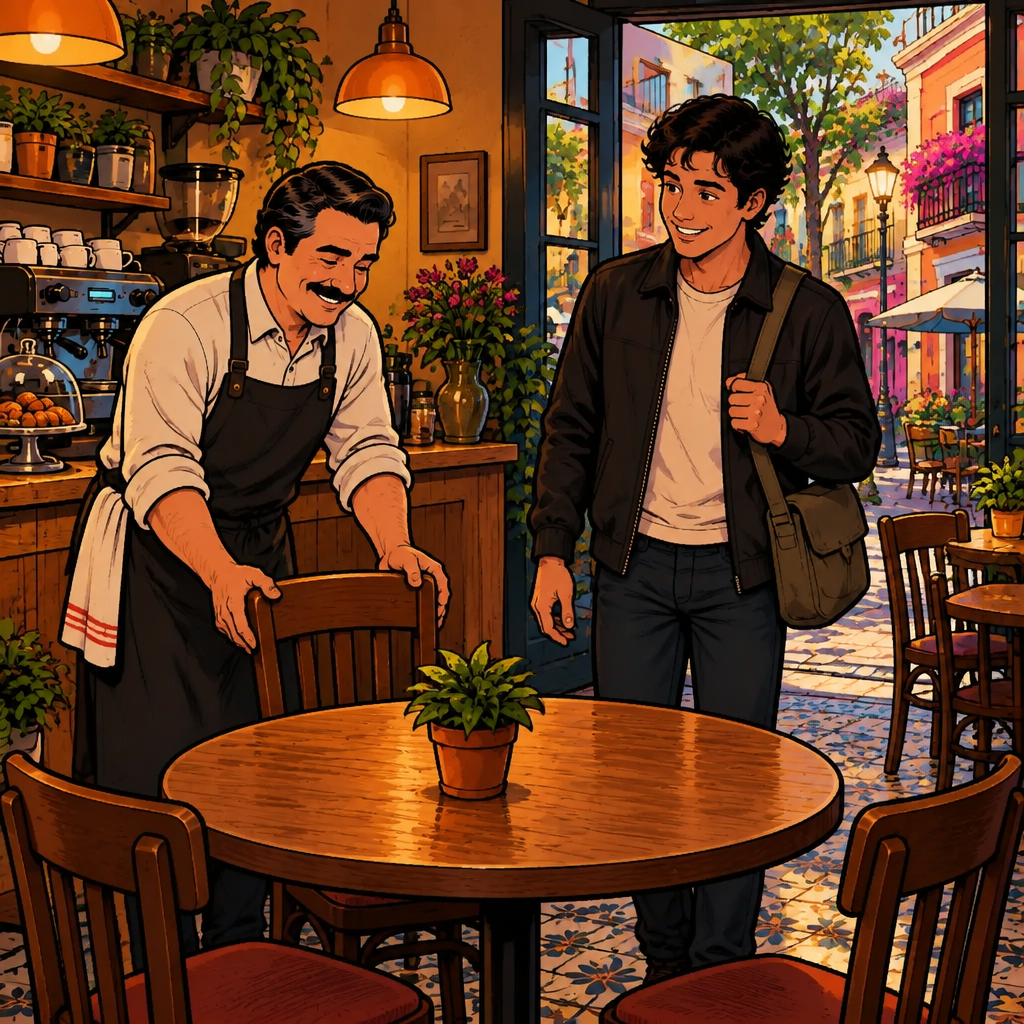
Café Laurel is busy, and Justin still hasn't seen a drop of water. He's polite, though — he says por favor before the bump and perdón after it.
Yako is stuck on two chairs and truly cannot move. Yako waves it all off with no pasa nada.
In this lesson you'll ask for things politely, say thanks, and apologize when you bump into someone.
By the end of this lesson
Ask for something politely, thank someone, and apologize.
- ___, por favor___, please
- GraciasThank you
- De nadaYou're welcome
- DisculpaExcuse me
- PerdónSorry
- Lo siento, no puedoSorry, I can't
- No pasa nadaIt's fine
Scene — no glass yet
It's late morning inside Café Laurel. Justin's glass of water hasn't arrived yet, and the table has no glass on it at all.
Yako is parked on two chairs and truly can't budge. One turning elbow is about to cause real trouble.

Learn — please and sorry
Here are seven short lines to keep you polite in Mexico City.
You'll cover asking for things, thanking people, and apologizing — the whole social toolkit for a café.

___, por favor
___, please
When to use it: Add por favor to any request to make it polite.
Put what you want first, then por favor.
Say it: por fah-VOR, stress the last syllable.
Gracias
Thank you
When to use it: Say gracias whenever someone helps you.
Say it: GRAH-syahs in Mexico.

De nada
You're welcome
When to use it: Say de nada when someone thanks you.
Say it: deh NAH-dah.

Disculpa
Excuse me
When to use it: Use it to get past someone or soften a bump, like saying excuse me.
Say it: dees-KOOL-pah.

Perdón
Sorry
When to use it: Say perdón to apologize for a small accident.
Say it: pehr-DOHN, stress the last syllable.

Lo siento, no puedo
Sorry, I can't
When to use it: Say this when you're sorry you can't do something.
Learn lo siento, no puedo as one chunk.
Say it: no PWEH-doh.

No pasa nada
It's fine
When to use it: Say no pasa nada to tell someone it's fine.
Say it: no PAH-sah NAH-dah.
Story — the bumped chair
Watch how one bumped chair turns into a whole polite conversation.
Every line you just learned shows up, from the first request to the final you're welcome.
 JustinHola. Agua, por favor.Hi. Water, please.
 MichaelClaro.Sure.
- Justin's seat is behind Yako's two chairs.
- JustinDisculpa.Excuse me.
 YakoLo siento, no puedo.Sorry, I can't.
- Justin squeezes past anyway and bumps Yako's chair.
- JustinPerdón.Sorry.
- YakoNo pasa nada.It's fine.
- Michael straightens the chair for Justin.
- JustinGracias.Thank you.
- MichaelDe nada.You're welcome.
Practice — thanks and sorry
Eleven quick exercises are coming up to lock these lines in.
They're short, so run through them all — listening, matching, and building sentences yourself.
0 of 10 done
What did you hear?
What did you hear?
Match the pairs
Spanish
GraciasDrop the English hereDe nadaDrop the English herePerdónDrop the English hereSí, por favorDrop the English hereEnglish
What do you say?
What do you say?
You want a glass of water and you want to be polite.
Pick the reply
Michael says:
Pick the reply
Gracias
Thank you
And you reply with:
Build the line
Build the line
Sorry, I can't
,
Tap the words in order.
Find the mistake
Find the mistake
Sort them
Sorry
Thanks
What does it mean?
What does it mean?
Hola.
True or false?
True or false?
No pasa nada means someone is in trouble.
Put the chat in order
- JustinWhat comes first?
- Yako…
- Justin…
- Yako…
Say it — ask and apologize
Now you're Justin. When it's your turn, tap the microphone and say your line.
Tap ▶ first if you want to hear it. Don't worry, your recording stays on your device.
- Justin (you)Ask Michael for water, politely.
Ask Michael for water, politely.
___, por favor
___, please
0 of 4 said
Recap — what you can say now
| Spanish | English | Play |
|---|---|---|
| ___, por favor | ___, please | |
| Gracias | Thank you | |
| De nada | You're welcome | |
| Disculpa | Excuse me | |
| Perdón | Sorry | |
| Lo siento, no puedo | Sorry, I can't | |
| No pasa nada | It's fine |
Save your progress — it’s free
Keep your place in the course and see which lines you’ve learned.
Want the next lesson in your inbox?
Get the next lesson by email, one a day.
Join the newsletterDaily lesson emails are coming soon. Newsletter subscribers get them first.
Keep practicing with Yak Cards
Nice work — you just handled a bump, an apology, and a thank-you in Spanish. Keep going with these on your Yak Cards.
Come back tomorrow and run the Say it again — Michael's still waiting on that water.
Open Yak Cards