
New here? This is lesson 194 of a free 238-lesson Spanish course.
Free Spanish CourseLesson 194 of 238
It stopped working in Spanish
Something in Justin's apartment used to work fine, and now it doesn't. Not an emergency, but worth mentioning.
In this lesson you'll explain what broke, when it started, and what you already tried. These lines work for a water heater, a stove, a laptop, anything.
You'll also ask someone nicely to take a look at it.
By the end of this lesson
Explain a problem that used to be fine and say what you already tried.
- ___ no está funcionando bien___ isn't working right
- Antes estaba bien, pero ahora ___It used to be fine, but now ___
- El problema empezó cuando ___It started when ___
- Intenté ___, pero no sirvióI tried to ___, but it didn't help
- Esto ya había pasado antesThis had happened before
- ¿Podrías revisarlo por mí?Could you take a look?
Scene — the water heater
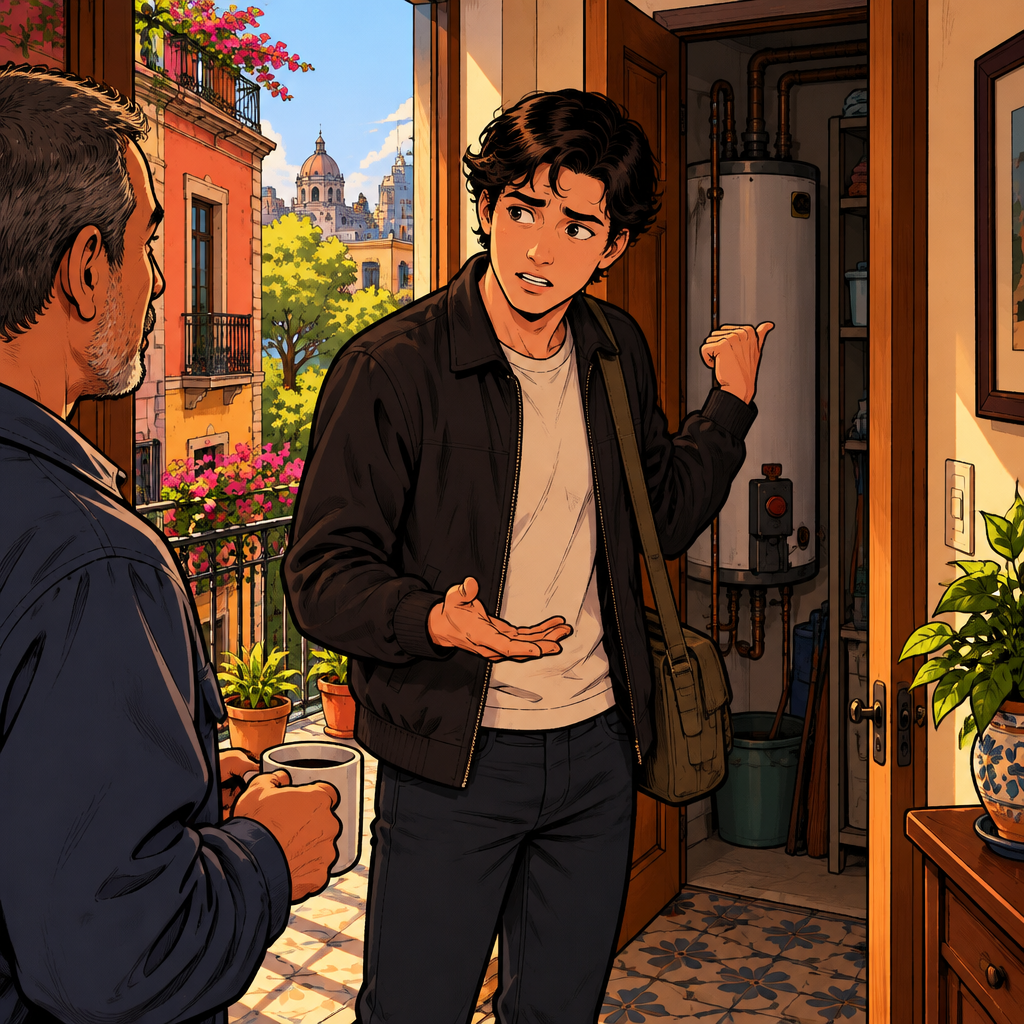
Saturday morning in colonia El Laurel. Justin's shower ran cold again, so he called Peter, who takes care of the building.
Peter is at the door now, coffee in hand. The water heater is in a closet in the hallway.

Learn — what changed, and what you tried
Six lines that tell the whole story of a small problem: what isn't working, how it used to be, when it started, and what you tried.
Notice the past forms. You'll use them over and over when something breaks.
___ no está funcionando bien
___ isn't working right
When to use it: Say this about something that still runs but acts up.
Fill the blank with el calentador, la estufa, and so on.

Antes estaba bien, pero ahora ___
It used to be fine, but now ___
When to use it: Say this to contrast how things were with how they are.
Estaba is the imperfect, used for how something used to be.

El problema empezó cuando ___
It started when ___
When to use it: Say this to pin down the moment the trouble began.
Empezó is preterite: one moment when it started.

Intenté ___, pero no sirvió
I tried to ___, but it didn't help
When to use it: Say this to report what you already tried, and that it failed.
Intenté is preterite: a finished attempt. Sirvió is also preterite.

Esto ya había pasado antes
This had happened before
When to use it: Say this when the same problem has come up before.
Había pasado is past perfect: it had already happened earlier.

¿Podrías revisarlo por mí?
Could you take a look?
When to use it: Ask this to request a favor politely.
Podrías is softer than puedes, like could instead of can.
Say it: Po-DEE-ahs: the r in revisarlo is a soft tap.
Story — Peter takes a look
Peter asked what happened, and Justin walks him through it step by step.
The highlighted lines are the ones you just learned. Watch how Justin uses them to tell the whole story.
- Saturday morning. Peter knocks, and Justin opens the door.
- PeterBuenos días, Justin. ¿Qué pasó?Good morning, Justin. What happened?
 JustinBuenos días. Hay un problema con el calentador de agua.Good morning. There's a problem with the water heater.
- JustinEl calentador no está funcionando bien.The water heater isn't working right.
- Peter¿Y antes? ¿Funcionaba bien?And before? Did it work well?
- JustinAntes estaba bien, pero ahora no enciende.It used to be fine, but now it won't turn on.
- Peter¿Cuándo empezó el problema?When did the problem start?
- JustinEl problema empezó cuando se fue la luz el jueves.It started when the power went out on Thursday.
- Peter¿Y no intentaste nada?And you didn't try anything?
- JustinIntenté apagarlo y encenderlo, pero no sirvió.I tried turning it off and on, but it didn't help.
- Peter¿Primera vez que falla?First time it fails?
- JustinNo. Esto ya había pasado antes, en el invierno.No. This had happened before, in the winter.
- Justin¿Podrías revisarlo por mí?Could you take a look at it for me?
- Peter opens the closet and stares at the water heater for a long moment.
- PeterCreo que es el termostato. No es grave.I think it's the thermostat. It's not serious.
- JustinQué alivio. Gracias, Peter.What a relief. Thanks, Peter.
- PeterLo arreglo hoy. No es emergencia, pero hoy queda.I'll fix it today. It's not an emergency, but it gets done today.
Practice — explain it again
Ten exercises, from listening to building whole lines.
Pay attention to the past forms like estaba and intenté. That's where most mistakes happen at this level.
0 of 11 done
What did you hear?
What did you hear?
Fill the gap
Fill the gap
It started when ___
El problema ____ cuando ___
What do you say?
What do you say?
Your water heater still runs, but the water comes out lukewarm. Tell Peter what's wrong with it.
Match the pairs
Spanish
___ no está funcionando bienDrop the English hereIntenté ___, pero no sirvióDrop the English here¿Podrías revisarlo por mí?Drop the English hereEnglish
Pick the reply
Peter says:
Pick the reply
¿Cuándo empezó el problema?
When did the problem start?
And you reply with:
Find the mistake
Find the mistake
Build the line
Build the line
This had happened before
Tap the words in order.
Which one doesn’t belong?
Which one doesn’t belong?
Swap the word
Swap the word
You don't just want Peter to glance at the heater; you want him to check it properly.
¿Podrías ____ por mí?
What does it mean?
What does it mean?
¿Podrías revisarlo por mí?
What do you say?
What do you say?
Peter is at your door. Mention the water heater before anything else.
Say it — tell Peter yourself
Now you're Justin, explaining the water heater to Peter. Tap the microphone when it's your turn.
Tap ▶ first if you want to hear the line. Your recording stays on your device.
- Peter¿Qué pasó con el calentador?What happened with the water heater?
- Justin (you)Say the water heater isn't working right.
Say the water heater isn't working right.
___ no está funcionando bien
___ isn't working right
0 of 6 said
Recap — what you can say now
| Spanish | English | Play |
|---|---|---|
| ___ no está funcionando bien | ___ isn't working right | |
| Antes estaba bien, pero ahora ___ | It used to be fine, but now ___ | |
| El problema empezó cuando ___ | It started when ___ | |
| Intenté ___, pero no sirvió | I tried to ___, but it didn't help | |
| Esto ya había pasado antes | This had happened before | |
| ¿Podrías revisarlo por mí? | Could you take a look? |
Save your progress — it’s free
Keep your place in the course and see which lines you’ve learned.
Want the next lesson in your inbox?
Get the next lesson by email, one a day.
Join the newsletterDaily lesson emails are coming soon. Newsletter subscribers get them first.
Keep practicing with Yak Cards
Keep these problem-explaining lines handy with the Yak Cards for this lesson, and practice them anywhere.
A daily round with the Yak Cards keeps your estaba, intenté and había pasado lines ready when something breaks.
Open Yak Cards