
New here? This is lesson 157 of a free 238-lesson Spanish course.
Free Spanish CourseLesson 157 of 238
What I mean is in Spanish
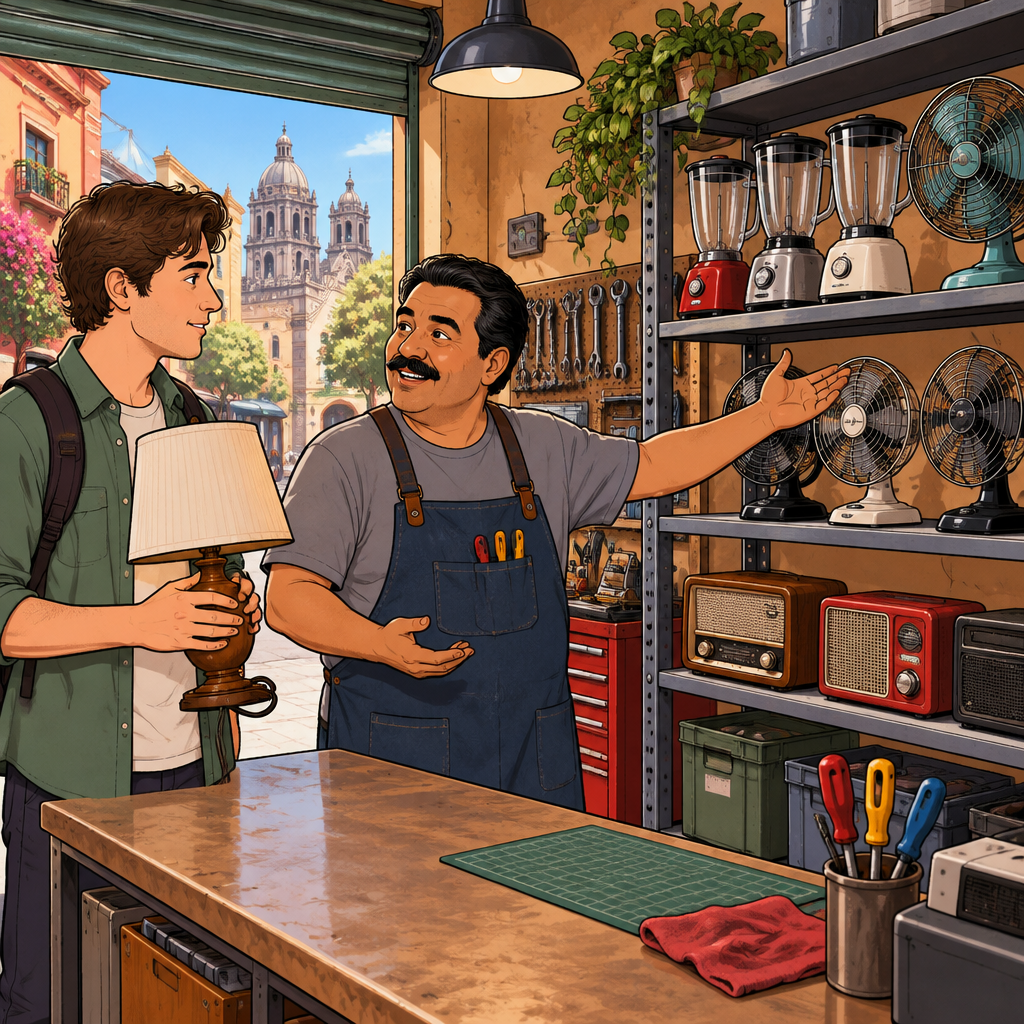
Justin takes a broken lamp to the repair shop, and Alex explains how the whole process works.
You'll learn the phrases Mexican speakers use to make an explanation simple: what I mean is, basically, in a few words, it works like this, and it's a way to.
By the end, you can explain something plainly and check that the other person follows you.
By the end of this lesson
Explain something in a simple way and check that it makes sense.
- Lo que quiero decir es ___What I mean is ___
- En pocas palabras, ___In a few words, ___
- Básicamente, ___Basically, ___
- Funciona asíIt works like this
- Es una forma de ___It's a way to ___
Scene — one broken lamp
A small electronics repair shop in El Laurel. Justin has just carried in a lamp that stopped working last night.
Alex is behind the counter, and behind him waits a line of blenders, fans, and radios.

Learn — say it plainer
Five phrases that make any explanation easier to follow: restate your point, cut to the core, promise the short version, lay out the steps, or say what something is for.
Learn each one as a single piece.

Lo que quiero decir es ___
What I mean is ___
When to use it: Use this to restate the point you were trying to make.
Learn it as one piece; decir stays in the infinitive after quiero.
Say it: decir: deh-SEER, with a soft d like the th in “the”.

En pocas palabras, ___
In a few words, ___
When to use it: Say this right before giving a short summary of a longer explanation.
Palabras is feminine plural, so it takes pocas.
Say it: POH-kahs pah-LAH-brahs

Básicamente, ___
Basically, ___
When to use it: Use it to strip an explanation down to its core idea.
Words ending in -mente stress the -men syllable; the accent on á is kept from básico, as in rápidamente.

Funciona así
It works like this
When to use it: Say this just before describing a process step by step.
The thing works; the person doesn't. Funciona comes from funcionar.
Es una forma de ___
It's a way to ___
When to use it: Use it to describe what something is for, in simple terms.
After de, use the infinitive: una forma de asegurar.
Story — three steps
Watch how Alex keeps his explanation simple with the highlighted phrases. Justin asks the questions and Alex does the explaining.
Turn on Show English if a step gets away from you.
- Justin carries in a lamp that stopped working last night.
 JustinHola. Esta lámpara ya no prende. ¿La reparan aquí?Hi. This lamp won't turn on anymore. Do you repair it here?
- AlexSí, pero el proceso tiene tres pasos.Yes, but the process has three steps.
- Justin¿Cómo? Mejor explícamelo fácil.How? Better explain it to me simply.
- AlexFunciona así: primero la revisamos y te cotizamos.It works like this: first we check it and give you a quote.
- Justin¿Y el depósito de la puerta?And the deposit at the door?
- AlexLo que quiero decir es que el depósito aparta tu lugar en la fila.What I mean is, the deposit holds your place in line.
- JustinAh, o sea, no es el pago.Oh, I mean, it isn't the payment.
- AlexExacto. Es una forma de decir que vas a volver.Exactly. It's a way of saying you'll come back.
- Justin¿Y si no regreso?And if I don't come back?
- AlexBásicamente, pierdes el depósito. Nada más.Basically, you lose the deposit. That's all.
- JustinO sea: revisión, cotización y depósito.So: checkup, quote, and deposit.
- AlexEn pocas palabras, sí: la dejas, la revisamos, te avisamos.In a few words, yes: you leave it, we check it, we let you know.
- Alex¿Tiene sentido?Does that make sense?
- JustinSí, tiene sentido. La dejo.Yes, it makes sense. I'll leave it.
- Justin picks up an umbrella to leave — it's Alex's.
- JustinPerdón, casi me llevo su sombrilla.Sorry, I almost took your umbrella.
- AlexPasa seguido. Ya hasta le pongo etiquetas.It happens a lot. I'm about to start putting labels on things.
Practice — pick the plain one
Eleven quick exercises: listen, match, pick the right phrase for each situation, and put a short chat in order.
Watch out for basically and in a few words — they sound alike but do different jobs.
0 of 11 done
What did you hear?
What did you hear?
Match the pairs
Spanish
Lo que quiero decir es ___Drop the English hereEn pocas palabras, ___Drop the English hereEs una forma de ___Drop the English hereEnglish
What does it mean?
What does it mean?
Básicamente, ___
What do you say?
What do you say?
Alex took your first sentence to mean the deposit is the payment. You restate your real point.
Pick the reply
Alex says:
Pick the reply
Uf, fue mucha información. ¿Me la resumes?
Wow, that was a lot of information. Can you sum it up for me?
And you reply with:
What do you say?
What do you say?
You explain what the café's points program is for: its way of thanking the regular customers.
Fill the gap
Fill the gap
It works like this
Funciona ____
Swap the word
Swap the word
You point at the paper in your hand — the idea at hand, not the one across the room.
A ____ me refiero
What do you say?
What do you say?
You want to make your explanation concrete with one real case, like Monday's morning rush.
True or false?
True or false?
This line says that an explanation is clear and holds together.
Put the chat in order
- JustinWhat comes first?
- Alex…
- Justin…
- Alex…
Say it — explain it yourself
Now the roles flip: you're the one explaining, and Alex asks the questions. Tap the microphone when it's your turn.
Tap ▶ first to hear the model line. Your recording stays on your device.
- AlexJustin, ¿cómo funciona lo de los puntos? Me perdí con tu explicación.Justin, how does the points thing work? I got lost in your explanation.
- Justin (you)Restate your point: you get a point for every coffee.
Restate your point: you get a point for every coffee.
Lo que quiero decir es ___
What I mean is ___
0 of 5 said
Recap — what you can say now
| Spanish | English | Play |
|---|---|---|
| Lo que quiero decir es ___ | What I mean is ___ | |
| En pocas palabras, ___ | In a few words, ___ | |
| Básicamente, ___ | Basically, ___ | |
| Funciona así | It works like this | |
| Es una forma de ___ | It's a way to ___ |
Save your progress — it’s free
Keep your place in the course and see which lines you’ve learned.
Want the next lesson in your inbox?
Get the next lesson by email, one a day.
Join the newsletterDaily lesson emails are coming soon. Newsletter subscribers get them first.
Keep practicing with Yak Cards
Want to keep these explaining phrases handy? Grab the Yak Cards for this lesson and review them anywhere.
A quick round with the Yak Cards each day keeps your explaining phrases ready when you need them.
Open Yak Cards