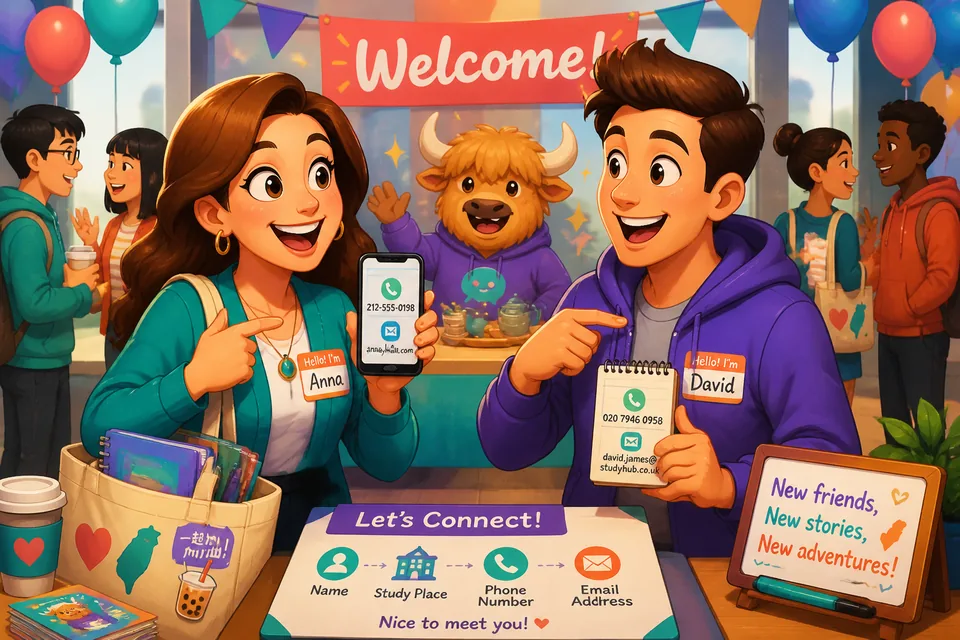
Ready to talk about yourself? In this short lesson you’ll practice common personal-info phrases used in everyday chats.
Have fun — say the lines out loud and pretend you’re meeting a new friend.
Level A1: In this lesson you'll learn and practice basic identity phrases — how to give your name, phone, email, birthday, nationality, where you study, and how to ask for contact details. This CEFR-aligned mini-lesson focuses on short ready-to-use phrases you can repeat, recognize in conversation, and use when meeting people.
After this lesson you'll be able to:
Give and ask for phone numbers and email addresses.
Say your name, birthday, nationality, and where you study.
Ask a simple question about someone’s workplace.
Practice pronunciation by repeating and speaking aloud (A1).
Ready? Let's go!
When you tap play on phrases, we track your progress through this lesson.
1. Reading + Listening Practice
Hear core phrases, repeat aloud.
Mi número de teléfono es ___.
My phone number is ___.
Meaning: My phone number is ___.
When to use: Use when you want to give someone your phone number. Add the digits after the phrase.
Tip: Don't forget country or area codes if the person is abroad; learners sometimes omit them.
Mi número de teléfono es 555-1234.
My phone number is 555-1234.
Mi número de teléfono es +34 612 345 678.
My phone number is +34 612 345 678.
¿Cuál es tu número de teléfono?
What's your phone number?
Meaning: What's your phone number?
When to use: Ask this informally when you want someone's phone number. For formal situations use “¿Cuál es su número de teléfono?”.
¿Cuál es tu número de teléfono? Quiero mandarte un mensaje.
What's your phone number? I want to send you a message.
Si necesitas ayuda, dime: ¿Cuál es tu número de teléfono?
If you need help, tell me: What's your phone number?
Mi correo es ___.
My email address is ___.
Meaning: My email address is ___.
When to use: Give your email address; you can use this short form in casual conversation.
Tip: Be sure to include the @ and domain; beginners sometimes say only the name without the full address.
Mi correo es ana@gmail.com.
My email is ana@gmail.com.
Para enviar el documento: Mi correo es trabajo@empresa.com.
To send the document: My email is trabajo@empresa.com.
¿Cuál es tu correo?
What's your email address?
Meaning: What's your email address?
When to use: Ask informally for someone's email. Formal version: “¿Cuál es su correo electrónico?”.
¿Cuál es tu correo? Necesito tu contacto.
What's your email? I need your contact.
Cuando termines, pregúntale: ¿Cuál es tu correo?
When you finish, ask them: What's your email?
Estudio en ___.
I study at ___.
Meaning: I study at ___.
When to use: Use this to tell where you study (school, college, university). Add the place after the phrase.
Estudio en la Universidad de Barcelona.
I study at the University of Barcelona.
Estudio en un colegio cerca de casa.
I study at a school near home.
Mi nombre es ___.
My first name is ___.
Meaning: My first name is ___.
When to use: Introduce yourself with your first name. Add your given name after the phrase.
Mi nombre es Laura.
My name is Laura.
Hola, mi nombre es Carlos. Mucho gusto.
Hi, my name is Carlos. Nice to meet you.
Mi cumpleaños es el ___.
My birthday is ___.
Meaning: My birthday is ___.
When to use: Give your birthday using a date after the phrase, for example: “Mi cumpleaños es el 5 de mayo.”
Mi cumpleaños es el 12 de enero.
My birthday is January 12th.
¿Cuándo es tu cumpleaños? Mi cumpleaños es el 5 de mayo.
When is your birthday? My birthday is May 5th.
¿Dónde trabajas?
Where do you work?
Meaning: Where do you work?
When to use: Ask informally where someone works. For formal use: “¿Dónde trabaja?”.
¿Dónde trabajas? Trabajo en una tienda.
Where do you work? I work in a shop.
Si quieres saber más, pregúntale: ¿Dónde trabajas?
If you want to know more, ask: Where do you work?
Soy ___
My nationality is ___.
Meaning: My nationality is ___.
When to use: State your nationality in conversation. You can simply say the country adjective after “Soy.”
Tip: Learners sometimes say “Yo soy de México” (I am from Mexico) — that’s also correct but slightly different (origin vs. nationality).
Soy mexicana.
I am Mexican.
Soy peruano y vivo aquí.
I am Peruvian and I live here.
2. Conversational Listening Practice
Hear phrases in a real mini-conversation.
Anna and David meet and share name, study place, phone and email.
Anna
Hola, mi nombre es Anna.
Hi, my name is Anna.
David
Hola Anna, mi nombre es David. Soy mexicano.
Hi Anna, my name is David. I'm Mexican.
Anna
¿Dónde trabajas?
Where do you work?
David
Estudio en la Universidad de Sevilla.
I study at the University of Seville.
Anna
¿Cuál es tu número de teléfono?
What's your phone number?
David
Mi número de teléfono es 612-345-678. ¿Cuál es tu correo?
My phone number is 612-345-678. What's your email?
Anna
Mi correo es anna@mail.com.
My email is anna@mail.com.
3. Guided Practice
Quizzes and matching to lock in meaning.
Which phrase asks for an email address informally?
How do you say 'My name is María'?
Which phrase correctly gives a birthday?
How do you ask someone where they work informally?
Ana asks for his phone; he answers 'My phone number is 555-6789.'
Ana pregunta: '¿Cuál es tu número de teléfono?' Marcos responde: '_____ 555-6789.'
She answers with 'My email is laura@example.com.'
Le escribo a Laura. Ella pregunta: '¿Cuál es tu correo?' Laura responde: '_____ laura@example.com.'
Carlos says: 'I study at the Autonomous University.'
Carlos presenta su universidad: '_____ la Universidad Autónoma.'
Match the core phrases
Match the extra phrases
4. Speaking Practice
Say phrases yourself (mic/recording).
Recording stays on your device only. Check speech uses your browser's speech tools when available.