Nice to see you — welcome to Lesson 12! Short and useful: we'll practice polite ways to ask about needs, say you don't need something, choose items, and refuse more.
Level A1: In this short CEFR-aligned lesson you'll learn seven practical phrases for wants and needs: how to refuse more politely, say you don't need something, ask if you need or must do something, choose an item, and ask for a small amount. Lesson 12 focuses on real situations like shops, food, and chores so you can use these lines right away.
After this lesson you'll be able to:
Recognize and say polite refusals like "Ya no, gracias."
Ask and answer basic need questions: "¿Necesito ___?" and "¿Tengo que ___?"
Choose items and request small amounts: "Este, por favor." and "Un poco, por favor."
Use short replies to say actions or things are not necessary: "No necesito ___." / "No tengo que ___."
Level A1: practice listening, choosing, and speaking useful survival phrases.
Ready? Let's go!
When you tap play on phrases, we track your progress through this lesson.
1. Reading + Listening Practice
Hear core phrases, repeat aloud.
Ya no, gracias.
No more, thanks.
Meaning: No more, thanks.
When to use: Use this to politely refuse any additional amount — more food, drink, or another piece. Slightly stronger than just “No, gracias” when you mean you don’t want any more.
Tip: Don't mix with 'no más' (which can mean other things). Say the full phrase to sound polite.
¿Quieres otra porción? — Ya no, gracias.
I don't want another serving, thanks.
¿Más pan? — Ya no, gracias.
No more bread, thanks.
No necesito ___.
I don't need ___.
Meaning: I don't need ___.
When to use: Say this when something isn't necessary for you. Add a noun after the blank, for example: "No necesito ayuda."
No necesito ayuda, gracias.
I don't need help, thanks.
No necesito más dinero.
I don't need more money.
¿Necesito ___?
Do I need ___?
Meaning: Do I need ___?
When to use: Use this question to ask if a noun or thing is necessary. Fill the blank with a noun: "¿Necesito un paraguas?"
¿Necesito un paraguas hoy?
Do I need an umbrella today?
¿Necesito traer mi pasaporte?
Do I need to bring my passport?
¿Tengo que ___?
Do I have to ___?
Meaning: Do I have to ___?
When to use: Ask this before a verb or action to check whether it is necessary, for example: "¿Tengo que ir ahora?"
¿Tengo que pagar ahora?
Do I have to pay now?
¿Tengo que llenar este formulario?
Do I have to fill out this form?
No tengo que ___.
I don't have to ___.
Meaning: I don't have to ___.
When to use: Use before a verb to say an action is not necessary: "No tengo que trabajar mañana."
Tip: Learners sometimes confuse 'no tengo que' with 'no necesito'. 'No tengo que' talks about actions (verbs).
No tengo que trabajar mañana.
I don't have to work tomorrow.
No tengo que pagar hasta la próxima semana.
I don't have to pay until next week.
Este, por favor.
This one, please.
Meaning: This one, please.
When to use: Point to an item and use this to select it politely. If the item is feminine, use "Esta, por favor."
Tip: Watch gender: choose 'este' (masculine) or 'esta' (feminine) to match the item.
¿Cuál quiere? — Este, por favor.
Which one do you want? — This one, please.
En la tienda: "Este, por favor."
At the shop: "This one, please."
Un poco, por favor.
A little, please.
Meaning: A little, please.
When to use: Use when asking for a small amount of something (sugar, salt, sauce). Slightly more polite than saying nothing.
¿Cuánta salsa? — Un poco, por favor.
How much sauce? — A little, please.
Quiero café con leche, un poco, por favor.
I want coffee with milk, a little please.
2. Conversational Listening Practice
Hear phrases in a real mini-conversation.
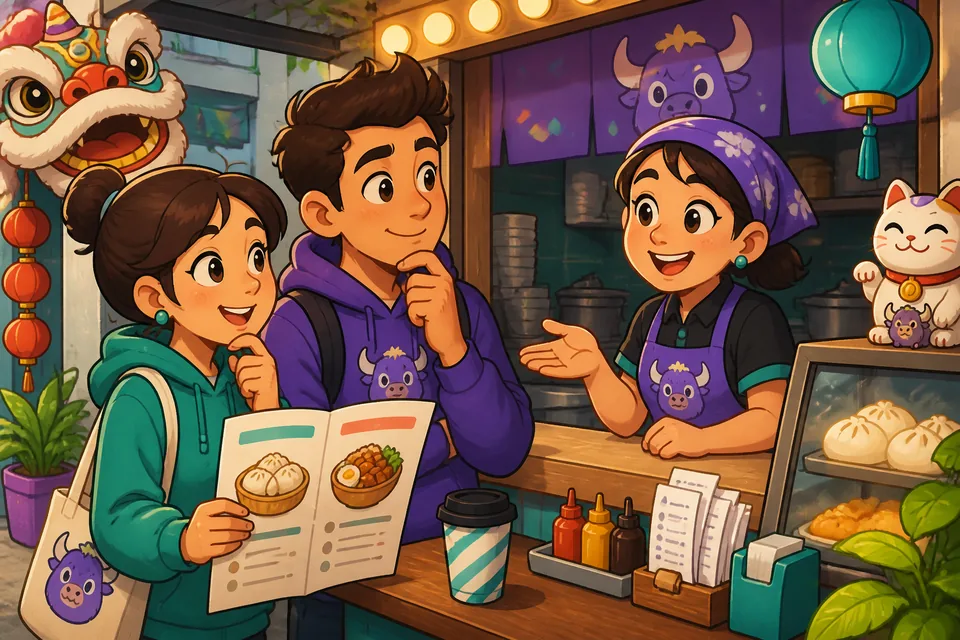
Buying food at a small stall
Anna
Este, por favor.
This one, please.
David
¿Necesita algo más?
Do you need anything else?
Anna
No necesito más. Ya no, gracias.
I don't need more. No more, thanks.
David
¿Tengo que envolverlo para regalo?
Do I have to wrap it as a gift?
Anna
No tienes que. ¿Me puede dar salsa? Un poco, por favor.
You don't have to. Can you give me sauce? A little, please.
3. Guided Practice
Quizzes and matching to lock in meaning.
How do you politely say “No more, thanks”?
Which phrase asks if an action is necessary?
How would you ask 'Do I need an umbrella?'
You only want a small amount of sugar. What do you say?
At the café, the barista asks if you want more coffee. You answer: No more, thanks.
At the café, the barista asks if you want more coffee. You answer: ___.
You point to a sandwich on the menu and order: This one, please.
You point to a sandwich on the menu and order: ___.
Your friend offers to carry your bag, but you can manage. You say: I don't need help.
Your friend offers to carry your bag, but you can manage. You say: ___.
Match the core phrases
Match the extra phrases
4. Speaking Practice
Say phrases yourself (mic/recording).
Recording stays on your device only. Check speech uses your browser's speech tools when available.