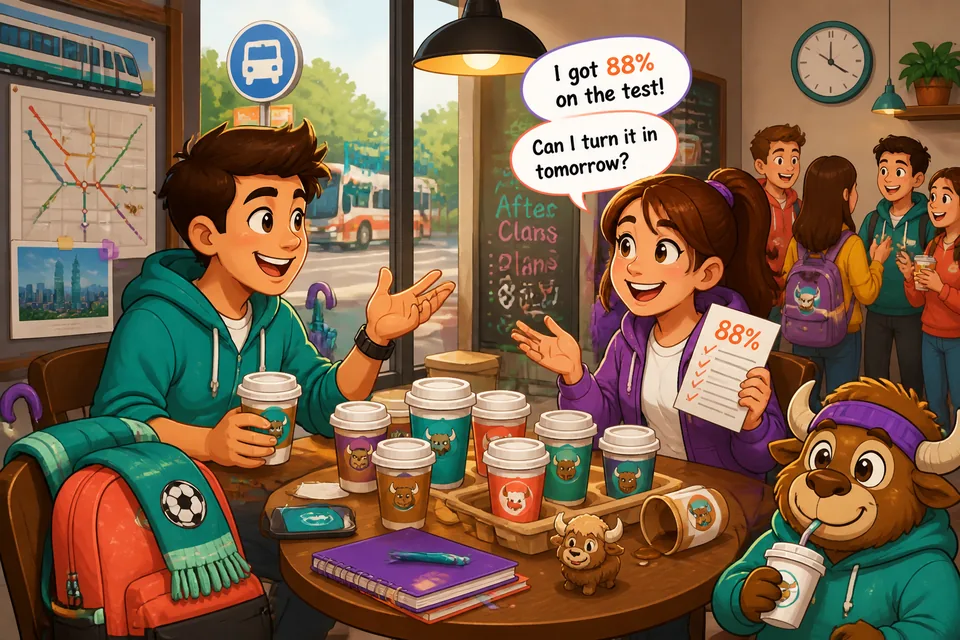
Ready for another short school-themed lesson? We'll practice polite requests, talking about tests and common classroom phrases. Keep it relaxed—this is A2 work, not a final exam!
Level A2: In this lesson you'll learn and use useful school phrases in Spanish: asking to turn something in later, talking about test scores, saying you forgot something, and describing what you're studying. This CEFR-aligned practice focuses on listening, repeating, and speaking short, natural lines you can use at school.
After this lesson you'll be able to:
Ask politely to submit work later and say you forgot something.
Report a test score and ask how someone did on a test.
Describe what a class is studying, give school start times, and request that someone check your work.
Use these phrases comfortably in short spoken exchanges (Level A2).
Ready? Let's go!
When you tap play on phrases, we track your progress through this lesson.
1. Reading + Listening Practice
Hear core phrases, repeat aloud.
¿Puedo entregarlo mañana?
Can I turn it in tomorrow?
Meaning: Can I turn it in tomorrow?
When to use: Use this polite question when you need permission to submit homework or an assignment a day late.
Tip: Avoid mixing formal 'puede' with 'mañana'—use '¿Puedo...?' with classmates or informal teachers.
Perdón, ¿Puedo entregarlo mañana? Se me hizo tarde.
Excuse me, can I turn it in tomorrow? I ran out of time.
La profesora dijo la fecha, pero ¿Puedo entregarlo mañana si tengo un problema?
The teacher said the due date, but can I turn it in tomorrow if I have a problem?
Saqué ___ en el examen.
I got ___ on the test.
Meaning: I got ___ on the test.
When to use: Use this to report your score or grade after an exam.
Saqué 9 en el examen de matemáticas.
I got a 9 on the math test.
No estoy seguro, creo que saqué 6 en el examen sorpresa.
I'm not sure; I think I got a 6 on the surprise test.
¿Cómo te fue en el examen?
How did you do on the test?
Meaning: How did you do on the test?
When to use: Ask a classmate or friend informally about their test results.
Hola, ¿Cómo te fue en el examen de historia?
Hi, how did you do on the history test?
Después de la clase le pregunté: ¿Cómo te fue en el examen?
After class I asked him: How did you do on the test?
Estamos viendo ___.
We're learning about ___.
Meaning: We’re learning about ___.
When to use: Say what topic your class is covering right now.
Estamos viendo la Revolución Industrial en historia.
We're learning about the Industrial Revolution in history.
En biología estamos viendo las células hoy.
In biology we're learning about cells today.
La escuela empieza a las ___.
School starts at ___.
Meaning: School starts at ___.
When to use: Give the start time for school or class (use 'a la una' for 1:00).
La escuela empieza a las ocho y media.
School starts at 8:30.
En mi pueblo la escuela empieza a las siete.
In my town school starts at seven.
Falté a clase ayer.
I missed class yesterday.
Meaning: I missed class yesterday.
When to use: Tell someone that you didn't attend class the previous day.
Falté a clase ayer porque estaba enfermo.
I missed class yesterday because I was sick.
Lo siento, falté a clase ayer y no tengo las notas.
Sorry, I missed class yesterday and I don't have the notes.
Se me olvidó mi ___ en la casa.
I forgot my ___ at home.
Meaning: I forgot my ___ at home.
When to use: Use this natural expression to say you left an item at home (use 'mis' for plural items).
Tip: Remember to change to 'mis' if the item is plural (se me olvidaron mis libros).
Se me olvidó mi libro en la casa.
I forgot my book at home.
Hoy se me olvidó mi estuche; no tengo lápices.
Today I forgot my pencil case; I don't have pencils.
Tenemos un proyecto sobre ___.
We have a project about ___.
Meaning: We have a project about ___.
When to use: Tell someone the topic of a group or class project.
Tenemos un proyecto sobre energías renovables.
We have a project about renewable energy.
En la clase de arte tenemos un proyecto sobre retratos.
In art class we have a project about portraits.
¿Puedes revisar mi ___?
Can you check my ___?
Meaning: Can you check my ___?
When to use: Ask a friend or classmate informally to look over your homework or notes.
¿Puedes revisar mi ensayo antes de entregarlo?
Can you check my essay before I turn it in?
¿Puedes revisar mi respuesta en la pregunta 3?
Can you check my answer to question 3?
2. Conversational Listening Practice
Hear phrases in a real mini-conversation.
Two classmates catch up after class.
Anna
Hola, ¿Cómo te fue en el examen?
Hi, how did you do on the test?
David
Saqué 7 en el examen de ciencias.
I got a 7 on the science test.
Anna
Tenemos un proyecto sobre historia. ¿Puedes revisar mi esquema?
We have a project about history. Can you check my outline?
David
Claro, pero se me olvidó mi cuaderno en la casa.
Sure, but I forgot my notebook at home.
Anna
¿Puedo entregarlo mañana? Mi parte no está lista.
Can I turn it in tomorrow? My part isn't ready.
David
Yo falté a clase ayer, así que no sé qué estamos viendo hoy.
I missed class yesterday, so I don't know what we're learning today.
3. Guided Practice
Quizzes and matching to lock in meaning.
Which Spanish sentence asks permission to submit something tomorrow?
Which phrase asks someone to check your work?
How would you say 'I missed class yesterday' in Spanish?
Choose the sentence that means 'We’re learning about cells.'
Today I didn't bring pencils; I forgot my pencil case at home.
Hoy no traje lápices; __ mi estuche en la casa.
After the test, Marta asks Luis: 'How did you do on the exam?'
Después de la prueba, Marta le pregunta a Luis: '____ en el examen?'
The teacher announces: 'We're learning about the Renaissance in art this week.'
La profesora anuncia: '___ el Renacimiento en arte esta semana.'
Match the core phrases
Match the extra phrases
4. Speaking Practice
Say phrases yourself (mic/recording).
Recording stays on your device only. Check speech uses your browser's speech tools when available.