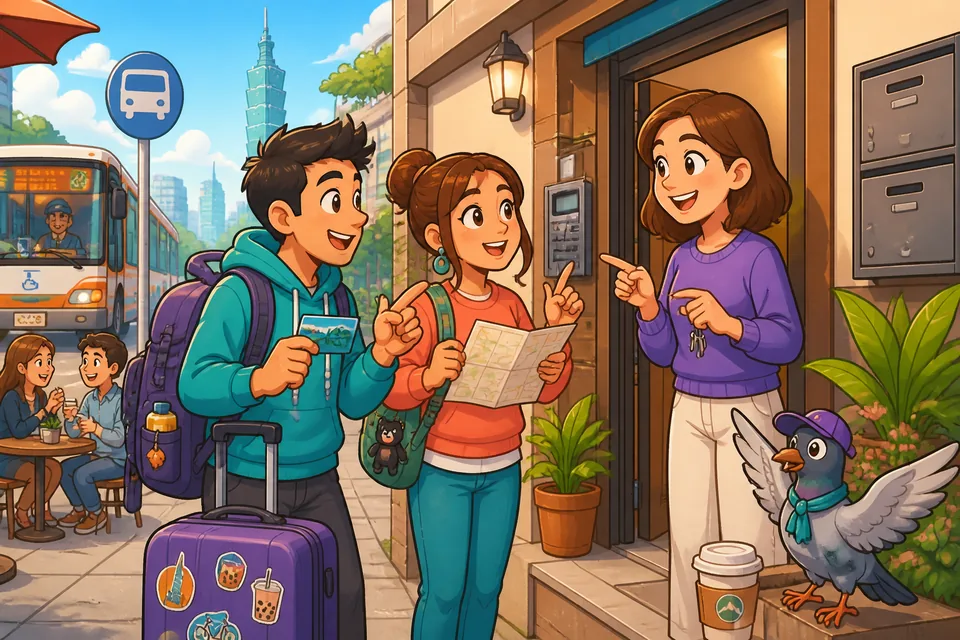
Welcome! This lesson focuses on useful phrases for traveling by bus or train. Practice these quick frames to get on, get off, buy tickets and ask questions politely.
Level A2: In this lesson you'll practice common transit phrases for asking about tickets, seats, stops and frequencies. These CEFR-aligned phrases help you talk to drivers and fellow passengers — polite requests, short explanations, and useful questions for real journeys.
After this lesson you'll be able to:
Understand and use polite requests to get off, buy tickets, and ask about seats.
Ask and answer simple questions about ticket machines, direct routes, and frequency.
Be comfortable saying where you need to get off and handling small problems on public transport.
Ready? Let's go!
When you tap play on phrases, we track your progress through this lesson.
1. Reading + Listening Practice
Hear core phrases, repeat aloud.
Tengo que bajarme en ___.
I need to get off at ___.
Meaning: I need to get off at ___.
When to use: Use this to tell the driver or a travel companion which stop you plan to get off at (fill the blank with the stop name).
Tip: Don't drop the preposition 'en'—say 'bajarme en' + place, not just 'bajarme' alone.
Tengo que bajarme en la estación Central.
I need to get off at Central station.
Tengo que bajarme en mi parada dentro de cinco minutos.
I need to get off at my stop in five minutes.
¿Me baja en la próxima parada, por favor?
Please let me off at the next stop.
Meaning: Please let me off at the next stop.
When to use: Say this politely to the driver when you want them to stop at the next stop (common polite form).
Disculpe, ¿me baja en la próxima parada, por favor?
Excuse me, will you let me off at the next stop, please?
Si puede, ¿me baja en la próxima parada, por favor? Estoy con prisa.
If you can, please let me off at the next stop — I'm in a hurry.
¿Puedo comprar el boleto en el autobús?
Can I buy a ticket on the bus?
Meaning: Can I buy a ticket on the bus?
When to use: Ask this when you're on board and unsure if drivers sell tickets or if you must buy one beforehand.
¿Puedo comprar el boleto en el autobús o tengo que comprarlo antes?
Can I buy the ticket on the bus or do I have to buy it before?
Subí rápido. ¿Puedo comprar el boleto en el autobús?
I boarded quickly. Can I buy the ticket on the bus?
¿Tengo que pasar la tarjeta al subir y al bajar?
Do I have to tap in and out?
Meaning: Do I have to tap in and out?
When to use: Use this to check whether a transit system requires you to use a card both when boarding and leaving.
Tip: Students sometimes say 'pasar la tarjeta al subir y bajar' — include 'al' before both verbs or use 'al subir y al bajar' for clarity.
¿Tengo que pasar la tarjeta al subir y al bajar en este sistema?
Do I have to tap the card when boarding and when leaving in this system?
Mi tarjeta nueva: ¿tengo que pasar la tarjeta al subir y al bajar?
With my new card: do I have to tap in and out?
¿Está ocupado este asiento?
Is this seat taken?
Meaning: Is this seat taken?
When to use: Ask politely when you want to sit in a public transport seat that might be occupied.
Perdón, ¿está ocupado este asiento?
Excuse me, is this seat taken?
¿Está ocupado este asiento? Si no, me siento.
Is this seat taken? If not, I'll sit down.
Me pasé de mi parada.
I missed my stop.
Meaning: I missed my stop.
When to use: Say this when you realize you went past the stop you intended to get off at.
Tip: Beginners sometimes say 'perdí mi parada' — that's understandable, but 'me pasé de mi parada' is the natural phrasing here.
¡Ay! Me pasé de mi parada, ¿dónde puedo bajar ahora?
Oh! I missed my stop — where can I get off now?
Me pasé de mi parada y tengo que regresar en el siguiente tren.
I missed my stop and I have to go back on the next train.
La máquina de boletos no funciona.
The ticket machine isn't working.
Meaning: The ticket machine isn't working.
When to use: Report a problem with a ticket machine so staff or other passengers understand the issue.
La máquina de boletos no funciona; ¿dónde puedo pagar?
The ticket machine isn't working; where can I pay?
Intenté usarla pero la máquina de boletos no funciona esta mañana.
I tried to use it but the ticket machine isn't working this morning.
¿Dónde puedo comprar un boleto?
Where can I buy a ticket?
Meaning: Where can I buy a ticket?
When to use: Ask this when you need to find a place to purchase a transit ticket (station, kiosk, online, etc.).
Disculpe, ¿dónde puedo comprar un boleto para el tren?
Excuse me, where can I buy a ticket for the train?
¿Dónde puedo comprar un boleto? La máquina no funciona.
Where can I buy a ticket? The machine is not working.
¿Cada cuánto pasa el ___?
How often does the ___ come?
Meaning: How often does the ___ come?
When to use: Use this to ask about the frequency of a bus, train or metro line (fill in the vehicle or line).
¿Cada cuánto pasa el autobús número 5?
How often does bus number 5 come?
Antes de salir, pregunto: ¿cada cuánto pasa el tren aquí?
Before leaving, I ask: how often does the train come here?
¿Hay un ___ directo a ___?
Is there a direct ___ to ___?
Meaning: Is there a direct ___ to ___?
When to use: Ask whether there is a direct service (bus, train, shuttle) to a destination — a helpful travel question.
¿Hay un autobús directo a la playa?
Is there a direct bus to the beach?
¿Hay un tren directo a la estación del aeropuerto?
Is there a direct train to the airport station?
2. Conversational Listening Practice
Hear phrases in a real mini-conversation.
Two passengers on a bus asking about seats, tickets and stops.
Anna
Perdón, ¿está ocupado este asiento?
Excuse me, is this seat taken?
David
No, puede sentarse.
No, you can sit.
Anna
Gracias. ¿Puedo comprar el boleto en el autobús?
Thanks. Can I buy the ticket on the bus?
David
Creo que sí, pero la máquina de boletos no funciona.
I think so, but the ticket machine isn't working.
Anna
Tengo que bajarme en la estación Central. ¿Me baja en la próxima parada, por favor?
I need to get off at Central station. Will you let me off at the next stop, please?
David
¡Qué mal! Me pasé de mi parada antes. Ten cuidado.
Oh no! I missed my stop earlier. Be careful.
3. Guided Practice
Quizzes and matching to lock in meaning.
Which Spanish phrase asks if this seat is taken?
How do you say 'I missed my stop' in Spanish?
Which phrase asks if it's possible to buy a ticket aboard the bus?
Which sentence asks about tapping a transit card when boarding and leaving?
I need to get off at ___.
I need to get off at ____.
If the ticket machine is broken, you can say: The ticket machine isn't working.
If the ticket machine is broken, you can say: ____.
To ask whether there is a direct service to the airport, you say: Is there a direct ___ to ___?
To ask whether there is a direct service to the airport, you say ____.
Match the core phrases
Match the extra phrases
4. Speaking Practice
Say phrases yourself (mic/recording).
Recording stays on your device only. Check speech uses your browser's speech tools when available.