Te escucho.
I'm listening.
Te escucho. Cuéntame lo que pasó cuando estés listo.
I'm listening. Tell me what happened when you're ready.
Si necesitas hablar ahora mismo, te escucho.
If you need to talk right now, I'm listening.
Lesson 93 of 159

Goal: Comforting someone with short, honest phrases
Free Spanish lessons with guided practice, audio, and speaking support.
Welcome — let's practice phrases that help you connect when someone is struggling. This lesson is friendly and practical: listen, repeat, and try the short exercises.
Level B1: In this lesson (93) you'll practice three warm phrases used to show empathy and reassurance: Te escucho; Ojalá pudiera hacerlo más fácil para ti; and No es tu culpa. We'll hear them, use them in a short conversation, and do quizzes and speaking practice to build confidence — CEFR-aligned and ready for real moments.
After this lesson you'll be able to:
Ready? Let's go!
When you tap play on phrases, we track your progress through this lesson.
Hear core phrases, repeat aloud.
Te escucho.
I'm listening.
Ojalá pudiera hacerlo más fácil para ti.
I wish I could make it easier.
No es tu culpa.
It's not your fault.
Hear phrases in a real mini-conversation.
Anna calls David upset about a project and feelings of guilt.
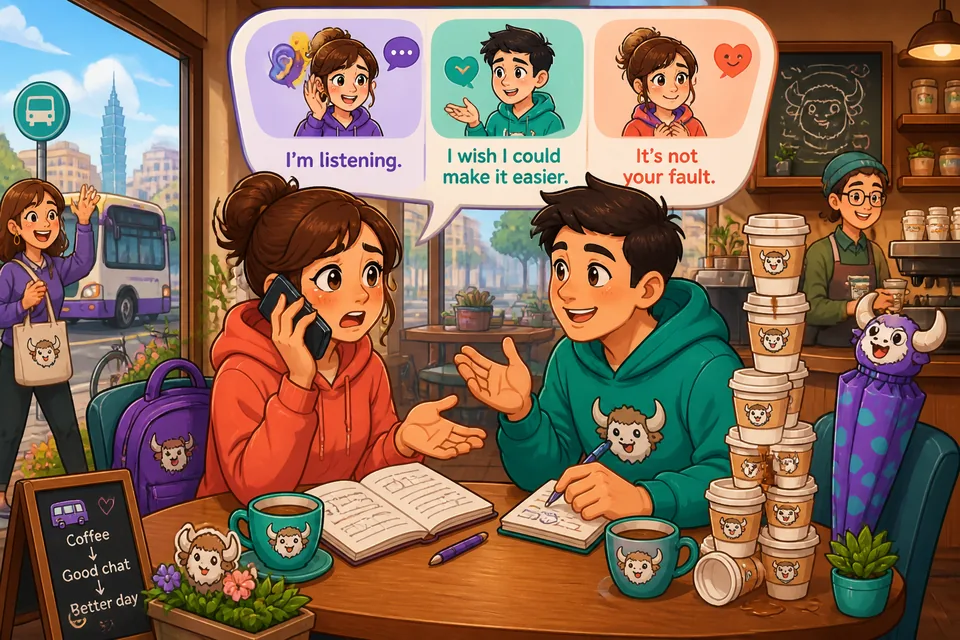

Anna
Estoy agotada y siento que todo salió mal.
I'm exhausted and I feel like everything went wrong.

David
Te escucho. Dime qué pasó desde el principio.
I'm listening. Tell me what happened from the start.
Anna
Pensé que era mi culpa, fallé en la parte que me tocaba.
I thought it was my fault; I failed the part that was mine.
David
No es tu culpa. Hubo muchos factores fuera de tu control.
It's not your fault. There were many factors beyond your control.
Anna
Gracias. Ojalá pudiera hacerlo más fácil para ti también, porque me siento mal por pedir ayuda.
Thanks. I wish I could make it easier for you too, because I feel bad for asking for help.
David
No te preocupes, estoy aquí y te escucho.
Don't worry, I'm here and I'm listening.
Quizzes and matching to lock in meaning.
Cuando lloró después de la reunión, su amiga le dijo: '_______' para calmarlo.
Antes de empezar a contar su historia, Ana dijo: '_______', así su amiga se concentró.
Al hablar del problema, él suspiró y dijo: '_______', porque no sabía cómo arreglar todo.
Say phrases yourself (mic/recording).
Recording stays on your device only. Check speech uses your browser's speech tools when available.
Say this phrase out loud:
Te escucho.
I'm listening.
Say this phrase out loud:
Ojalá pudiera hacerlo más fácil para ti.
I wish I could make it easier for you.
Say this phrase out loud:
No es tu culpa.
It's not your fault.