Simplified Chinese - School Life

Lesson 57 of 156

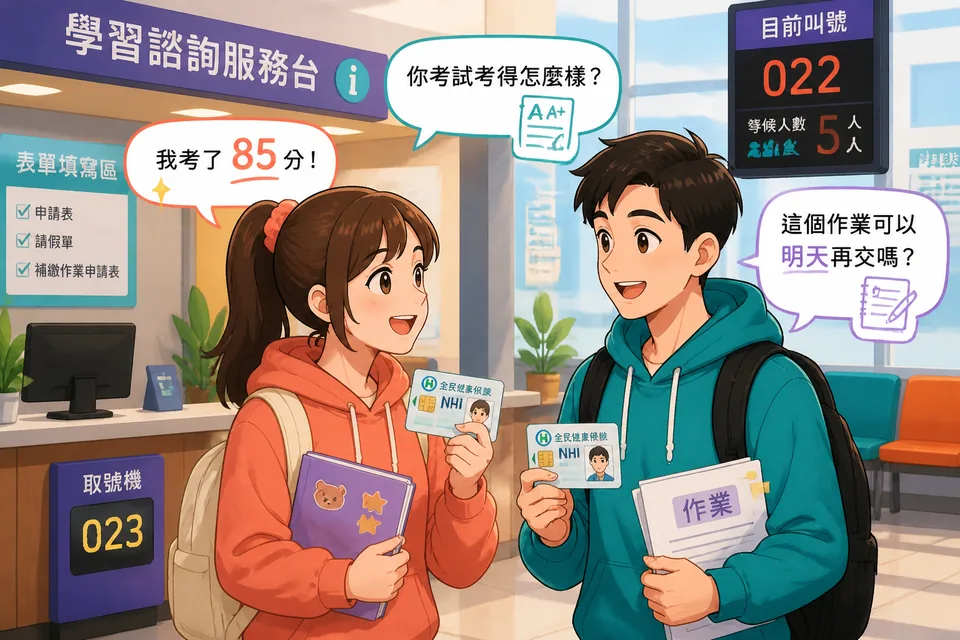
Students chatting in a Chinese school hallway; Simplified Chinese phrases for school life float nearby.

Goal: Talking about tests, projects, and everyday school stuff

Free Simplified Chinese lessons with guided practice, audio, and speaking support.

Ready to chat about school? This lesson is short, practical, and full of phrases you can use with classmates and teachers. Have fun — a little Yak Yacker energy helps when you practice aloud!

Level A2: In Lesson 57 you'll practice common school phrases used for talking about tests, projects, missing class, and asking for help. We'll focus on asking permission to turn in work, reporting scores, describing what you're learning, and simple requests like “Can you check this?” This lesson is CEFR-aligned and built for quick listening, repetition, and speaking.

After this lesson you'll be able to:

  • Practice asking permission to submit work and making polite requests.
  • Report test results and ask classmates how they did.
  • Talk about class times, topics, projects, and forgetting items.
  • Build confidence saying these phrases aloud (A2 level).
A colorful classroom scene showing students working on a group project; the scene highlights school vocabulary in Simplified Chinese.

Ready? Let's go!

When you tap play on phrases, we track your progress through this lesson.

1. Reading + Listening Practice

Hear core phrases, repeat aloud.

我明天交可以吗?

Wǒ míngtiān jiāo kěyǐ ma?

Can I turn it in tomorrow?

Meaning: Can I turn it in tomorrow?

When to use: Use this to ask a teacher or classmate for permission to submit homework or an assignment one day late. You can add a polite opener like “老师” for teachers.

Tip: Some learners drop 明天 or mix up 明天 and 后天 — be specific about the day.

老师,我明天交可以吗?

Lǎoshī, wǒ míngtiān jiāo kěyǐ ma?

Teacher, can I turn it in tomorrow?
作业没写完,我明天交可以吗?

Zuòyè méi xiě wán, wǒ míngtiān jiāo kěyǐ ma?

I didn't finish the homework. Can I turn it in tomorrow?

我这次考试得了___。

Wǒ zhè cì kǎoshì dé le ___.

I got ___ on the test.

Meaning: I got ___ on the test.

When to use: Fill the blank with a score or grade (e.g., “90分”, “B+”). Use this to report how you did on a test.

Tip: Beginners sometimes say 得了 before the subject; keep the order 我这次考试得了+score.

我这次考试得了95分。

Wǒ zhè cì kǎoshì dé le 95 fēn.

I got 95 points on this test.
我这次考试得了B+。

Wǒ zhè cì kǎoshì dé le B+.

I got a B+ on this test.

你这次考试考得怎么样?

Nǐ zhè cì kǎoshì kǎo de zěnmeyàng?

How did you do on the test?

Meaning: How did you do on the test?

When to use: Ask this when you want to know a classmate’s test result or general performance.

你这次考试考得怎么样?

Nǐ zhè cì kǎoshì kǎo de zěnmeyàng?

How did you do on the test?
小李,期中考试你考得怎么样?

Xiǎo Lǐ, qīzhōng kǎoshì nǐ kǎo de zěnmeyàng?

Xiao Li, how did you do on the midterms?

我们正在学___。

Wǒmen zhèngzài xué ___.

We're learning about ___.

Meaning: We're learning about ___.

When to use: Use this to say what subject or topic your class is currently studying; fill the blank with a topic like 数学, 地理, or 写作。

我们正在学生物。

Wǒmen zhèngzài xué shēngwù.

We're learning about biology.
我们正在学如何写报告。

Wǒmen zhèngzài xué rúhé xiě bàogào.

We're learning how to write reports.

学校___开始上课。

Xuéxiào ___ kāishǐ shàngkè.

School starts at ___.

Meaning: School starts at ___.

When to use: Put a time in the blank (e.g., “八点”, “八点半”) to tell when classes begin.

学校八点开始上课。

Xuéxiào bā diǎn kāishǐ shàngkè.

School starts at eight o'clock.
学校周一早上八点半开始上课。

Xuéxiào zhōu yī zǎoshang bā diǎn bàn kāishǐ shàngkè.

School starts at 8:30 on Monday mornings.

我昨天没去上课。

Wǒ zuótiān méi qù shàngkè.

I missed class yesterday.

Meaning: I missed class yesterday.

When to use: Use this to explain you did not attend class yesterday (for illness, appointments, or other reasons).

我昨天没去上课,因为发烧。

Wǒ zuótiān méi qù shàngkè, yīnwèi fāshāo.

I didn't go to class yesterday because I had a fever.
我昨天没去上课,今天问同学要笔记。

Wǒ zuótiān méi qù shàngkè, jīntiān wèn tóngxué yào bǐjì.

I missed class yesterday; today I'm asking classmates for notes.

我把___忘在家里了。

Wǒ bǎ ___ wàng zài jiā lǐ le.

I forgot my ___ at home.

Meaning: I forgot my ___ at home.

When to use: Put the forgotten item in the blank, such as 课本, 作业, 练习本. Use this to explain why you can't turn in or use something.

Tip: Learners sometimes forget to use 把+object+忘在家里了; the 把-structure is natural here.

我把课本忘在家里了。

Wǒ bǎ kèběn wàng zài jiā lǐ le.

I forgot my textbook at home.
对不起,我把作业忘在家里了。

Duìbuqǐ, wǒ bǎ zuòyè wàng zài jiā lǐ le.

Sorry, I forgot my homework at home.

我们有一个关于___的项目。

Wǒmen yǒu yí ge guānyú ___ de xiàngmù.

We have a project about ___.

Meaning: We have a project about ___.

When to use: Fill the blank with the project topic (e.g., 环境保护, 中国历史). Use this to tell others the subject of your group work.

我们有一个关于环境保护的项目。

Wǒmen yǒu yí ge guānyú huánjìng bǎohù de xiàngmù.

We have a project about environmental protection.
我们有一个关于中国历史的项目,需要做演示。

Wǒmen yǒu yí ge guānyú Zhōngguó lìshǐ de xiàngmù, xūyào zuò yǎnshì.

We have a project about Chinese history and need to make a presentation.

你能帮我检查一下___吗?

Nǐ néng bāng wǒ jiǎnchá yíxià ___ ma?

Can you check my ___?

Meaning: Can you check my ___?

When to use: Fill the blank with 作业, 答案, 文章, etc. Use this to politely ask classmates or teachers to review your work.

你能帮我检查一下答案吗?

Nǐ néng bāng wǒ jiǎnchá yíxià dá'àn ma?

Can you check my answers?
你能帮我检查一下我的中文作文吗?

Nǐ néng bāng wǒ jiǎnchá yíxià wǒ de Zhōngwén zuòwén ma?

Can you check my Chinese essay?

2. Conversational Listening Practice

Hear phrases in a real mini-conversation.

Two classmates meet after class and talk about tests and homework.

Two classmates talking about a test and homework in Simplified Chinese inside a school courtyard.

Who mentions forgetting something at home?

Portrait of Anna in a Simplified Chinese lesson dialogue

Anna

你这次考试考得怎么样?

Nǐ zhè cì kǎoshì kǎo de zěnmeyàng?

How did you do on the test?

Portrait of David in a Simplified Chinese lesson dialogue

David

我这次考试得了85分。

Wǒ zhè cì kǎoshì dé le 85 fēn.

I got 85 on this test.

Portrait of Anna in a Simplified Chinese lesson dialogue

Anna

我昨天没去上课,老师今天让我们交作业。

Wǒ zuótiān méi qù shàngkè, lǎoshī jīntiān ràng wǒmen jiāo zuòyè.

I missed class yesterday, and the teacher asked us to hand in homework today.

Portrait of David in a Simplified Chinese lesson dialogue

David

哎,你明天交可以吗?

Āi, nǐ míngtiān jiāo kěyǐ ma?

Oh, can you turn it in tomorrow?

Portrait of Anna in a Simplified Chinese lesson dialogue

Anna

我把作业忘在家里了。你能帮我检查一下答案吗?

Wǒ bǎ zuòyè wàng zài jiā lǐ le. Nǐ néng bāng wǒ jiǎnchá yíxià dá'àn ma?

I forgot my homework at home. Can you help check the answers?

Portrait of David in a Simplified Chinese lesson dialogue

David

没问题,我帮你看看。我们正在学第十章的内容。

Méi wèntí, wǒ bāng nǐ kànkan. Wǒmen zhèngzài xué dì shí zhāng de nèiróng.

No problem, I'll help. We're learning chapter ten's content.

3. Guided Practice

Quizzes and matching to lock in meaning.

Which phrase asks for permission to submit something tomorrow?

Which sentence asks about someone's test performance?

Which phrase means 'I missed class yesterday'?

Which sentence politely asks someone to check your work?

Can I turn it in tomorrow?

老师说作业今天交。学生说:"___"

I got 90 points on this test.

老师问:"你这次考试考得怎么样?" 学生回答:"我这次考试得了 ___ 。"

School starts at eight o'clock.

老师问:"学校几点开始上课?" 学生回答:"学校 ___ 开始上课。"

Match the core phrases

Match the extra phrases

4. Speaking Practice

Say phrases yourself (mic/recording).

Recording stays on your device only. Check speech uses your browser's speech tools when available.

Say this phrase out loud:

我明天交可以吗?

Wǒ míngtiān jiāo kěyǐ ma?

Can I turn it in tomorrow?

Say this phrase out loud:

我这次考试得了___。

Wǒ zhè cì kǎoshì dé le ___.

I got ___ on the test.

Say this phrase out loud:

你这次考试考得怎么样?

Nǐ zhè cì kǎoshì kǎo de zěnmeyàng?

How did you do on the test?

Say this phrase out loud:

我们正在学___。

Wǒmen zhèngzài xué ___.

We're learning about ___.

Say this phrase out loud:

学校___开始上课。

Xuéxiào ___ kāishǐ shàngkè.

School starts at ___.

Say this phrase out loud:

我昨天没去上课。

Wǒ zuótiān méi qù shàngkè.

I missed class yesterday.

Say this phrase out loud:

我把___忘在家里了。

Wǒ bǎ ___ wàng zài jiā lǐ le.

I forgot my ___ at home.

Say this phrase out loud:

我们有一个关于___的项目。

Wǒmen yǒu yí ge guānyú ___ de xiàngmù.

We have a project about ___.

Say this phrase out loud:

你能帮我检查一下___吗?

Nǐ néng bāng wǒ jiǎnchá yíxià ___ ma?

Can you check my ___?