Simplified Chinese - Food Preferences

Lesson 63 of 156

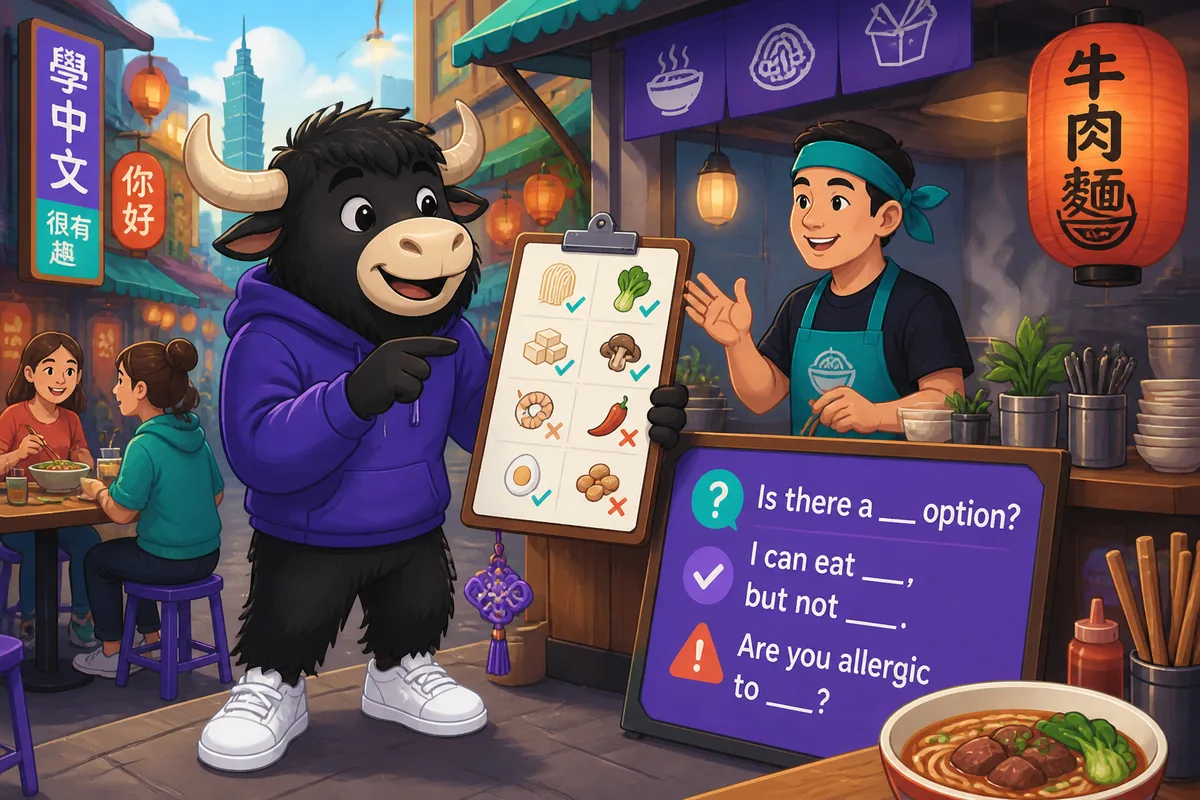
A friendly cafe scene showing people ordering and talking about food preferences in Simplified Chinese; theme: Food Preferences.

Goal: Talk about likes, allergies, and asking for options

Free Simplified Chinese lessons with guided practice, audio, and speaking support.

Welcome back! This short lesson helps you talk about what you can and can't eat—super handy when ordering or visiting friends. You'll listen, practice, and say these phrases aloud so they feel natural.

Level A2: In this lesson you'll practice useful phrases for talking about food preferences, allergies, and asking whether a restaurant has certain options (for example: vegetarian or sugar-free). This CEFR-aligned set focuses on asking about options, stating what you can or can't eat, and politely refusing items—perfect for ordering or social meals. Lesson 63 brings friendly, real-world examples so you can jump straight into conversation.

After this lesson you'll be able to:

  • Ask if a restaurant has a certain option with 有___的吗? (Yǒu ___ de ma?).
  • Explain what you can and cannot eat: 我可以吃___,但不能吃___。 (Wǒ kěyǐ chī ___, dàn bù néng chī ___).
  • Ask and answer about allergies: 你对___过敏吗? (Nǐ duì ___ guòmǐn ma?).
  • Politely refuse items and say what you especially like using 我不要___,谢谢。 and 我特别喜欢___。
A close-up of a menu and a customer pointing, asking in Simplified Chinese whether the restaurant has vegetarian options.

Ready? Let's go!

When you tap play on phrases, we track your progress through this lesson.

1. Reading + Listening Practice

Hear core phrases, repeat aloud.

有___的吗

Yǒu ___ de ma?

Is there a ___ option?

Meaning: Is there a ___ option?

When to use: Use this to ask whether a place or menu has a specific option (e.g., vegetarian, sugar-free, gluten-free).

Tip: Don't drop 的 after the option when you make it a noun phrase (e.g. say 有素食的吗? not only 有素食?).

请问你们有素食的吗?

Qǐngwèn nǐmen yǒu sùshí de ma?

Do you have vegetarian options?
这家店有无糖的饮料吗?

Zhè jiā diàn yǒu wútáng de yǐnliào ma?

Does this place have sugar-free drinks?

我可以吃___,但不能吃___。

Wǒ kěyǐ chī ___, dàn bù néng chī ___.

I can eat ___, but not ___.

Meaning: I can eat ___, but not ___.

When to use: Use this to explain clearly what ingredients or dishes are acceptable and which are not.

Tip: Beginners sometimes swap 能 and 可以; use 我可以吃... when describing permission/ability with food choices.

我可以吃鸡肉,但不能吃海鲜。

Wǒ kěyǐ chī jīròu, dàn bù néng chī hǎixiān.

I can eat chicken, but I can't eat seafood.
我可以吃豆腐,但不能吃猪肉。

Wǒ kěyǐ chī dòufu, dàn bù néng chī zhūròu.

I can eat tofu, but not pork.

你对___过敏吗?

Nǐ duì ___ guòmǐn ma?

Are you allergic to ___?

Meaning: Are you allergic to ___?

When to use: Ask this when you need to check for food allergies before cooking or ordering.

你对花生过敏吗?

Nǐ duì huāshēng guòmǐn ma?

Are you allergic to peanuts?
小心,他对海鲜过敏。

Xiǎoxīn, tā duì hǎixiān guòmǐn.

Be careful, he is allergic to seafood.

你喜欢吃什么菜?

Nǐ xǐhuan chī shénme cài?

What kind of food do you like?

Meaning: What kind of food do you like?

When to use: Ask this to learn someone's general food preferences—use 菜 to mean dishes or cuisine.

你喜欢吃什么菜?我喜欢川菜。

Nǐ xǐhuan chī shénme cài? Wǒ xǐhuan Chuāncài.

What kind of food do you like? I like Sichuan food.
他们问我喜欢吃什么菜,我说不太能吃辣。

Tāmen wèn wǒ xǐhuan chī shénme cài, wǒ shuō bù tài néng chī là.

They asked what food I like; I said I can't really eat spicy food.

我不要___,谢谢。

Wǒ bú yào ___, xièxie.

No ___ for me, please.

Meaning: No ___ for me, please.

When to use: Politely refuse a food item, ingredient, or dish when ordering or at a shared meal.

Tip: Don’t forget 谢谢 after refusing in polite situations; it softens the refusal.

我不要辣的,谢谢。

Wǒ bú yào là de, xièxie.

No spicy food for me, thanks.
这道菜里有花生吗?我不要花生,谢谢。

Zhè dào cài lǐ yǒu huāshēng ma? Wǒ bú yào huāshēng, xièxie.

Does this dish have peanuts? No peanuts for me, thanks.

我特别喜欢___。

Wǒ tèbié xǐhuan ___.

I'm a big fan of ___.

Meaning: I'm a big fan of ___.

When to use: Use this to emphasize a strong positive preference for a dish or cuisine.

我特别喜欢甜点,尤其是冰淇淋。

Wǒ tèbié xǐhuan tiándiǎn, yóuqí shì bīngqílín.

I especially like desserts, especially ice cream.
我特别喜欢川菜的麻辣味。

Wǒ tèbié xǐhuan Chuāncài de málà wèi.

I'm a big fan of the numbing-spicy flavor of Sichuan food.

你有什么不能吃的吗?

Nǐ yǒu shénme bù néng chī de ma?

Is there anything you can't eat?

Meaning: Is there anything you can't eat?

When to use: Ask this when planning a meal for someone or before you cook; it’s a polite way to learn restrictions.

你有什么不能吃的吗?我们可以准备不含海鲜的菜。

Nǐ yǒu shénme bù néng chī de ma? Wǒmen kěyǐ zhǔnbèi bù hán hǎixiān de cài.

Is there anything you can't eat? We can prepare dishes without seafood.
派对前我问大家:你有什么不能吃的吗?

Pàiduì qián wǒ wèn dàjiā: Nǐ yǒu shénme bù néng chī de ma?

Before the party I asked everyone: is there anything you can't eat?

还可以,但不是我最喜欢的。

Hái kěyǐ, dàn bú shì wǒ zuì xǐhuān de.

It's okay, but it's not my favorite.

Meaning: It's okay, but it's not my favorite.

When to use: Use this to soften criticism—say a dish is acceptable but not preferred.

这道汤还可以,但不是我最喜欢的。

Zhè dào tāng hái kěyǐ, dàn bú shì wǒ zuì xǐhuan de.

This soup is okay, but it's not my favorite.
这家饭馆的牛肉还可以,但不是我最喜欢的。

Zhè jiā fànguǎn de niúròu hái kěyǐ, dàn bú shì wǒ zuì xǐhuan de.

The restaurant's beef is okay, but not my favorite.

2. Conversational Listening Practice

Hear phrases in a real mini-conversation.

At a small restaurant, ordering and checking allergies

Two friends at a table discussing allergies and favorite dishes in Simplified Chinese, one saying they can't eat seafood.

What does David say he cannot eat?

Portrait of Anna in a Simplified Chinese lesson dialogue

Anna

请问你们有素食的吗?

Qǐngwèn nǐmen yǒu sùshí de ma?

Do you have vegetarian options?

Server

有,我们有素食套餐。

Yǒu, wǒmen yǒu sùshí tàocān.

Yes, we have vegetarian set meals.

Portrait of Anna in a Simplified Chinese lesson dialogue

Anna

David,你有什么不能吃的吗?

David, nǐ yǒu shénme bù néng chī de ma?

David, is there anything you can't eat?

Portrait of David in a Simplified Chinese lesson dialogue

David

我可以吃鸡肉,但不能吃海鲜。

Wǒ kěyǐ chī jīròu, dàn bù néng chī hǎixiān.

I can eat chicken, but not seafood.

Portrait of Anna in a Simplified Chinese lesson dialogue

Anna

你对花生过敏吗?

Nǐ duì huāshēng guòmǐn ma?

Are you allergic to peanuts?

Portrait of David in a Simplified Chinese lesson dialogue

David

不,我不对花生过敏。不过我不要辣的,谢谢。

Bú, wǒ bù duì huāshēng guòmǐn. Bùguò wǒ bú yào là de, xièxie.

No, I'm not allergic to peanuts. But no spicy food for me, thanks.

3. Guided Practice

Quizzes and matching to lock in meaning.

Which phrase asks if someone is allergic to something?

How do you politely refuse an ingredient when ordering?

Which phrase asks generally what food someone likes?

Which phrase says a dish is acceptable but not preferred?

Before ordering, Anna asks the server: Do you have vegetarian options?

在点菜前,Anna问服务员:请问你们有___的吗?

David tells the server: I can eat chicken, but I can't eat seafood.

David对服务员说:我可以吃___,但不能吃海鲜。

When asked if there is anything he can't eat, David answers: I'm allergic to peanuts.

服务员问:你有什么不能吃的吗?David回答:___

Match the core phrases

Match the extra phrases

4. Speaking Practice

Say phrases yourself (mic/recording).

Recording stays on your device only. Check speech uses your browser's speech tools when available.

Say this phrase out loud:

有___的吗

Yǒu ___ de ma?

Is there a ___ option?

Say this phrase out loud:

我可以吃___,但不能吃___。

Wǒ kěyǐ chī ___, dàn bù néng chī ___.

I can eat ___, but not ___.

Say this phrase out loud:

你对___过敏吗?

Nǐ duì ___ guòmǐn ma?

Are you allergic to ___?

Say this phrase out loud:

你喜欢吃什么菜?

Nǐ xǐhuan chī shénme cài?

What kind of food do you like?

Say this phrase out loud:

我不要___,谢谢。

Wǒ bú yào ___, xièxie.

No ___ for me, please.

Say this phrase out loud:

我特别喜欢___。

Wǒ tèbié xǐhuan ___.

I'm a big fan of ___.

Say this phrase out loud:

你有什么不能吃的吗?

Nǐ yǒu shénme bù néng chī de ma?

Is there anything you can't eat?

Say this phrase out loud:

还可以,但不是我最喜欢的。

Hái kěyǐ, dàn bú shì wǒ zuì xǐhuan de.

It's okay, but it's not my favorite.