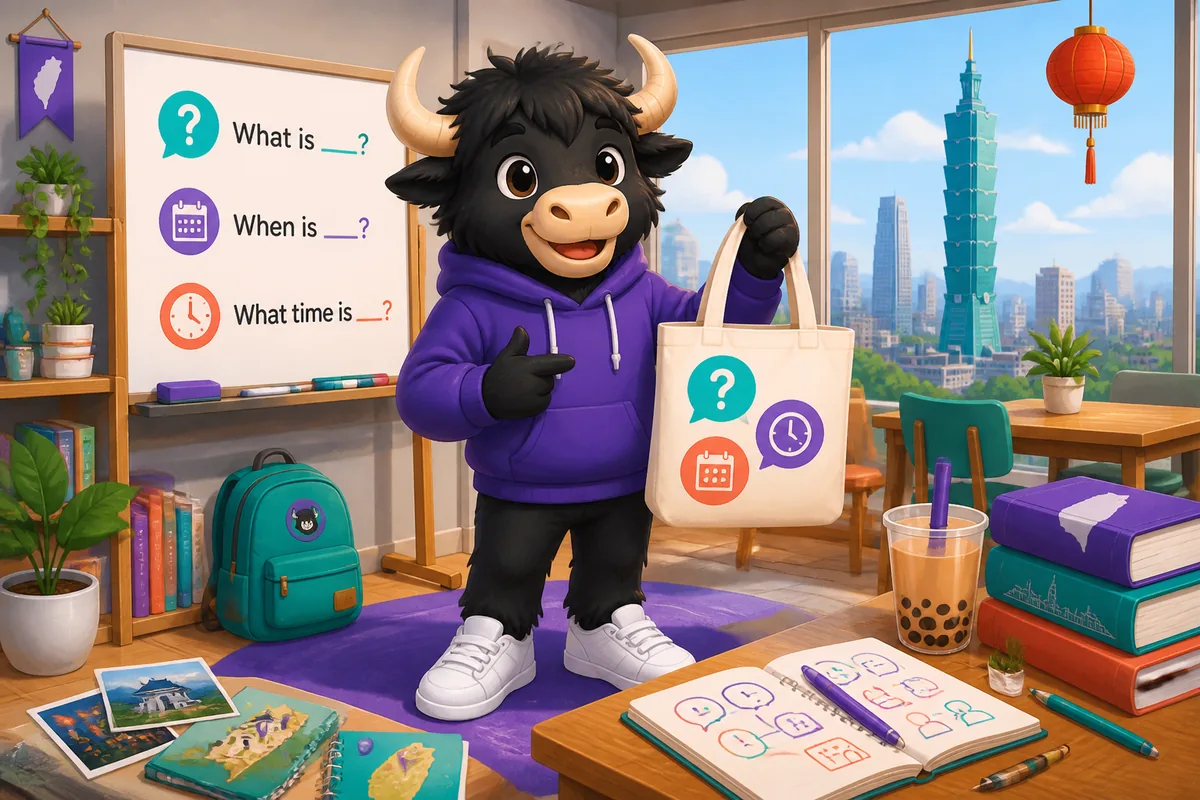
Welcome to Lesson 25 — you’re doing great! In this short lesson we’ll listen, repeat, and use five super-handy question frames that make everyday conversation much easier.
Each Yak Yacker lesson has three quick steps: listen to the phrases, practice with short quizzes, then speak them out loud. Ready?
Level A1: In Lesson 25 you'll learn five basic question frames for asking identity, time, and simple favors (___是什么?, ___是什么时候?, ___几点?, 你能___吗?, ___怎么说?). These are practical lines you can use right away — ask what something is, when an event happens, what time it starts, ask someone to do something, and ask how to say a word. This CEFR-aligned mini-lesson keeps things small and useful.
After this lesson you'll be able to:
Recognize and say five common question frames in Mandarin: ___是什么? (___ shì shénme?), ___是什么时候? (___ shì shénme shíhou?), ___几点? (___ jǐ diǎn?), 你能___吗? (nǐ néng ___ ma?), ___怎么说? (___ zěnme shuō?).
Ask about identity (What is ...?), schedule/time (When? / What time?), and ask someone to do something.
Practice listening, choosing correct phrases in context, and saying the phrases aloud.
Ready? Let's go!
When you tap play on phrases, we track your progress through this lesson.
1. Reading + Listening Practice
Hear core phrases, repeat aloud.
___是什么
___ shì shénme?
What is ___?
Meaning: What is ___?
When to use: Use ___是什么? to ask the identity or name of an object, word, or thing you don't know.
这是什么
Zhè shì shénme?
What is this?
菜单上的这个字是什么?
Càidān shàng de zhège zì shì shénme?
What is this character on the menu?
___是什么时候?
___ shì shénme shíhou?
When is ___?
Meaning: When is ___?
When to use: Use ___是什么时候? to ask when an event or appointment happens (date or general time).
Tip: Beginners sometimes confuse ___是什么时候? with ___几点? — use 什么时候 for general times/dates and 几点 for a clock time.
会议是什么时候?
Huìyì shì shénme shíhou?
When is the meeting?
你生日是什么时候?
Nǐ shēngrì shì shénme shíhou?
When is your birthday?
___几点
___ jǐ diǎn?
What time is ___?
Meaning: What time is ___?
When to use: Use ___几点? to ask the clock time when an event or activity starts.
电影几点开始
Diànyǐng jǐ diǎn kāishǐ?
What time does the movie start?
会议几点开始
Huìyì jǐ diǎn kāishǐ?
What time does the meeting start?
你能___吗
nǐ néng ___ ma?
Can you ___?
Meaning: Can you ___?
When to use: Use 你能___吗? to ask someone politely to do a simple action. For extra politeness, you can add 请 at the start.
Tip: Learners sometimes only say 能 or 可以 — both work, but include 你 and 吗 for a full polite question (你能...吗?).
你能帮我拿行李吗?
Nǐ néng bāng wǒ ná xíngli ma?
Can you help me carry the luggage?
你能告诉我怎么去地铁站吗?
Nǐ néng gàosu wǒ zěnme qù dìtiě zhàn ma?
Can you tell me how to get to the metro station?
___怎么说
___ zěnme shuō?
How do you say ___?
Meaning: How do you say ___?
When to use: Use ___怎么说? when asking how to express a word or phrase in Chinese (or another language).
“menu”中文怎么说?
“menu” zhōngwén zěnme shuō?
How do you say 'menu' in Chinese?
这个词英语怎么说?
Zhège cí yīngyǔ zěnme shuō?
How do you say this word in English?
2. Conversational Listening Practice
Hear phrases in a real mini-conversation.
At a café: menu and meeting time
Anna
这是什么
Zhè shì shénme?
What is this?
David
那是菜单
Nà shì càidān.
That's the menu.
Anna
‘menu’中文怎么说?
'menu' zhōngwén zěnme shuō?
How do you say 'menu' in Chinese?
David
就是菜单,càidān。
Jiù shì càidān.
It's càidān.
Anna
会议几点开始
Huìyì jǐ diǎn kāishǐ?
What time does the meeting start?
David
三点。你能来吗?
Sān diǎn. Nǐ néng lái ma?
At 3. Can you come?
Anna
我可以,没问题。
Wǒ kěyǐ, méi wèntí.
I can, no problem.
3. Guided Practice
Quizzes and matching to lock in meaning.
Which Chinese question frame asks 'What is ___?'
You want to ask 'When is the meeting?' Which is best?
Which asks 'Can you help me?'
How would you ask 'How do you say "thank you" in Chinese?'
The teacher asked: 'What time is tomorrow's exam?' I answered: '9 AM.'