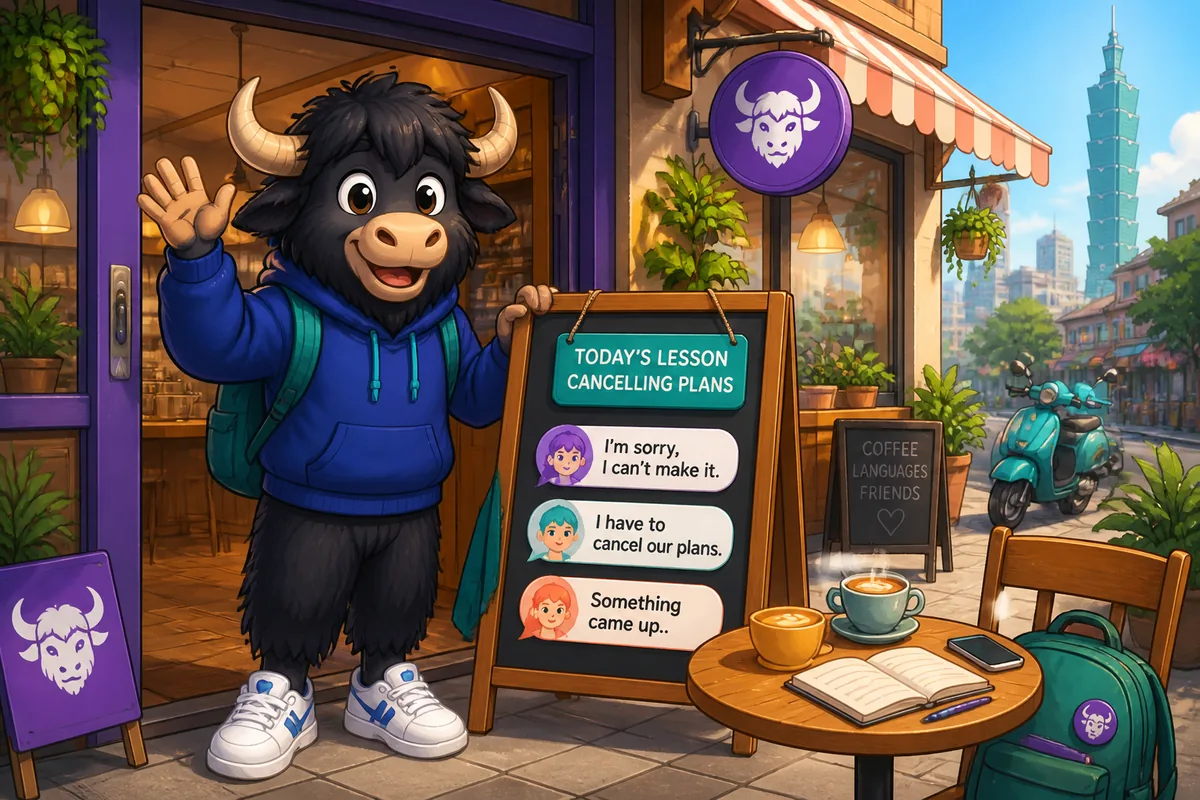
不好意思,我去不了了。
Bù hǎo yìsi, wǒ qù bù liǎo le.
I'm sorry, I can't make it.
Meaning: I'm sorry, I can't make it.
When to use: Use this polite phrase to cancel an appointment or plan you previously agreed to. It's more courteous than simply saying 我去不了.
Tip: Beginners sometimes drop 了 (le) and say 我去不了, which is okay but less polite; include 不好意思 for courtesy.
Examples ▼ 不好意思,我去不了了,今天有急事。
Bù hǎo yìsi, wǒ qù bù liǎo le, jīntiān yǒu jíshì.
Sorry, I can't make it; something urgent came up today.
不好意思,我去不了了,能改到周末吗?
Bù hǎo yìsi, wǒ qù bù liǎo le, néng gǎi dào zhōumò ma?
Sorry, I can't come; can we move it to the weekend?
我得取消我们的计划了。
Wǒ děi qǔxiāo wǒmen de jìhuà le.
I have to cancel our plans.
Meaning: I have to cancel our plans.
When to use: Say this to state directly that you must cancel an arrangement; for close friends you can say 咱们的计划 instead of 我们的计划.
Examples ▼ 对不起,我得取消我们的计划了,今天实在赶不回来。
Duìbuqǐ, wǒ děi qǔxiāo wǒmen de jìhuà le, jīntiān shízài gǎn bu huílái.
Sorry, I have to cancel our plans; I really can't get back today.
我得取消我们的计划了,下次我补请你吃饭。
Wǒ děi qǔxiāo wǒmen de jìhuà le, xiàcì wǒ bǔ qǐng nǐ chīfàn.
I have to cancel our plans. I'll treat you next time.
我临时有点事
Wǒ línshí yǒu diǎn shì.
Something came up.
Meaning: Something came up.
When to use: Use this neutral, brief phrase to explain a last-minute change without giving details.
Examples ▼ 很抱歉,我临时有点事,可能要晚一点到。
Hěn bàoqiàn, wǒ línshí yǒu diǎn shì, kěnéng yào wǎn yìdiǎn dào.
Sorry, something came up; I might arrive a bit late.
我临时有点事,今天不能参加了。
Wǒ línshí yǒu diǎn shì, jīntiān bù néng cānjiā le.
Something came up; I can't attend today.
我身体不太舒服。
Wǒ shēntǐ bú tài shūfu.
I'm not feeling well.
Meaning: I'm not feeling well.
When to use: Use this neutral phrase when you need to cancel or excuse yourself for health reasons.
Examples ▼ 我身体不太舒服,能改天再见面吗?
Wǒ shēntǐ bú tài shūfu, néng gǎitiān zài jiànmiàn ma?
I'm not feeling well; can we meet another day?
昨天开始我身体不太舒服,今天想休息一下。
Zuótiān kāishǐ wǒ shēntǐ bú tài shūfu, jīntiān xiǎng xiūxi yíxià.
I started feeling unwell yesterday; I want to rest today.
我们能改个时间吗?
Wǒmen néng gǎi ge shíjiān ma?
Can we reschedule?
Meaning: Can we reschedule?
When to use: Use this common spoken question to ask if the other person is open to arranging the plan for another time; add 麻烦 for extra politeness.
Examples ▼ 很抱歉,我临时有事,我们能改个时间吗?
Hěn bàoqiàn, wǒ línshí yǒu shì, wǒmen néng gǎi ge shíjiān ma?
Sorry, something came up. Can we reschedule?
今天不行,我们能改个时间吗?我周末有空。
Jīntiān bù xíng, wǒmen néng gǎi ge shíjiān ma? Wǒ zhōumò yǒu kòng.
Today doesn't work. Can we change the time? I'm free on the weekend.
我们能改到___吗?
Wǒmen néng gǎi dào ___ ma?
Can we move it to ___?
Meaning: Can we move it to ___?
When to use: Use this to suggest a specific new time or date; fill the blank with the new day or time (e.g., 周六, 明天晚上八点).
Tip: Beginners sometimes say 改成 instead of 改到; both can work, but 改到 + specific time is very natural for scheduling.
Examples ▼ 我们能改到周六吗?那天我比较空。
Wǒmen néng gǎi dào zhōuliù ma? Nà tiān wǒ bǐjiào kòng.
Can we move it to Saturday? I'm freer that day.
这次不开会了,我们能改到下周一吗?
Zhè cì bù kāihuì le, wǒmen néng gǎi dào xià zhōu yī ma?
This meeting is off. Can we move it to next Monday?
___你还方便吗?
___ nǐ hái fāngbiàn ma?
Does ___ still work for you?
Meaning: Does ___ still work for you?
When to use: Use this to check if the original or proposed time is still convenient for the other person; put the time or day where the blank is.
Tip: Beginners may forget to put the time before 你还方便吗; remember the blank is where the time or day goes.
Examples ▼ 周五你还方便吗?我们能照常见面吗?
Zhōu wǔ nǐ hái fāngbiàn ma? Wǒmen néng zhàocháng jiànmiàn ma?
Are you still available Friday? Can we meet as planned?
下班后你还方便吗?要不我们改时间。
Xiàbān hòu nǐ hái fāngbiàn ma? Yào bù wǒmen gǎi shíjiān.
Are you still free after work? If not, we can change the time.
我们改天再约吧。
Wǒmen gǎi tiān zài yuē ba.
Let's do it another time.
Meaning: Let's do it another time.
When to use: Use this to postpone plans without setting a specific new date — friendly and non-committal.
Examples ▼ 今天不行,我们改天再约吧。
Jīntiān bù xíng, wǒmen gǎi tiān zài yuē ba.
Today doesn't work. Let's do it another time.
你不方便就别勉强了,改天再约吧。
Nǐ bù fāngbiàn jiù bié miǎnqiǎng le, gǎi tiān zài yuē ba.
Don't force it if you're busy; let's meet another day.
不好意思,这么临时通知你。
Bù hǎo yìsi, zhème línshí tōngzhī nǐ.
Sorry for the short notice.
Meaning: Sorry for the short notice.
When to use: Use this polite apology when you cancel or change plans at the last minute. For more formality, use 抱歉,这么临时通知您。
Examples ▼ 不好意思,这么临时通知你,我下午有个紧急会议。
Bù hǎo yìsi, zhème línshí tōngzhī nǐ, wǒ xiàwǔ yǒu gè jǐnjí huìyì.
Sorry for the short notice; I have an urgent meeting this afternoon.
抱歉,这么临时通知您,医生今天约了我。
Bàoqiàn, zhème línshí tōngzhī nín, yīshēng jīntiān yuē le wǒ.
Sorry for the short notice; the doctor scheduled me today.
谢谢你理解
Xièxie nǐ lǐjiě.
Thanks for understanding.
Meaning: Thanks for understanding.
When to use: Use this polite phrase after someone accepts your cancellation or change to show appreciation. For extra politeness say 谢谢您的理解。
Examples ▼ 谢谢你理解,我下次一定补上。
Xièxie nǐ lǐjiě, wǒ xiàcì yídìng bǔ shàng.
Thanks for understanding; I'll make it up to you next time.
我知道麻烦你了,谢谢你理解。
Wǒ zhīdao máfan nǐ le, xièxie nǐ lǐjiě.
I know this is inconvenient for you; thanks for understanding.
我需要改一下___。
Wǒ xūyào gǎi yíxià ___.
I need to change the ___.
Meaning: I need to change the ___.
When to use: Use this to say one part of a plan needs adjustment (time, place, item). Fill the blank with 时间, 地点, 预约, etc.
Examples ▼ 我需要改一下时间,能改到下周二吗?
Wǒ xūyào gǎi yíxià shíjiān, néng gǎi dào xià zhōu'èr ma?
I need to change the time. Can we move it to next Tuesday?
我需要改一下地点,我们在公司门口见可以吗?
Wǒ xūyào gǎi yíxià dìdiǎn, wǒmen zài gōngsī ménkǒu jiàn kěyǐ ma?
I need to change the place. Can we meet at the company entrance?
我们晚点见可以吗?
Wǒmen wǎndiǎn jiàn kěyǐ ma?
Is it okay if we meet later?
Meaning: Is it okay if we meet later?
When to use: Use this polite question to ask if you can push the meeting to a later time.
Examples ▼ 我现在在路上,我们晚点见可以吗?
Wǒ xiànzài zài lùshàng, wǒmen wǎndiǎn jiàn kěyǐ ma?
I'm on the way now. Is it okay if we meet later?
下班高峰太拥挤,我们晚点见可以吗?
Xiàbān gāofēng tài yōngjǐ, wǒmen wǎndiǎn jiàn kěyǐ ma?
Rush hour is bad; is it okay if we meet a bit later?
那个时间我不方便。
Nàge shíjiān wǒ bù fāngbiàn.
I'm not available then.
Meaning: I'm not available then.
When to use: Use this neutral sentence to say a suggested time doesn't suit you.
Examples ▼ 那个时间我不方便,我们能换个时间吗?
Nàge shíjiān wǒ bù fāngbiàn, wǒmen néng huàn ge shíjiān ma?
I'm not available then. Can we change the time?
不好意思,那个时间我不方便,明天下午可以吗?
Bù hǎo yìsi, nàge shíjiān wǒ bù fāngbiàn, míngtiān xiàwǔ kěyǐ ma?
Sorry, that time doesn't work for me. Is tomorrow afternoon okay?
Which phrase is the polite way to say “I'm sorry, I can't make it”? 不好意思,我去不了了。 我们能改到___吗? 谢谢你理解 我们改天再约吧。
Which sentence asks to reschedule? 我们能改个时间吗? 不好意思,这么临时通知你。 我身体不太舒服。 那个时间我不方便。
Which phrase checks if a specific time still works for the other person? 我们能改到___吗? 我们晚点见可以吗? 我得取消我们的计划了。 ___你还方便吗?
Which sentence is used to apologize for notifying someone at the last minute? 不好意思,这么临时通知你。 谢谢你理解 我们改天再约吧。 我临时有点事
Sorry, I can't go tonight — something came up, so I have to cancel our plans. 对不起,今晚我不能去了,___,所以要取消我们的计划。
Duìbuqǐ, jīnwǎn wǒ bù néng qù le, ___, suǒyǐ yào qǔxiāo wǒmen de jìhuà.
我们能改个时间吗? 我们晚点见可以吗? 我临时有点事 谢谢你理解
The doctor says I have a fever, so I'm not feeling well; let's talk tomorrow. 医生说我发烧了,所以___,明天再说吧。
Yīshēng shuō wǒ fāshāo le, suǒyǐ ___, míngtiān zài shuō ba.
不好意思,我去不了了。 我身体不太舒服。 我们改天再约吧。 我们能改到周六吗?
If Friday doesn't work for you, can we move it to Saturday? I can meet Saturday. 如果周五你不方便,___?我可以周六见面。
Rúguǒ zhōu wǔ nǐ bù fāngbiàn, ___? Wǒ kěyǐ zhōuliù jiànmiàn.
我们能改到周六吗? 谢谢你理解 不好意思,这么临时通知你。 那个时间我不方便。
不好意思,我去不了了。 Bù hǎo yìsi, wǒ qù bù liǎo le. 我们能改个时间吗? Wǒmen néng gǎi ge shíjiān ma? 我临时有点事 Wǒ línshí yǒu diǎn shì. 我身体不太舒服。 Wǒ shēntǐ bú tài shūfu. 我们能改到___吗? Wǒmen néng gǎi dào ___ ma? 我们改天再约吧。 Wǒmen gǎi tiān zài yuē ba. 不好意思,这么临时通知你。 Bù hǎo yìsi, zhème línshí tōngzhī nǐ. 谢谢你理解 Xièxie nǐ lǐjiě. I'm sorry, I can't make it. Can we reschedule? Something came up. I'm not feeling well. Can we move it to ___? Let's do it another time. Sorry for the short notice. Thanks for understanding.
我得取消我们的计划了。 Wǒ děi qǔxiāo wǒmen de jìhuà le. ___你还方便吗? ___ nǐ hái fāngbiàn ma? 我需要改一下___. Wǒ xūyào gǎi yíxià ___. 我们晚点见可以吗? Wǒmen wǎndiǎn jiàn kěyǐ ma? 那个时间我不方便。 Nàge shíjiān wǒ bù fāngbiàn. 抱歉,这么临时通知您。 Bàoqiàn, zhème línshí tōngzhī nín. I have to cancel our plans. Does ___ still work for you? I need to change the ___. Is it okay if we meet later? I'm not available then. Sorry for the short notice (more formal).
Recording stays on your device only. Check speech uses your browser's speech tools when available.
Say this phrase out loud:
不好意思,我去不了了。
Bù hǎo yìsi, wǒ qù bù liǎo le.
I'm sorry, I can't make it.
Check speech
Record Play back
Say this phrase out loud:
我得取消我们的计划了。
Wǒ děi qǔxiāo wǒmen de jìhuà le.
I have to cancel our plans.
Check speech
Record Play back
Say this phrase out loud:
我临时有点事
Wǒ línshí yǒu diǎn shì.
Something came up.
Check speech
Record Play back
Say this phrase out loud:
我身体不太舒服。
Wǒ shēntǐ bú tài shūfu.
I'm not feeling well.
Check speech
Record Play back
Say this phrase out loud:
我们能改个时间吗?
Wǒmen néng gǎi ge shíjiān ma?
Can we reschedule?
Check speech
Record Play back
Say this phrase out loud:
我们能改到___吗?
Wǒmen néng gǎi dào ___ ma?
Can we move it to ___?
Check speech
Record Play back
Say this phrase out loud:
___你还方便吗?
___ nǐ hái fāngbiàn ma?
Does ___ still work for you?
Check speech
Record Play back
Say this phrase out loud:
我们改天再约吧。
Wǒmen gǎi tiān zài yuē ba.
Let's do it another time.
Check speech
Record Play back
Say this phrase out loud:
不好意思,这么临时通知你。
Bù hǎo yìsi, zhème línshí tōngzhī nǐ.
Sorry for the short notice.
Check speech
Record Play back
Say this phrase out loud:
谢谢你理解
Xièxie nǐ lǐjiě.
Thanks for understanding.
Check speech
Record Play back
Say this phrase out loud:
我需要改一下___。
Wǒ xūyào gǎi yíxià ___.
I need to change the ___.
Check speech
Record Play back
Say this phrase out loud:
我们晚点见可以吗?
Wǒmen wǎndiǎn jiàn kěyǐ ma?
Is it okay if we meet later?
Check speech
Record Play back
Say this phrase out loud:
那个时间我不方便。
Nàge shíjiān wǒ bù fāngbiàn.
I'm not available then.
Check speech
Record Play back