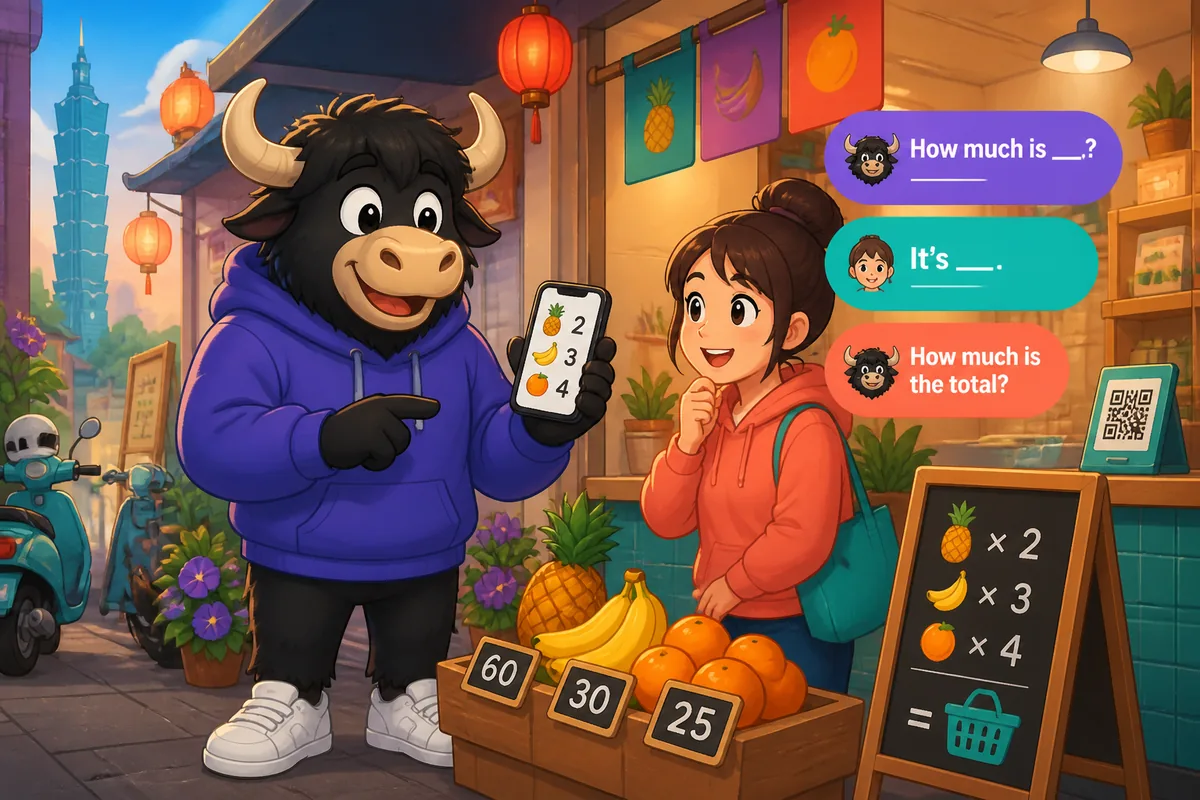
Ready to practice prices and quantities? In this short lesson you'll learn the key phrases people use when buying things in mainland China. Have fun — a little bargaining spirit is okay!
Level A1: In this lesson you'll learn practical shopping chunks like “多少钱?” (duōshǎo qián? — How much is it?), how to ask quantities, and polite ways to ask for a cheaper option or request an exact amount. We'll listen, repeat, and practice quick questions and tiny dialogs you can use at a market or shop.
After this lesson you'll be able to:
Ask and answer basic price questions like “多少钱?” (duōshǎo qián?) and “一共多少钱?” (Yígòng duōshǎo qián?)
Request quantities and items politely using “请给我___。” (Qǐng gěi wǒ ___.) and “只要___,谢谢。” (Zhǐ yào ___, xièxie.)
Level A1: Recognize and say simple reactions like “太贵了。” (Tài guì le.) and ask for cheaper options.
Ready? Let's go!
When you tap play on phrases, we track your progress through this lesson.
1. Reading + Listening Practice
Hear core phrases, repeat aloud.
___多少钱
___ duōshao qián?
How much is ___?
Meaning: How much is ___?
When to use: Use this when you point to an item and want to know its price (e.g., 这件/这个 ___ 多少钱?).
这件衣服多少钱?
Zhè jiàn yīfu duōshǎo qián?
How much is this piece of clothing?
这个苹果多少钱?
Zhè ge píngguǒ duōshǎo qián?
How much is this apple?
要___
Yào ___.
It's ___.
Meaning: It's ___. (stating a price or amount)
When to use: Use to answer with a price or to state cost: 要十块。You can say just the amount too (e.g., 十块).
Tip: Beginners sometimes say 我要十块。(Wǒ yào shí kuài.) — that sounds like 'I want ten kuai' rather than giving the price.
要十块
Yào shí kuài.
It’s ten kuai.
要三十五块一个。
Yào sānshíwǔ kuài yí gè.
It's 35 kuai each.
一共多少钱
Yígòng duōshao qián?
How much is the total?
Meaning: How much is the total?
When to use: Ask this at checkout to find out the total amount to pay.
一共多少钱
Yígòng duōshǎo qián?
How much is it in total?
结账时,顾客问:一共多少钱?
Jiézhàng shí, gùkè wèn: Yígòng duōshǎo qián?
At checkout, the customer asks: How much is the total?
多少个
Duōshao ge?
How many?
Meaning: How many?
When to use: Ask about quantity using the general counter “个” (e.g., 多少个?).
Tip: Don't use 多少个? for uncountable amounts (e.g., rice). Use a different measure word or 多少? instead.
你要多少个
Nǐ yào duōshǎo gè?
How many do you want?
这个箱子里有多少个?
Zhè ge xiāngzi lǐ yǒu duōshǎo gè?
How many are in this box?
多少钱
Duōshǎo qián?
How much?
Meaning: How much is it?
When to use: A short, common way to ask price — use at markets and shops.
这个多少钱
Zhè ge duōshǎo qián?
How much is this?
服务员,桌上这些小吃多少钱?
Fúwùyuán, zhuō shàng zhèxiē xiǎochī duōshǎo qián?
Waiter, how much are these snacks on the table?
请给我___
Qǐng gěi wǒ ___.
___, please.
Meaning: ___, please. (polite request)
When to use: Ask the seller to give you a specific quantity or item: 请给我两斤葡萄。
请给我两斤苹果。
Qǐng gěi wǒ liǎng jīn píngguǒ.
Please give me two jin of apples.
请给我一个杯子。
Qǐng gěi wǒ yí gè bēizi.
Please give me one cup.
只要___,谢谢。
Zhǐ yào ___, xièxie.
Just ___, please.
Meaning: Just ___, please. (only that amount)
When to use: Use to say you only want a small or specific quantity politely: 只要一个,谢谢。
我只要两块蛋糕,谢谢。
Wǒ zhǐ yào liǎng kuài dàngāo, xièxie.
I only want two pieces of cake, thanks.
只要一个就够了,谢谢。
Zhǐ yào yí gè jiù gòu le, xièxie.
Just one is enough, thank you.
太贵了
Tài guì le.
That's too expensive.
Meaning: That's too expensive.
When to use: Say this when the price is higher than you expect; often used when bargaining or reacting.
这个太贵了
Zhè ge tài guì le!
This is too expensive!
你能便宜一点吗?太贵了。
Nǐ néng piányi yìdiǎn ma? Tài guì le.
Can you make it cheaper? It's too expensive.
有便宜一点的吗?
Yǒu piányi yìdiǎn de ma?
Do you have a cheaper one?
Meaning: Do you have a cheaper one?
When to use: Ask this if you want a lower priced option: 有便宜一点的吗?
这个太贵了,有便宜一点的吗?
Zhè ge tài guì le, yǒu piányi yìdiǎn de ma?
This is too expensive — do you have a cheaper one?
我想看有便宜一点的吗。
Wǒ xiǎng kàn yǒu piányi yìdiǎn de ma.
I want to see if there's something a bit cheaper.
我钱不够
Wǒ qián bú gòu.
I don't have enough money.
Meaning: I don't have enough money.
When to use: Explain that you can't pay the full price: 我钱不够。
抱歉,我钱不够。
Bàoqiàn, wǒ qián bú gòu.
Sorry, I don't have enough money.
我钱不够,能不能便宜一点?
Wǒ qián bú gòu, néng bu néng piányi yìdiǎn?
I don't have enough money — can it be cheaper?
现金还是刷卡
Xiànjīn háishi shuākǎ?
Cash or card?
Meaning: Cash or card?
When to use: Ask or offer a payment method at checkout: 现金还是刷卡?
收银员问:现金还是刷卡?
Shōuyín yuán wèn: Xiànjīn háishi shuākǎ?
The cashier asks: Cash or card?
你要现金还是刷卡?
Nǐ yào xiànjīn háishi shuākǎ?
Do you want to pay cash or by card?
这是一个的价格吗?
Zhè shì yí gè de jiàgé ma?
Is that each?
Meaning: Is that each? (Is that the price per item?)
When to use: Ask whether the stated price is the unit price (per piece) — e.g., when prices might be per kilo or per item.
Tip: Beginners may confuse '一个' (per item) with '一斤' (per jin).
这是一个的价格吗?
Zhè shì yí gè de jiàgé ma?
Is that the price for one?
海报上写的价格是每斤,还是这是一个的价格吗?
Hǎibào shàng xiě de jiàgé shì měi jīn, háishi zhè shì yí gè de jiàgé ma?
The poster price is per jin, or is that the price for one?
___一个
___ yí gè.
___ each.
Meaning: ___ each. (unit price)
When to use: Use this to state '___ per one' when giving a unit price: 五块一个。
五块一个
Wǔ kuài yí gè.
Five kuai each.
两个多少钱?两个十块,一个五块。
Liǎng ge duōshǎo qián? Liǎng ge shí kuài, yí gè wǔ kuài.
How much for two? Two for 10 kuai, five each.
2. Conversational Listening Practice
Hear phrases in a real mini-conversation.
At a fruit stall
Anna
这些苹果多少钱?
Zhèxiē píngguǒ duōshǎo qián?
How much are these apples?
David
老板说:五块一个。
Lǎobǎn shuō: Wǔ kuài yí gè.
The vendor says: five kuai each.
Anna
那我只要两个,谢谢。
Nà wǒ zhǐ yào liǎng gè, xièxie.
Then I only want two, thanks.
David
一共多少钱
Yígòng duōshǎo qián?
How much is the total?
3. Guided Practice
Quizzes and matching to lock in meaning.
Which phrase means 'How much is it?'
You want to politely ask the shopkeeper to give you three apples. Which is best?
If the price is too high and you want to complain, which phrase fits?
At checkout the cashier asks how you will pay. Which phrase is that?
Customer asks: How much is this watermelon?
顾客看了西瓜的价签,问:请问这个西瓜___?
Gùkè kàn le xīguā de jiàqiān, wèn: Qǐngwèn zhè ge xīguā ___?